major taylor
Reviewed by Duncan Jamieson, Ashland University
3 december 2014 archive
Mention bicycle racing and Americans immediately turn their attention to Lance Armstrong, the fallen hero of seven consecutive Tour de France competitions. Older followers of the race may remember Greg LeMond, three time winner, and real aficionados will mention some the European superstars—Eddie Merckx, the five time winner from Belgium, the Frenchman Bernard Hinault who also has five victories, or the Spaniard Miguel Indurain, the only other five time winner.
When it comes to African American superstars, four times gold medalist in track and field Jesse Owens is a name known to virtually all interested in sport. The general public is likely familiar with Jackie Robinson for breaking Major League baseball's color bar with grace and dignity. Muhammad Ali has widespread name recognition for his stance against the Vietnam War which cost him his heavyweight boxing crown, though the boxing world knows he regained it by defeating the younger and until then undefeated world title holder George Foreman at the "Rumble in the Jungle." Not far behind these three might be the early twentieth century boxer, Jack Johnson. Certainly all three are deserving of the fame they achieved and their historical legacy, but whatever their accomplishments and however much abuse they received from the white community, neither the accomplishments nor the abuse rise above that of Marshall "Major" Taylor, the fastest man of the late nineteenth and early twentieth century.
One of eight children, Marshall was born November 26, 1878 in rural Indiana to a Civil War veteran and his wife. Taylor's father took care of the horses and stables of a wealthy white family. As the family included a son Marshall's age, his father took him along and the two boys played together. Marshall received more of an education than he would have had at home, and, of equal importance, a bicycle. Much more adventuresome than his siblings, he taught himself to ride and then added tricks to his repertoire. When the bicycle needed repairs he took it to a shop on Indianapolis' Bicycle Row. When it was ready Marshall started riding it around the store, completing some of his tricks to the amazement of the owner who saw a marketing potential; he hired the boy to clean the store in the morning, and then to attract attention perform his bicycle feats in the afternoon. While performing he wore a military style uniform with brass buttons, which according to legend led a spectator to call him "Major." The nickname stuck and he remained Major Taylor for the rest of his life. Again with an eye to exposure, Marshall's employer encouraged him to enter a ten mile road race. At age thirteen, given a fifteen minute handicap he managed to cross the finish line seconds ahead of the favorite. That emboldened him to save his money and enter a track race, one of the most popular sporting venues of the day. There he earned a third place finish which convinced him the future lay in bicycle racing. While he competed in road races and one six day race, his forte was the sprint.
Major Taylor began his racing career as segregation rose to prominence in the United States. In the South de jure segregation carried the force of law, which effectively separated African Americans. Despite de facto segregation in the North Taylor still found a place in bicycle racing and quickly began winning sprints. Unfortunately, racism being what it was he often found himself being boxed, pocketed, sandwiched or elbows by his white competitors. The other riders often worked together to make it impossible for Taylor to break out and win; however, given even the slightest opening Taylor would slip to the front and cross the line first. Frequently fouled, he suffered a brutal attack at the conclusion of the One-Mile Massachusetts Open in September, 1897. Tom Butler led the pack, followed by William Becker in second and Taylor in third. The three then broke away from the peloton. In the final stretch Taylor squeezed by Becker but was unable to catch Butler who finished a length ahead. As Taylor leaned over his bicycle gasping for breath, Becker came up from behind and threw Taylor to the ground choking him. Fans poured out of the stands but Becker continued to choke Taylor until police arrived and dragged him off. It took Taylor twenty minutes to revive and stumble into the locker room. Despite his obvious distress one of the race stewards suggested Taylor race in the final heat until collectively they decided to disqualify Becker. Though sports writers called for a lengthy, perhaps life suspension for Becker, the League of American Wheelmen, the sponsoring organization, gave no suspension and only a fifty dollar fine, basically condoning violence against the African American. To add insult to injury, other sympathetic white riders chipped in to pay Becker's fine. The racing circuit included the Southern Extension where Taylor might have gained points to earn a top three finish for the 1897 season, but racism kept him from the track.
His manager, Tom Brady, wanted to organize an 1898 match race, which would offer Taylor a level playing field, increased publicity, large crowds and a sizeable purse. Unfortunately, none of the top American sprinters—Eddie Bald, Arthur Gardiner, Tom Cooper or Earl Kiser—expressed any interest in racing against the African American. Brady had to reach out to a Welsh rider, Jimmy Michaels, seen to be invincible in paced match races. Even though Michaels held the world record in paced mile races, Taylor rode past his pacers to beat Michaels by two yards.
Even though he held a significant point lead in 1898, due to a rain delay the championship race took place on Sunday. Remembering the Christian dictate to keep the Sabbath holy, Major Taylor refused to race on Sundays and the League of American Wheelmen named Tom Butler the sprint champion. After the season ended Taylor went after sprint records at the Woodside Park Track in Philadelphia. Before a small crowd and several official time keepers, he obliterated the quarter mile, half mile, three quarter mile, kilometer and two mile records. Next to fall was the mile flying start; on that cold November day he became the fastest human being when he passed his pace team to cross the line at 1:31 4/5. "His exploits, in fact, reached well beyond bike-racing fans. He had not only beaten the fastest man, he had also shaved more than three-and-one-half seconds off the world record speed of the celebrated horse Salvator, an especially noteworthy accomplishment at the time" (150). Though his enemies saw him as arrogant, egotistical and marble hearted, Taylor saw his records as appropriate retribution. He now set his sights on the 1899 world championships, to be held in the United States.
In 1899 Taylor won twenty-two of twenty-nine LAW races to take its championship title but Tom Cooper won the American Championship sponsored by the rival National Cycling Association, which meant no clear American victor. To make matters worse, Eddie McDuffie beat Taylor's 1898 one-mile record by more than ten seconds. He took the challenge and in November lowered the mile pace to 1:19, nearly two seconds faster than McDuffie. In 1900 he won the American championship outright, but due to Sunday racing did not try for the world championship. In 1901, with an agreement negating Sunday racing achieved, Taylor went to Europe to race against their best, including the 1900 World Champion Edmond Jacquelin. After losing the first race Taylor buried Jacquelin to capture the World Championship title. Taylor also raced in Australia, where like in Europe he believed he could ride without fear for being African American. Unfortunately such was not the case. In a 1904 best two out of three match race Taylor won the first heat by two lengths. In the second heat Australia's Iver Lawson purposely steered into Taylor, sending him to the track at forty miles an hour. After what seemed an eternity Taylor came to, skin and flesh ripped away, bleeding profusely. In seclusion for months, Taylor reappeared in 1907 to race in France, setting new one-half and one-quarter mile records that stood for decades, but it signaled the end of his career. He raced in 1909, beating the world champion in his last race, but he knew he had stayed too long.
Marshall "Major" Taylor married the athletic Daisy Morris in 1902. They named their daughter Sydney, in honor of her place of birth. During Taylor's retirement he and Daisy drifted apart and separated. Though wealthy, Taylor lost his money through bad investments and self-publishing his autobiography, The Fastest Bicycle Rider in the World in 1929. He died a pauper in a charity ward in Chicago in 1932 and was buried in an unmarked grave. In 1948 with money donated by Schwinn Bicycles his remains were exhumed and reburied in Mount Glenwood Cemetery near Chicago. A statue in his honor stands in Worcester, Massachusetts where he and Daisy lived during his racing days. The Major Taylor Velodrome in Indianapolis and a bicycle trail in Chicago are two other memorials to his extraordinary career.
The Kerbers' book joins Andrew Ritchie's 1988 biography, Major Taylor. The Kerbers have written an interesting and readable monograph on an extraordinary bicycle racer from the early days of the twentieth century. Despite the racism of American society and the brutal treatment from many of his competitors, Marshall "Major" Taylor earned world-wide fame as a premier bicycle racer.
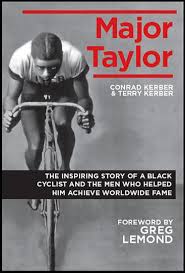
Kerber, Conrad and Kerber, Terry. Major Taylor: The Inspiring Story of a Black Cyclist and the Men Who Helped Him Achieve Worldwide Fame. New
York: Skyhorse Publishing, 2014. xii + 418 pp. Illustrations, Notes,
Index. $24.95
Copyright © 2014 by Duncan Jamieson