sport in the greek and roman worlds
Reviewed by Justin D. Lyons, Ph.D., Professor of History and Political Science, Ashland University
2 december 2014 archive
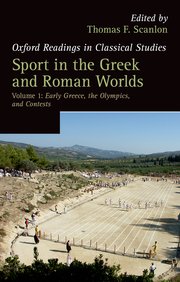
It is a common observation that historically reconstructing the ancient world is similar to assembling a jigsaw puzzle for which many of the pieces are missing. This difficulty must necessarily make itself felt in pursuing the project of these volumes: to overcome popular images and search for hard evidence to recover the real nature of ancient sport. The editor and authors of these essays have this difficulty well in mind, sifting through the available archaeological and literary evidence and weighing each piece for applicability and veracity; indeed, this examination is so meticulous that these volumes will likely be of greater interest to specialists than to the general reader.
A crucial part of overcoming popular images of ancient games and spectacles is confrontation with the differences from modern sport. We do, after all, tend to read our own preconceptions and purposes back into the past. This tendency is intensified by cinematic presentations of ancient games appealing to modern audiences, such as Ben Hur and Gladiator, and strengthened by the simple continuance of athletic competition—particularly in the case of the modern Olympics which, though passed down as an inheritance, bears little relation to its ancient ancestor. This collection confronts these differences under a number of headings, among which are origins, purpose, and organization. As sport is so often a reflection of core cultural values, such a confrontation reveals the very different underpinnings of ancient and modern competitions.
The search for the origins of ancient Greek games must begin very far back in time and is hampered by the fragmentary and mythic/poetic nature of the extant sources. The ancient Minoan bull games, for example, in which acrobatic youths vaulted over the horns and back of a charging bull, are depicted in frescoes unearthed at Knossos in Crete, but we have little other evidence concerning them. Nor do we gain much illumination by the connection of these portrayals to the myth of Theseus and the Minotaur. Funeral games to mark the deaths of heroes are well attested in the classical epics, but the extent to which these poetic presentations can be taken as factual guides for the conduct of these games must remain in doubt.
Closely connected to the question of origins is the investigation of purpose. Here, too, we will find much that is uncertain. The pursuit of religious ritual or initiation to adulthood, the winning of individual or community prestige, the reinforcement of common identity, or all of them at once is variously suggested by the sources. Whatever fragments of shared motivation the modern sports enthusiast will find here are far outweighed by the cultural differences that formed the well-spring of Greek sport. Certainly the pursuit of simple entertainment finds little testimony in ancient sources, nor is the sacred ever entirely banished from the fields of ancient competition.
It is perhaps in the last category, organization, that modern sport enthusiasts are most likely to incorrectly assume continuity between ancient and modern games. Putting aside certain events such as the chariot race, many of the competitions held by the ancient Greeks—archery, boxing, wrestling, long-jumping, footraces, and horse races—are not unknown to the modern age, and so we tend to assume that they were conducted in ways that would be familiar to us. But many of the characteristics of modern sport such as bureaucratic organization, quantification, the quest for records, merchandizing, and abstract team loyalty were either unknown or very different. Greek sport was not standardized; indeed several of the articles are devoted to sifting archaeological evidence to determine the physical layout of the fields of competition. There was very little quantification. Individual athletes boasted the number of their victories, but uniform or universal formal records were not kept of distances, speeds, etc. The Greeks had no preoccupation with fairness—there were no weight classes for wrestling or boxing, for example. Finally, the dominance of media and spectator priorities in athletic events is a modern phenomenon made desirable by the shift toward the entertainment of non-participants and made possible by technological advances.
The second volume of this collection addresses a shift in the psychology and purpose of sport that occurred with the growing power of Rome. Rome's dominance over Greece was accompanied by cultural exchange of many kinds, sport among them. But the purposes of the Romans were different from the Greeks. While they did adopt and participate in traditional Greek competitions, they also had preoccupations of their own. While some of the events in which they indulged (one hesitates to call them sports) such as gladiatorial combats and beast spectacles in which thousands of animals were killed, may shock modern sensibilities; the Romans were in some ways more modern in their approach. The training, ranking, and pricing of gladiators was carefully regulated and recorded and, most importantly, the entertainment of the multitude became the dominating purpose of their events.
These volumes assemble a notable array of scholarly treatments ranging across a great many aspects of ancient sport, and they are valuable for what they reveal about the past. But perhaps their greater value is less explicit: despite the disparities, the very continuation of sport and competition through the long centuries demonstrates the continuities of human nature lurking beneath cultural and historical differences. The desire to strive, to compete, and to triumph has been common to all ages.
Thomas F. Scanlon, ed., Sport in the Greek and Roman Worlds, 2 vols. (Oxford University Press, 2014).
Copyright © 2014 by Justin D. Lyons