the soccer diaries
Reviewed by Matthew S. Tettleton
4 november 2014 archive
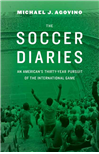
Michael Agovino's The Soccer Diaries is introspective, perceptive, and intelligent, and it masterfully blends single-event snapshots into narrative mosaics in a way that echoes Nick Hornby's canonical Fever Pitch. Agovino leaves us with a depiction of American engagement with the global game that reveals frustration, confusion, earnestness, devotion, and at times even a dose of cynicism. As each World Cup cycle passes, Americans more steadily trickle into MLS stadiums on summer evenings and onto couches on early Saturday mornings to watch English Premier League matches. The burgeoning soccer fandom in the United States has limited expression through literature, and Agovino's memoir offers a voice that speaks to the experience of the nascent American soccer fandom.
Agovino follows the narrative structure of Hornby's Fever Pitch. Agovino's text is delivered in the form of diary entries, with each entry focusing on a particular match or event. The entries tell the reader about Agovino's development as a soccer fan and, at times, as a person. These entries comprise three larger sections of the memoir: Part 1: The Dark Ages, 1982-1993; Part 2: The Renaissance, 1994-2003; and Part 3: The Enlightenment, 2004-2012. The sections, as their titles might suggest, aptly describe both Agovino's state of mind and the state of soccer culture and its media availability in the United States.
Part 1 juxtaposes Agovino's new and growing interest in the sport with his frustration with his lack of access to the sport. Having become fascinated with the game after watching the 1982 World Cup, Agovino is only able to sporadically watch matches of whatever club or national team happens to be playing—usually on Spanish language television channels. He supplements his soccer exposure by collecting any soccer accounts, histories, or literatures he can get his hands on. Frustrated by his lack of access to the game, Agovino turns his attention to playing for his high school team. However, his teammates and coaches do not share his passion for the game, so his frustration continues.
In part 2, Agovino has graduated from NYU and is making his way as a magazine writer in New York when he regains hope in the midst of his soccer despair. This section begins with the promise of the World Cup coming to the U.S. in 1994. Part of the deal is that a new professional soccer league, Major League Soccer (MLS) will start up in the United States. Agovino is encouraged by the potential for growth in U.S. soccer, but by this point he has already become a fervent supporter of the Italian national team (owing to his Italian-American heritage) and A.S. Roma of the Italian league Serie A. In this period, Agovino deepens his knowledge of the game and begins to see soccer in other parts of the world (his adolescent matches were generally at The Meadowlands in New Jersey, an arduous trek on public transportation for Agovino). Part 2 comes to a close with an adult Agovino frustrated and disenchanted with his magazine career at Newsweek (which he coyly refers to asWeek News*). Agovino leaves to pursue a freelance career and live a pseudo-expatriate life in Switzerland.
In part 3, Agovino accrues a wealth of experiences in European stadiums watching soccer, and he develops an aesthetic sense of the American soccer fan. Having grown up seeing soccer as a sort of countercultural enterprise, he held dear the notion that anyone who loved the game would be welcome. Everyone should be accepted, and the soccer pitch should be a place of inclusion, equality, and mutual cooperation. This humanistic approach to the game is ultimately expressed in the poignant epilogue, in which Agovino tries and fails to secure a ticket at the gate for a Real Madrid vs. A.C. Milan match at Yankee Stadium. Agovino consoles a nearby father and son who also failed to get into the game. As he walks on his way, Agovino contentedly ruminates on the fact that soccer is being played professionally inside Yankee Stadium and joyously by children outside the stadium.
Agovino's engagement with the European game as an American fan is of particular interest. Because of soccer's unpopularity during the 1980s, Agovino took on a bunker mentality about the sport. There were so few people on the inside of the soccer fan society, in Agovino's mind, that he could not be bothered by petty club rivalries or European tales of hooligans creating havoc for havoc's sake. Thus Agovino, who was drawn to Roma, finds himself fast friends with fans from rival clubs. Additionally, Agovino develops an appreciation for multicultural communities as a result of the friendships built during his youth while having practice sessions with the residents of his culturally and ethnically diverse neighborhood in the Bronx. The pitch becomes a space for traversing tacit cultural boundaries and the ball a focal point for social exchanges.
Another intriguing aspect of Agovino's approach to soccer is his engagement with other intellectuals who follow soccer. During his adolescence, Agovino is annoyed by what he perceives as a stubborn, simpleminded American take on the game. Local news coverage of the World Cup seemed proud of its ignorance of soccer and openly mocked soccer fans. Agovino's upbringing, along with his entrée into the writing profession, leads Agovino to a more cerebral appreciation of soccer than is shown by the mainstream media or than is seen in British hooligan memoirs, for example. However, for Agovino, that intellectualism is always in service to his understanding and his experience of the game. When Agovino finds his friends expressing this aesthetic as a method of distinction from less enlightened sports fans, Agovino rejects the notion. He bristles at his friend's self-identification as a "soccer weenie," (who would blame him?) and at the term "Euro-snob" to refer to American soccer fans who follow European leagues (a common occurrence). This type of fan is practicing exclusion rather than inclusion, and for Agovino (and I agree with him), this type of American soccer fan is less than a credit to the passion and joy available through the beautiful game.
Ultimately, Agovino leaves the reader with a deep understanding of the growth of soccer fandom in the United States from the 1980s through 2012. Well written and engaging, Agovino's text is a valuable addition to a burgeoning American soccer canon that will continue to grow with the sport's popularity. While it might not deserve immediate placement alongside the likes of Fever Pitch, it is a worthy successor in the soccer fan memoir genre, and it provides an American answer to Hornby's English viewpoint. Unlike other American soccer books like Franklin Foer's How Soccer Explains the World, it engages on the emotional level and demonstrates an appreciation of the game that is deeper than surface level. As an object of literature, it is a well-executed example of the memoir genre, and as a cultural object it is invaluable to America's still adolescent experience with the world's most popular sport.
The Soccer Diaries: An American's Thirty-Year Pursuit of the International Game. By Michael J. Agovino. Lincoln: University of Nebraska Press, 2014. 295 pp., hardcover, $26.95.
Copyright © 2014 by Matthew S. Tettleton