for the love of baseball
Reviewed by Matthew Teutsch
1 november 2014 archive
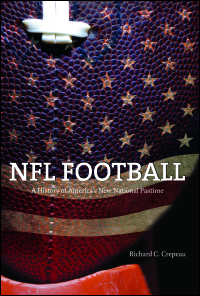
In "Lisa the Greek," from the third season of The Simpsons, Lisa finds out that Homer is betting on football games because it makes watching them more interesting and asks, "What could be more exciting than the savage ballet of pro football?" With this question, Lisa not only sums up the "savage ballet" on the field, but she also manages to sum up the "savage ballet" that took place behind the scenes to make the National Football League (NFL) into the media juggernaut that it is today. Richard C. Crepeau's NFL Football: A History of America's New National Pastime tells the history of the NFL by not looking exclusively at the on-the-field action. Instead, he examines the NFL's role on the field and in the back rooms taking the time to situate its growth "within the larger context of American social, economic, and technological history" (ix). To accomplish this, Crepeau explores the history of the NFL both chronologically and thematically.
Crepeau divides his history into three distinct sections. Beginning with "The Formative Years," he traces the beginnings of professional football in the United States and its contentions with college football and trying to garner a fan base during the early part of the twentieth century through about 1958 when the Baltimore Colts defeated the New York Giants in the "Greatest Game Ever Played." Crepeau starts by showing how professional football grew out of the working class, and he retraces the contentions it had with college football and the idea of amateurism. During the 1920, Crepeau argues, as American saw an increase in prosperity after World War I, professional football increased in popularity, especially after the debut and grueling whirlwind tour of Red Grange in 1925. Grange appeared at the moment when sports heroes such as Babe Ruth and Jack Dempsey became something more than athletes, they became celebrities. Grange followed suit. Crepeau contends that this occurred because the prosperity in the 1920s created a more consumerist culture where individuals sought instant gratification and entertainment, sports provided just that. While Grange tapped into the flourishing consumer culture of the 1920s, Bronko Nagurski arose after the Stock Market Crash of 1929 during the Great Depression. Nagurski debuted for the Chicago Bears in 1930, and instead of representing the consumer culture through endorsements, Nagurski became a symbol of the primal in football. One of the appeals of football, as Crepeau argues, is its vicarious nature to let men live out their masculine, primal urges vicariously through the athletes. Nagurski fit this bill, being described as a frontier man who supposedly lived in the woods surviving by himself before going to college where he ate raw, red meat before each game. While Crepeau does not spend too much time on Grange or Nagurski, they represent a broader discussion of professional football's rise in the twentieth century that Crepeau explores through discussions of labor, race, and technological advancements such as television and radio. Crepeau concludes the first section with a brief discussion of the 1958 championship game mentioned above. This year, and game, according to Crepeau, saw the confluence of multiple factors within American society that propelled the NFL towards its dramatic rise under the ever watchful and domineering eye of Pete Rozelle.
The largest section in Crepeau's book centers on Commissioner Peter Rozelle who led the NFL for a span of twenty-nine years: 1960-1989. Instead of entirely organizing this section chronologically, Crepeau examines Rozelle's reign both chronologically and topically. Starting with 1959, Crepeau shows professional football's increasing popularity by citing, as he does throughout the book, contemporary articles that explored the ritualistic, controlled violence of football and its relationship to modern masculinity. This increased exposure through print media led CBS television to premier "The Violent World of Sam Huff" in 1959, a documentary that showed the New York Giants linebacker wired for sound during practice and an exhibition game. As Crepeau says, "The impact of the program was stronger than anyone anticipated and left a lasting impression on the nation, especially those middle-management softies in suburbia" (56). Elsewhere in his discussion of Rozelle's reign, Crepeau talks about the NFL's competition with the AFL in the 1960s and the USFL in the 1980s and how those periods led to expansion teams and increased salaries for players. Of course, the periods also saw labor strife and Crepeau focuses diligently on the rise of the National Football Players Association and its run ins with ownership and Rozelle over player salaries, schedule length, free agency, and more. Occasionally, the Rozelle section gets bogged down in extravagant numbers that made up viewership, television contracts, and team income. While showing the astronomical increase in the revenue that the NFL took in, it becomes overwhelming at times to keep up with the ever inflating numbers.
Following the section on Pete Rozelle, Crepeau moves on to chapters on Paul Tagliabue, Roger Goodell, and concludes with a chapter on that "bacchanalian spectacle" that has come to be known as the Super Bowl. Again, the chapters on Tagliabue and Goodell tackle issues that Crepeau talks about earlier in his historical look at the NFL. The topics of expansion, labor peace, salaries, and even race within the NFL all make reappearances throughout these chapters. It would take too much time to cover all of these topics in this review, but needless to say, Crepeau covers them in great detail. For example, under Tagliabue, Crepeau talks about Doug Williams' Super Bowl appearance, the origination of the Rooney Rule, and the continued practice of "stacking" within the span of two and a half pages. Mainly, these chapters deal with the expanding revenues of the NFL, race, Goodell's discipline policy (with the recent events surrounding Ray Rice and Adrian Peterson this section becomes enlightening), and the NFL's response to former players suffering from chronic traumatic encephalopathy (CTE). Within his examination of this subject, Crepeau harkens back to an earlier time in the NFL and also clearly displays how the shield works hard to construct and maintain its image, responding to the cases with family friendly advertisements and community initiatives.
Crepeau ends the book with a chapter on the Super Bowl. As with the rest of the book, this chapter could be a book in and of itself. Ultimately, the chapter traces the rise of the big, mid-winter festival into something that clearly rivals Mardi Gras or Carnival. The amount of money and energy poured into the event is astronomical. Crepeau examines the effects of the Super Bowl on national and local businesses, discussing how it affects prostitution, gambling, media, and even religion. Crepeau even mentions a 1978 study on masculinity in American where Warren Farrell talks about being able to discuss the big game and its aftermath the next day at work as display of masculinity and manhood. All in all, concluding with the Super Bowl, Crepeau brings his history of the NFL to its culmination by talking about "a national holiday that excessively celebrates excess" (207). With this statement, Crepeau does more than just sum up the Super Bowl; he effectively sums up the history, and present state, of the NFL.
As stated earlier, this review only scratches the surface of Crepeau's informative book. In the course of the book, Crepeau achieves his goal of situating the role of football within the context of the ever-changing American cultural landscape. He does this by exploring issues such as labor, masculinity, race, consumerism, technological advancements, and other items. Needless to say, Crepeau's history of the NFL, while not exhaustive, provides readers with a broad swath of the league's history and how the league has served as a microcosm of American culture at some moments and helped to shape American culture at others. Anyone interested in the NFL's history should definitely pick up Crepeau because even if he does not provide enough information on a certain topic to satisfy you as a reader, as I mentioned with race under Paul Tagliabue, he provides you with enough to get you excited about the topic.
NFL Football: A History of America’s New National Pastime. By Richard C. Crepeau. Urbana: University of Illinois Press, 2014. 272 pages. $19.95. (Paperback).
Copyright © 2014 by Matthew Teutsch