for the love of baseball
Reviewed by Scott D. Peterson, Wright State University
31 october 2014 archive
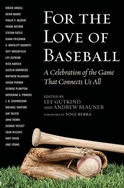
I was having a great deal of déjà vu all over again when I started For the Love of Baseball—and that was even before I read the forward by Yogi Berra. There was, at least, a good reason for this sensation: I read many of the creative non-fiction (CNF) pieces in 2008 when the book was published as Anatomy of Baseball. Some of them, including Susan Perabo's gender-driven imagined baseball bio, George Plimpton's mediations of the right fielder, and John Thorn's examination of fanhood, were as enjoyable and thought-provoking six years later. What's more, when I went back and reread my review for NINE, I found I had little to add overall, so here's the link (the review was republished online for Creative Non-Fiction) and Bobby's your uncle: https://www.creativenonfiction.org/reviews/97.
Just kidding. The pieces that were added to the most recent iteration (including editor Gutkind's new introduction) improve an already strong CNF lineup of biography, memoir, and essays that are immersive, personal, meditative, and/or lyrical. The common denominator, of course, is the love that generates meaning on any number of levels for each writer.
Gay Talese's contribution and Gutkind's introduction both provide insight into the 1950s. Even if Talese's commentary is a bit tongue-in-cheek, for the New York Times to publish a piece about the fashion of baseball in 1958 marks the logical extension of the work started by the Saturday Evening Post and other general interest magazines of the early twentieth century to feed the appetites of an audience that can't get enough about baseball—while convincing them that they can express their individual identities with their wardrobes. Gutkind's new introduction counts the ways in which he loves the game through the presence of All-Star Baseball, the spinner and statistics simulation game that allowed him to play parallel seasons to his childhood heroes. Such games have helped develop a love of the game as far back as the late 1860s when American families with $5.00 to spare could buy tabletop baseball for their parlors (see below). Francis Sebring's "Parlor Base-Ball Field" game was advertised in Frank Leslie's Illustrated Newspaper on December 8, 1866—just in time for Christmas!
George Vecsey's profile of Casey Stengel as the manager of the Yankees and Mets provides insight to both "the Old Man" and the early days of the 1960s. In their first season, the Mets lost 120 games, surpassing the record held by the Pittsburgh Alleghenies who lost 113 games during the Brotherhood War of 1890. Stengel's presence in the dugout—parallel to J. Palmer O'Neill's occupation of the front office seventy years earlier—generated press that helped define the teams as "loveable losers," a narrative that spans centuries for some teams. The essay also makes it clear that Covering Stengel as a young sportswriter helped cement Vecsey's love of the game.
Gutkind's profile of Art Williams spans the 1950s into the 1970s when Williams integrated the National League umpiring crews. Readers of this piece may come to understand the "lawsuits and awful allegations" that Gutkind mentioned coming out of the book he wrote about the time he spent following umpires. In addition to using Williams' playing days in the minors and his path to becoming a major league umpire, the anecdotes Gutkind includes serve as reminders that the 1970s were anything but politically correct, although it was clear everyone in the umpire's locker room loved the game in their own ways.
The inclusion of A. Bartlett Giamatti's classic 1977 essay leads off the collection and shares the plight of the Red Sox fan of that era. Instead of blaming a curse, Giamatti borrows the concept of Dame Mutability from his Ivy League education to help explain how his team fell short again. Whether or not the game is actually designed to break our hearts, Giamatti's anguish illustrates the power of a love that can lead its devotees to search for answers in printed texts from the Middle Ages.
Bringing the readers into the 1980s, Matthew McGough's "shaggy batboy" story retells an age old tale and Diana Friedman's piece examines the before and after of Title IX. While McGough's story harkens back to Mark Harris's 1953 book, The Southpaw, Friedman contrasts her own opportunities in sports growing up before the 1972 ruling and the options open to her daughter afterwards. Just as the other pieces humanize the game across the decades and personify what the game means in the process, Friedman makes the love of the game real and accessible.
As I finish this long-overdue review, pitch clocks are ticking in the Arizona Fall League in an attempt to speed up major league baseball games that have crept over three hours in average length. While baseball is in no danger of approaching the number of days required to decide a cricket match (except, perhaps, in the fiction of W.P. Kinsella), there is no denying that the length of the games has become an issue—especially in the Northeast where the Red Sox and Yankees engage in four-hour marathons 19 times a season.
That said, I wonder if the pitch clock and the automatic balls and strikes will put a single young player back onto the myriad empty ball fields across America. Will any of those measures feed the pipeline of future players turned fans who will return to the game with the same kind of abiding love that caused each of the authors in For Love of the Game to put pen to paper? When I drive past the city parks of southwest Ohio, I see them filled with young soccer players. These boys and girls may very well become the critical mass of fans that calls for stories and information about their favorite pastime in twenty to thirty years, and when they put fingers to keyboard or speak to some digital device to engage in memoir, biography, or meditative essays, they might be writing about their love for the sport the rest of the world calls football.
For the Love of Baseball, edited by Lee Gutkind and Andrew
Blauner, New York: Skyhorse Publishing, 2014, 237 pp., hardcover, $19.95.
Copyright © 2014 by Scott D. Peterson