heart of the order
Reviewed by Kenneth Sammond, Fairleigh Dickinson University, Madison, NJ
22 september 2014 archive
Western audiences have heard poetry sing of sports since Pindar and Homer. Even today, most Americans can recall a few lines from "Take Me Out to the Ball Game" or "Casey at the Bat," two of the best known early poems about baseball. I knew the chorus to the former before entering school and the climax of the latter before I could read it: such verses were part of my heritage and, later on, they even helped me tackle the ancient poets in college.
Baseball's origins were rooted in ancient poetry through the propitious link to the Vergilian Elysian Fields (by way of Hoboken) and the game itself has been in a continual embrace with verse ever since, as though the link were an intrinsic part of its nature. Moreover, our current games continue to be grounded in verses that celebrate their connection to our national ethos, the sandlot agons of our youth, and the ways that the game helps us mature.
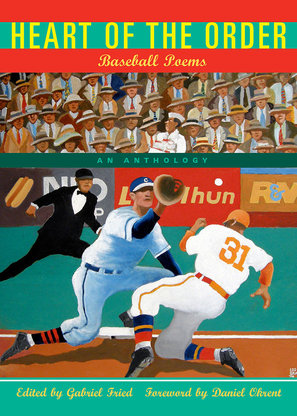
Heart of the Order, a slim anthology of baseball poems edited by Gabriel Fried, is a welcome addition to growing corpus of baseball poetry. Fried, a poet and Visiting Assistant Professor of English at the University of Missouri, has a keen ear for the sound of good baseball poetry and a good eye for a good baseball tale. As the editor, he professes two equal hopes for this anthology: that it "reaches some fans who don't typically read poetry—and some poetry readers who don't (yet) care for baseball" (xv). As a reader and a fan, I guess he had little to worry from me; however, I did rediscover some of the magic of the game as I read through the selections—the same kind of curious wonder I encountered as I helped my son begin little league this past spring.
This collection tips its hat to the past, but engages us with the dynamic nature of poetry and the game. The hat-tipping begins with Daniel Okrent's Foreword, which offers up two over-ripe references involving Walt Whitman: one is the poet's oft quoted line about "our … American game" and the other comes by way Annie Savoy in Bull Durham. These references set the tone for what follows, revealing a love for the sport and its seductive power while alternately sharing a self-deprecating reminder of the follies of the game which can result from our passion for it.
Though he is part of the introduction, Whitman has no poems here—as the great American poet and champion of baseball penned no poems about our national pastime. Nor can we find any of the old standards among the selections. Still, every book of baseball poetry has Whitman make a cameo: in this collection, Floyd Skloot's extraordinary, "Whitman Pinch Hits, 1961," imagines him as wanderer/spectator who is called from the sidelines to play in the game. Like so many of the other poems, the tone and imagery of this piece appeals to the avid reader of poetry and the fan who would dreams of being called up to hit—just once. After all, poetry is about what could happen, not what did happen.
Skloot is numbered among the many names, ranging from the familiar All Stars (including B.H. Fairchild, Marianne Moore, Rolfe Humphries, Quincy Troupe, and Gail Mazur) to other veterans who might be seasoned major leaguers or barnstormers (ranging from Elizabeth Powell and Thomas Reiter to Aaron Belz and Kevin Gonzalez), some seventy-five in all—each represented once. The anthology is divided up into seven sections, each one corresponding to a way we read, play and write baseball. The first one, "Baseball Fundamentals," is haunted by loss, reflection and the tyranny of the rules that alternately enrage and reaffirm our place in the world. Robert Francis' "The Pitcher" leads off this section, asserting the tension that makes every pitch appear as profound as a tragedy—offering us the essence of hamartia delivered in every pitch:
His art is eccentricity, his aimThe second section, "Stickball, Pickle, and Little League," covers the foibles and dreams of youthful endeavors on the field; still, the poems, as can be seen in these lines from Sharon Olson's "Running the Bases":
How not to hit the mark he seems to aim at (3).
The journey had been effortlessSuch verses are as much about how we recall and what we remember as they are about playing the game.
because she really did not remember running (40).
The terse relationship between pastoral simplicity and the loss of youthful ideals permeates the poems in the third section, titled "Cornfields and Sandlots." Yusef Komunyakaa's "Glory," which recounts a workingman's game, is a bittersweet reflection on the sweet but tragic endurance that flourished in African American communities in the mid-twentieth century. B.H. Fairchild's "Body and Soul" invites us hear a "blues ballad" about the "vast gap between talent and genius" starring a young, undiscovered Mickey Mantle playing sandlot ball in Commerce, Oklahoma.
The next two sections, "Expanding the Strike Zone" and "Screw Balls and Double Plays" distill the devotion, aesthetics and wry ways that we use baseball to discuss everything but the game. In "Grand Slam," Marjorie Maddox describes the winters of our old age which have
Glorious sleep that seeps back thereThis somber reflection is counterbalanced with several different turns on the sexual metaphors of baseball—with punchlines from Prunty, Belz, Thomsen, Hudgins and Yenser.
to the glory of our baseball days (80).
The book is titled, Heart of the Order (the third baseball tome carrying that name), which makes us pause and recall those players that form the core of the batting sequence, those players who are most likely to score. Though each section has its strong players, I am assured that the final two sections, "At the Letters" and "Greats of the Game," are positioned to score with even the most resistant or surly poet and fan.
The latter of these sections focuses on those places and players that have excelled in our dreams and have stretched out the possibilities of our game. In this section, poems from Michael Salcman, Christopher Burske and others reveal the flawed depths through which our love for the game and its players mediates our own life experiences: the poetry of baseball becomes a way to make sense of our own dilemmas and successes.
The former of these sections encourages us to reflect on how we create the game in verse and prose as well as how the game itself is poetry. It fulfills Marianne Moore's belief that
Writing is excitingIn the delightful Afterword to his 1989 collection of baseball essays, titled The Heart of the Order, Thomas Boswell described how "baseball was meant, and still is meant, to be irresponsible, anti-adult, silly, lyric, inexplicable, slightly rebellious and generally disreputable." Fried's anthology of poems not only shares the title of Boswell's work, but also shares his sensibility: these verses revel in the lyricism that baseball evokes, but it never allows us to forget its inexplicability. Perhaps this is why the final poem, William Matthew's "Babe Ruth at the End," invokes two of the greatest names of baseball in its final stanza—but it closes this stanza, this poem, and, by arrangement, this collection with an open-ended question. Which reminds me a lot of how the game is played.
and baseball is like writing.
You can never tell with either
how it will go
or what you will do (111).
And I won't spoil the ending by quoting it.
Overall, Gabriel Fried's new anthology, Heart of the Order: Baseball Poems, is a solid and worthy collection that any fan should enjoy and every poet should appreciate.
Heart of the Order: Baseball Poems, Edited by Gabriel Fried. New York: Persea, 2014. Paperback, 160 pgs. $17.95.
Copyright © 2014 by Kenneth Sammond