football
Reviewed by Ned Coates, Pennsylvania College of Technology
9 september 2014 archive
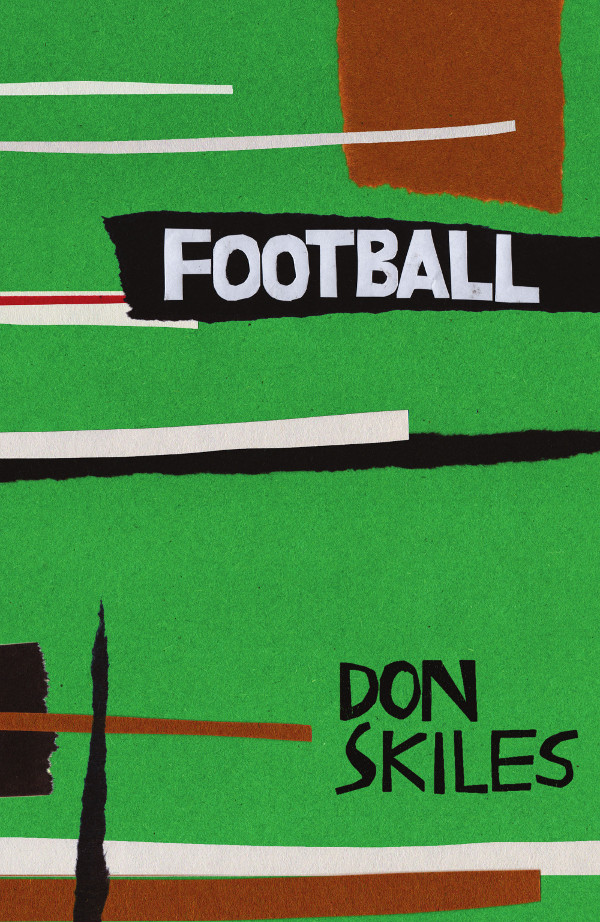
A tour de force enters the field of sport literature. a novel that sweeps up the sights, sounds, smells, history, gossip, mores, and hopes of the fictional Western Pennsylvania blue-collar "football town" of Ralston in the fading months of 1956. Into a plot peppered with allusions to the popular culture of the country and the times, San Francisco poet and short story writer Don Skiles, native to Western Pennsylvania, analyzes the role of football in Ralston through the experiences and observations of 10th-grade honor student and football candidate Larry Simmons, who himself is investigating the meaning of football to the townspeople, to the girls he and his buddies fantasize over but deem "unattainable," and to himself.
The subtitle "A Town, a Team, and a Dream" of H.G. Bissinger's acclaimed Friday Night Lights could apply also to Football, which paints in fiction an almost sociological account of the centrality of Ralston Raiders football to its town and school but on a wider canvas than Bissinger's non-fiction work and with the sensory density expected from an accomplished poet.
Smells pervade—of locker-room excrescences, girls' hair, buckwheat cakes, "and all that familiar game smell of cut wet grass and dirt and hot coffee and the steamy wooly smell of people in the air which Larry loved." It can be said (with apologies) that Skiles fills every rift with odor. Other senses not neglected, the result is living what Larry lives.
Although readers may initially prefer first-person immediacy, Skiles likely has chosen wisely a third-person narration which better integrates the many references to pop culture, literature, and football lore and makes the shifts in time and place away from the plot's progression seem fitting. From this slight distance, readers, reminded of their own teen years, can objectively consider what advice they might give Larry. For he seeks a mentor, his stepfather recently dead, his big brother Carl away in the Marines, and his mother—well, there are just some things a young man can't discuss with his mom.
Concerns about manliness and a love-alienation relationship to the football culture follow Larry through the novel, even through the town on rambles which recount its homes, stores, and people. Above it all stand the extraordinarily high and bright lights of the football field. These and the consistent winning record of the Raiders are Ralston's only glories. The field brings together under the Friday lights the many elements of the community—old and young, clergy and derelicts. Even to the ambivalent Larry, it is a "sacred place."
Mentor candidates include best friend Frankie Malone, the exotic teen beauty Cameron Mitchell, Head Coach Rossi, and Advanced literature teacher Mr. Turner. Frankie, a most enjoyable character, is direct, cynical, profane, but loyal. He typically undercuts Larry's idealistic and moralizing ponderings with dismissive or disputative pronouncements employing "bullshit" or "crap." Sometimes he is right. Black-tressed Cameron tells Larry he is at heart not a football player. She will escape Ralston for a modeling career in New York. Blonde Sandy Stevens of the elite majorette corps exudes Ralston values, asks Larry to the Autumn Hop, expects to be dating a football player, and probably will marry one. Although among the "unattainable," both, unaccountably to unsure Larry, find him attractive. Larry has observed, however, that attractive Ralston High girls become overweight wives to husbands who drag home from low-paying jobs that enrich their employers and the tavern owners. Carl has pointed out that few men live to enjoy the retirement they sweat for. Deja vous Odessa?
Many of those men frequent Sam's barbershop, surrogate cracker-barrel locus and repository of dead dreams. There they act as a chorus to reveal town gossip, history, and myth, much of it underscoring the manly values of football, hunting, military service, and daring deeds, such as Carl's perfect-arc dive from the top girder of the river bridge. Football brings to all these people excitement, relief, and meaning. Skiles literally and symbolically uses the field lights to illuminate the town, which from River Hill, where he parks with Cameron in her cherry red '55 Chevy, seems lovable but leavable. Overall, Ralston fares better than Odessa.
When most perplexed, Larry, a film devotee, asks himself, "What would James Dean do?" Recently dead, Dean offers little help, except to image coolness under social pressures. Larry, non-smoker and conservative dresser, is however no rebel without or with a cause. He is just trying to figure things out. The climax of the novel, when Larry has separate meetings with Mr. Turner and Coach Rossi, is satisfying and uncontrived. To his credit Skiles has not stereotyped these seeming opposites.
Football provides lots of football: the nitty-gritty of hitting the blocking sleds, tackling drills, gut-pounding warm-ups, Xs and Os, game exploits, Bednarik creaming Gifford. The attendant rituals are included, from the team's entry between rows of kneeling majorettes to the primordial bonfire (of tires) adjacent to the field and tended by disreputable older men till dawn. The chapter describing the first pre-game pep rally in the school auditorium is one of the finest set pieces in the book—exciting, ironic, amusing, reminiscent—but a bit scary. Larry is enchanted by all of this.
Another memorable chapter narrates Larry's first hunting trip to the boondocks of Pennsylvania's Cook Forest, There is a feel of Dickey's Cahulawassee about it, about the natives there, about sublimated violence that will haunt Larry ever after.
Challenging the manly quests for football glory and trophy animals are literature assignments by Mr. Turner, blessedly unlike some teachers, an opposite to Whitman's turgid learn'd astronomer. John Clare's 'The Badger" is presented in its stark entirety. Housman's athletic town hero who dies young raises pertinent questions. The language of "Fern Hill" thrills Larry, while Wilfred Owen reveals greater losses than those football brings. Skiles handles these literary inclusions and others with Keatsian Negative Capability, not reaching for the easy solutions nor prompting the reader to do so.
Although some established facts are reposited when subordinate references would suffice and some of Larry's inner perturbations may have us asking, "Where's Frankie when we need him?" Aha passages nevertheless unfailingly show up to stoke our memories, offer surprises, new acquaintances, interesting football trivia, and good laughs, all of which Football richly relates. After a long zig-zagging run, Skiles is in for the touchdown!
Skiles, Don. Football. Claremont, CA: Pelekenesis, 2014. 516 pp. $25.00.
Copyright © 2014 by Ned Coates