throwing hard easy
Reviewed by Robert Ciaffa
10 august 2014 archive
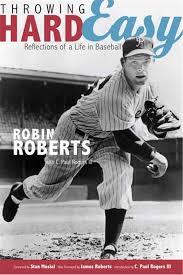
Robin Roberts was both an American original and also emblematic of his generation's work ethic. The future Hall of Famer was signed by the Philadelphia Phillies for a $25,000 bonus in 1948, and he developed quickly into the Phillies' broad-shouldered, "go-to" guy. He established himself as the team's ace and workhorse on the mound, compiling astonishing numbers for durability and longevity, even at a time when a pitcher was generally expected to finish what he started. In the six-season period between 1950 and 1955, Roberts started a total of 232 games for the Phillies and completed 161 of them. He pitched over 300 innings for six consecutive seasons. Of course, even though almost no one paid attention to pitch counts in that era, these figures are nevertheless jarring. No major league pitcher today would be expected—or even allowed—to complete 27 games in a season, which is the number Roberts averaged in that six-season window. The guy simply took the ball and pitched. And he really hated to be taken out of a game, because he considered it his job to finish. He was a hard critic of his own performance, and he accomplished a great deal because he demanded a lot of himself. Over a nineteen-year career, Roberts started 609 games and finished 305 of them—almost exactly half. He tossed 45 shutouts and compiled an excellent 3.41 lifetime earned run average.
Born to Welsh immigrant parents in a working-class family on September 30, 1926, Roberts spent his early years in Springfield, Illinois, and matured into a talented, multi-sport athlete. His parents taught basic values to him and his five siblings, and the family was a loving and close one. Excelling in baseball, football and basketball, he enrolled at Michigan State University on a basketball scholarship during World War II. Roberts promptly volunteered for a U.S. Army Air Corps flight training program—and even briefly considered volunteering for paratrooper duty—but he never saw combat service. After his discharge from the military, graduation from Michigan State, and a brief apprenticeship in the minor leagues, Roberts made it to the Phillies in 1948. He was the bellwether of the staff in the Whiz Kids' unexpected run for the National League pennant in 1950, and he defeated the Brooklyn Dodgers on the last day of the season to secure a World Series berth against the New York Yankees. That memorable game (a ten-inning complete game) was Roberts' third start in five days, and it propelled the Phils into the World Series against the New York Yankees.
This is the template for Robin Roberts' life story, which is carefully documented in Throwing Hard Easy: Reflections on a Life in Baseball, by C. Paul Rogers III. The author takes his material from numerous interviews with Roberts over several years. This is a book written in amazing detail by Rogers, who had followed Roberts' career from childhood, and who idolized him. The book does not suffer from Rogers' closeness to his subject—the two had met by chance at a luncheon in Dallas and became good friends in the 1990s—and if anything, Rogers' voluminous knowledge of the smallest details of Roberts' career and his off-the-field life greatly enhance the final product. The book is the result of both a personal and professional relationship. And this relationship tells us much about the open-handed honesty of Roberts, who easily trusted the author with the task of crafting a lasting and true record of his career and life.
Roberts' memory of the details of games that had occurred decades earlier is astonishing, and he relates these tales with honesty, genuine modesty and an occasionally wry sense of humor. In fact, Roberts, even though he was an excellent storyteller, had no interest in writing an autobiography when Rogers proposed the idea, believing that there would be scant interest in his life and career. Roberts had worked eagerly with Rogers on an earlier book about the Whiz Kids, and was very content to be a part of that project, and to be remembered for his integral role as part of his team's 1950 run to the National League pennant.
But as far Roberts' belief that there would be a lack of general interest in his life, he was wrong. On the contrary: avid baseball fans relish stories by the men who have made great contributions to the game, and most of us will devour a good story by or about former players who played for teams we may not have followed closely. Also, Phils fans enjoy a reputation as tough customers, but they are quite loyal to former players who had worked hard, hustled, and earned their respect. And Robin Roberts' dutiful and workmanlike approach to his craft—as well as his unwillingness to leave a game he'd started—was respected greatly by most fans, many of whom worked hard for a living themselves. And at a time when professional baseball players were generally paid well for their work (but not extravagantly), many fans felt a kinship with players when they watched them compete, and were loyal to them many years after they'd stopped playing.
C. Paul Rogers' effort has produced a solid and admirable record of the career and life of an enduringly good man who earned the respect of both his colleagues and fans through his honesty, loyalty, tireless work ethic, professionalism, personal integrity and simple decency. A devoted husband and father as well, Robin Roberts left lessons for all of us not only about how the game of baseball should be played—but also about how a good life could be lived. C. Paul Rogers' engaging narrative of this life was clearly a labor of love.
Throwing Hard Easy: Reflections on a Life in Baseball, by C. Paul Rogers III (University of Nebraska Press, Lincoln and London).
Copyright © 2014 by Robert Ciaffa