the continental league
Reviewed by Tom Wells, Schreiner University (retired)
8 july 2014 archive
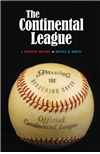
As a kid in small-town Texas in the 1950s I loved everything about baseball, but I especially loved the Baltimore Orioles. To this day I am not sure why. Perhaps, I just liked pulling for the underdog. Most of my friends were Yankee fans, some were fans of the Cards or Dodgers, but no one rooted for any Texas team – we didn't have one. That would soon change thanks in part to the attempt by Branch Rickey and several wealthy businessmen to create a new major league for baseball – the Continental League. As an underdog supporter, I was very excited to hear this news on the radio, especially when the announcer mentioned that Houston would probably be a member. The news came and went, much like the new league. I don't recall hearing much about the Continental League after that. I just knew it never happened. However, after the success of the American Football League and the semi-success of the American Basketball Association, the ill-fated Continental League would spring to mind over the years, more as a name than anything of substance.
Whatever happened to the Continental League? Who was involved? Why did it not succeed? Did any teams actually form? What about games, rules, players, etc.? These questions and more are answered in fine fashion in Russell D. Buhite's The Continental Baseball League: A Personal History (The University of Nebraska Press). Using a memoir format in much of the book, Buhite presents the history of the short-lived Continental League. His early years and his baseball background do manage to enhance the telling of the last attempt to form a third major league in professional baseball. Additionally, the author remains one of the few players who signed a contract with the Continental League. Buhite's "seat at the table" and his historian's perspective provide excellent bona fides for depicting the story of the Continental League.
Informing the interested reader of the who, what, why, where, and how of the Continental League, Professor Buhite uses a prologue to provide a wonderful, detailed account of the politics and philosophy of Branch Rickey and his resultant influence on the Continental League venture. Buhite claims that the new league would have provided a different economic model for baseball, and he concisely summarizes the planned operation and structure of the league in this prologue.
In this reviewer's opinion the opening chapter goes over the top presenting the biographical information of the author. Buhite's tale of using baseball as a way off the farm bogs down a bit with detail. His knowledge of baseball and what it takes to succeed in the game are obvious, but the opening chapter became tedious. However, its conclusion set the stage for Buhite's involvement in the Continental League.
Buhite opens Chapter 2 by commenting on the condition of major league baseball in 1959 in devastating fashion. In fact, he refers to it as "sick," and then expertly delivers the reasons for his diagnosis. From 1949 to 1959 the number of recognized minor leagues decreased from fifty-nine to twenty-one. Attendance in the AAA and AA minor leagues had dropped by over fifty percent. It was worse in the lower classifications. Major league baseball experienced a twenty percent decrease during this period. Major league baseball had not responded or reacted to the impact of television, air conditioning, and the Lazy-Boy recliner. To this reviewer the opening salvo in the second chapter is a stunner, and Buhite deftly follows this with a history of Ban Johnson being the driving force of moving the American League to major league status in the early 1900s. The consequences of the Dodgers and Giants move to California in 1958 include a renewed interest in expansion, especially to fill the void existing in New York City. Buhite clearly relates how a movement to re-locate a current major team to New York evolved into forming a new league. He tells this story well, and his cast of characters includes William Shea, Bob Howsam, and, of course, Branch Rickey, among others.
Major League baseball's reaction is depicted in Chapter 3 which is entitled, "The Horsehide Cartel Challenged." Buhite's knowledge of baseball history, especially the management side, shines through in this lengthy chapter. His research regarding the role of Congress in the status of major league baseball, not to mention the combination of the reserve clause and "territorial rights," is presented with clarity.
Standing on shaky ground, Branch Rickey convinces the owners of the Continental League to proceed by forming three minor leagues (two D leagues and one C league). Only one of these actually formed and played a season – the Western Carolina League. The goal was to sign players to eight teams with each team playing a 100-game schedule. Buhite signed a contract with Rutherford County, and this chapter describes the one season that the Continental League actually functioned as a baseball enterprise. The baseball commentary and anecdotes of "life in the minors" make for enjoyable reading.
Professor Buhite concludes his personal history of the Continental League by offering some excellent alternatives the league could have selected to be successful. Considering his study of the history of the league, combined with his actual on-the-field experience in the Continental League's only minor league season, he is definitely the expert.
This reviewer's overall take on The Continental League is positive. As a lover of baseball history, but not a historian, Buhite's analysis of the Continental League's emergence and ultimate failure worked for me. The writing was dry in spots and, as mentioned, the autobiographical aspects in Chapter 1 felt overdone. However, this work will be enjoyed by baseball history buffs and the casual baseball fan who loves to read about baseball. One other note of appreciation needs to address the inclusion of an Appendix which includes transcripts of Senate hearings on the issues affecting the Continental League and the following responses by Rickey and others. Additionally, the chapter notes enhanced this piece of work. This book is not for everyone, but for those interested in the Continental League and its impact on changing the landscape of major league baseball when it really needed a boost, one could do far, far worse.
Buhite, Russell D. The Continental League: A personal history. Lincoln: University of Nebraska Press, 2014. 240 pp. $24.95 hardcover.
Copyright © 2014 by Tom Wells