tales from the deadball era
Reviewed by Matthew Teutsch
The Deadball Era is Far from Dead: Mark S. Halfon's Tales from the
Deadball Era
1 july 2014 archive
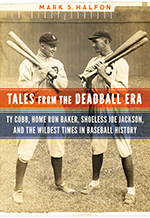
Last fall, I came across Ring Lardner's You Know Me, Al (1916) while preparing for a class. Lardner's epistolary novel tells the fictional story of Jack Keefe's exploits both on and off the baseball diamond during the Deadball Era. Lardner, who worked as a beat writer for the Chicago White Sox, peppers the novel with historical players such as "The Georgia Peach" Ty Cobb, Walter "The Big Train" Johnson, and Tris "Spoke" Speaker and managers such as John "Little Napoleon" McGraw and William "Kid" Gleason as well as White Sox's owner Charles Comiskey from the first part of the twentieth century. Mark S. Halfon's new book Tales from the Deadball Era: Ty Cobb, Home Run Baker, Shoeless Joe Jackson, and the Wildest Times in Baseball History adds to Lardner's fictional tale and provides an historic portrait of both the Deadball Era and the players, managers, owners, umpires, and fans that populated it.
Throughout, Halfon discusses the opposing poles that baseball displayed at the beginning of the twentieth century. He paints a picture of a day at the ballpark during the era as a homogenous crowd of well-dressed white men with the occasional ladies' day to bring in women. More than just cheering and heckling to affect the outcome of the game, fans lined the fields, even having to be roped off in the outfields and standing close behind home plate. This intimacy, of course, caused various incidents to occur. Halfon relates stories of open gambling in the stands and violence against players, umpires, and other fans. Opposing these anecdotes, Halfon discusses how fans treated players as idols by having special player days for them and adorning them with gifts, even in the middle of a game.
Providing a detailed description of the era, Halfon states that the Deadball Era got its name because pitchers dominated and offenses had to work to produce. For example, Sam Crawford in the American League and Red Murray in the National League in 1908 and 1909 respectively each led their individual leagues with seven homeruns. From 1911-1914, Home Run Baker lead the American League in homeruns each year without surpassing twelve in a single season. The various reasons for the dominance of pitching during the era included ballpark size, lack of defensive skill, lack of lighting at ballparks, lack of new baseballs during play, various "trick" pitches, and specific rules. The lack of production on the offensive side of the ball led some, like John McGraw to adopt a new strategy to win ballgames. McGraw and others started to implement "inside baseball," which, broadly defined, "refers to the use of the mind in all aspects of the game" (46). Discussing McGraw in the second section of the book, Halfon delves into the nuances of "inside baseball" and talks about McGraw's incorporation of sign language and his psychological managerial techniques.
For all of his in-depth storytelling and discussions of specific games and players, Halfon's book provides baseball enthusiasts with a plethora of information regarding how the game we know and love today came into being. Halfon mentions Barney Dreyfuss' use of a tarp in 1908 to keep the Pittsburgh infield dry during rain, the 1901 change in the foul-strike rule, the removal of "freak deliveries" from the game, and the increasing of umpires calling a game from one to two in 1911. Halfon mentions these items, and more, within the context of his broader discussions, adding depth to the book. Of all of the items that Halfon mentions in regards to the game, one of the most interesting is his discussion of mascots. These included dwarves, African Americans, and deaf and dumb individuals. Halfon mentions that Ty Cobb's superstitions led him and the Detroit Tigers to take on "a homeless nine-year-old black boy named Lil' Rastus" as their mascot (90). The team went on a winning streak in 1908 with Lil' Rastus around, but when they failed to take him on the road with the team, they did not fare as well.
While reading Halfon, I could not help but think about the recent debates surrounding performance enhancing drugs and the rhetoric of cheating permeating baseball over the past few years. One look through Tales from the Deadball Era and my mind began to change in regards to thinking about the contemporary debates. Players that became some of the first to call Cooperstown home cheated, gambled, and fought during the Deadball Era, yet with the distance of one hundred years, we remember them as constructing the fabric of the game we know today. Along with these thoughts, I also couldn't help but think about how Halfon reads alongside writers of the Deadball Era. Pairing the historical lens of Halfon with the contemporaneous views of Ring Lardner and Christy Mathewson enormously increases the pleasure and usefulness of Halfon's study. For anyone interested in baseball's past, Halfon's Tales from the Deadball Era provides an introduction not only to the sport itself but to American culture as well.
Tales from the Deadball Era: Ty Cobb, Home Run Baker, Shoeless Joe Jackson, and the Wildest Times in Baseball History. By. Mark S. Halfon.
Lincoln: Potomac Books, 2014. 226 pages. $26.95. (Hardback).
Copyright © 2014 by Matthew Teutsch