the great eight
Reviewed by G. Louis Heath, Ph.D., Ashford University
18 june 2014 archive
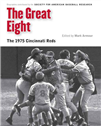
It's July, 1972 and I'm on the Cincinnati Reds' team bus, seated beside pitcher Gary Nolan, my childhood friend from our hometown, Oroville, California. We've just pulled away from the Queen Elizabeth Hotel in downtown Montreal where I lunched with the team and Gary introduced me to manager Sparky Anderson and three of "The Great Eight," Joe Morgan, Cesar Geronimo and Johnny Bench. We are headed for Jarry Park on the outskirts of the city, where I've been teaching summer session at Anglophone McGill University.
This lead paragraph should give you the gist of why I volunteered to review The Great Eight, a 8 x 10 inch coffee-table-style book in the University of Nebraska "Memorable Teams in Baseball History" series that includes a chapter on my high school pal, Gary Nolan, selected for the National League All-Star team that summer. His biography is Chapter 36, pages 175-180, one of 48 short chapters, 38 of which are biographies of players along with one of manager Anderson. The other chapters are more overviews, such as "Scouting and Player Development," "Preseason Outlook," "April 1975 Timeline," "September 1975 Timeline," and "Postseason."
The book title comes from the starting eight position players of the 1975 season: Johnny Bench, Tony Perez, Joe Morgan, Dave Concepcion, Pete Rose, George Foster, Cesar Geronimo, and Ken Griffey. The Reds had been touted to be great the previous few years prior to 1975, a favorite to win the World Series, but until 1975 they had not lived up to the hype. Finally, in that year, the team realized its potential, an achievement this large, encyclopedic volume documents in a wealth of detail that includes historical context, going back to the 1953-1956 original Big Red Machine star slugger Ted Kluszewski who also rates a biography.
The biographies feature great detail:
For example, on Hall of Fame catcher Johnny Bench: His high school years were marred by a tragic accident—a bus carrying his baseball team lost its brakes and rolled down a 50-foot ravine, killing two of Bench's friends and teammates. Bench was knocked unconscious but otherwise escaped physical harm.
In the chapter on power-hitting outfielder George Foster, we find: As his hitting improved, Foster began to admire another player's stained hickory bat and ordered one for himself. Foster's big, black 35-ounce, 35-inch bat was well known. Foster joked about having integrated the bat rack.
And in the chapter on my friend Gary Nolan (He has returned to live in Oroville, where I visit him on my trips home): Nolan found a second career as a blackjack dealer at the Golden Nugget in Las Vegas in 1978. In 1989 he became executive casino host at the Mirage, where he left any interest in baseball behind him. He wanted nothing to do with the Reds, never wore his championship rings, and even snubbed the team when he was elected to the Reds Hall of Fame in 1983.
To learn why, you should read this book, one that belongs in libraries, on Reds fans' coffee tables, and in the libraries of MLB fans everywhere.
Finally, the prospective reader should know this is a scholarly tome. Pages 237-256 cite hundreds of sources for the biographies, chapter by chapter. Chapter 21 on Bench has 13 works cited; Chapter 27 on Foster, 11 references; Chapter 36 on Nolan, 14 sources.
So, what can I say overall? The Great Eight is a fine reference book and a good read if read as such; that is, imbibed in small doses over time.
Mark Armour, editor, The Great Eight: The 1975 Cincinnati Reds
(Lincoln, Nebraska: University of Nebraska Press, 2014), 260 pages.
Copyright © 2014 by G. Louis Heath