big train's backyard
Reviewed by Jeffrey Beck, Ph.D., Kean University
8 june 2014 archive
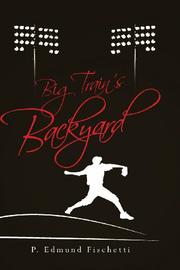
P. Edmund Fischetti's Big Train's Backyard is a long stroll (or train ride, if you prefer) down baseball memory lane, often emotional, as such journeys typically are. The fiction of a veteran third baseman's triumphant comeback season coinciding with a homecoming to Maryland and his love story with a girlfriend harps on many strings of baseball sentiment—think Bull Durham without the delicious grit of the minor leagues. It is a fiction of hero worship and sometimes pleasurable factoids, packaged in an attractive, glossy black cover.
The hero worship begins in Kansas City in the fourteenth year of Alex Santucci's major league career. We learn about his precocious homerun power, which brought him to the majors in his early twenties and his stardom with the Kansas City Crowns. Now at thirty-six and showing signs of losing his power stroke, he receives some helpful advice from his doctor, visits his adoptive parents in Bethesda, Maryland, and rekindles a passionate love for his sexy-nerd girlfriend Sally Keegan. Suddenly, his bat comes to life, homeruns start rifling distant seats, and Alex unexpectedly makes the all-star game, coincidentally held in hometown Kansas City. There he receives some disquieting news from his good doctor Walton, but wipes tears at the game, performing with his trademark excellence. In only a few days, he will be traded to the Washington Presidents at the July deadline, where he will battle to surpass Frank Howard in career homeruns and to do honor to his boyhood hero Walter "Big Train" Johnson. This is the "Big Train" of the title, and the backyard is Alex's boyhood home in Bethesda, Maryland.
Mixed in the veteran struggling to comeback plot are not only other varied plot strands (e.g. Alex's questioning of his relationship with the birth mother Leah he never knew), but also ample baseball history and trivia. In fact, at times the plot becomes secondary to the chronicling of baseball history. For instance, Fischetti comments on Alex's career homerun with the following factoids:
His career mark was 368 homeruns, 14 short of the great Washington Senator, Frank Howard (Hondo) at 382. …. Hondo was a hero to his birth dad, Philip. In the sixties Hondo woke up the baseball fans in D.C. with his seven years of upper deck blasts at RFK Stadium. He averaged 34 homeruns and 96 RBIs [sic] in D.C. during a pitching dominated era. 1968 was the year of the pitcher. They changed the height of the mound and the strike zone in 1969 because pitching was so dominate [sic]. Denny McLain won thirty-six games and Bob Gibson had an ERA of 1.12, breaking the record of 1.14 set by Johnson in 1913. The American League as a whole batted a combined, all-time low of .231 and had one player, Carl Yastrzemski crack the .300 mark, hitting .301 for the 1968 batting title, the lowest winning average in the history of baseball. (27-28)The long quotation illustrates several points to consider about the novel. First, Fischetti has a habit of switching from sentimental plot to baseball facts and stats, and back, as if the switch in style and contest was fluid and natural. Though the baseball facts are often pleasurable in themselves, they tend to derail, or at least delay, the plot. Second, the prose, as evidenced by the [sic] passages, is in need of further editing. And finally, the plot of Alex's dream comeback likewise suffers from the lack of an editor's discipline, as the author inflates the hero worship and sentiment, but minimizes the gritty detail that would bring the story to life.
Without revealing too much of the plot of Big Train's Backyard, I can say that the novel takes readers through many tunnels into baseball history, as well as onto the sunny diamonds of a veteran player's dream season. The formula for the journey is trifold: one part, heroic fantasy; one part, baseball history; one part, sentimental homecoming. Moments of the ride, like glimpses out a train window, are picturesque, but the ride bumps and jostles at times, closer to economy class than first-class accommodations.
P. Edmund Fischetti. Big Train's Backyard. Charleston, S.C.: P. Edmund Fischetti, 2012. 453 + iii pp. ISBN-13: 9780615701271. Paper. $15.95.
Copyright © 2014 by Jeffrey Beck