bring in the right hander!
Reviewed by Tim Morris, University of Texas at Arlington
9 may 2014 archive
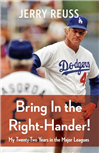
I thought of Jerry Reuss last year during one of those arguments over Jack Morris and the Hall of Fame. Was there ever a pitcher, I wondered, who had more major-league starts than Morris with a worse ERA relative to the league?
There were two. One is the ageless Jamie Moyer. You've probably guessed the other, also a long-lived left-hander: Jerry Reuss. In fact, Reuss's ERA, adjusted for context and relative to his league, was dead-average over his 22-year career: his career ERA+ was 100, as defined by Baseball-Reference.com, for 547 starts, twenty more than Morris. Reuss put in the longest career ever by a pitcher who was average or worse. That in itself is something to write a memoir about.
Of course being average at your trade for decades is a strong accomplishment. I've been a mediocre English teacher for 33 years now, and it's beginning to seem like distinction. To paraphrase another major-leaguer, Dick Farrell, it takes a heck of a pitcher to start 547 games with an ordinary ERA. Ballplayers' careers are composed of ups and downs, and while there were lots of downs, for many of those 22 years (mostly with the Pirates and Dodgers) Reuss was very successful. Twice an All-Star, he finished second in the 1980 Cy Young balloting to Steve Carlton. Reuss threw a five-hitter to win the crucial fifth game of the 1981 World Series for the champion Dodgers.
Reuss has achieved another distinction with Bring in the Right-Hander! University of Nebraska Press does not list a co-author. The ethos of Nebraska, and the contemporary custom to list co-authors as full collaborators on athletes' memoirs, suggest that Reuss wrote every word of the book – joining such sport memoirists as Jim Brosnan, Pat Jordan, Bill Bradley, Michael Oriard, Ken Dryden, Lynne Cox, and a few others in what's still a fairly limited club.
I can't say that Bring in the Right-Hander! is a literary achievement on par with A False Spring, The End of Autumn, or Swimming to Antarctica. But Reuss wasn't aiming for reflectiveness or poetic prose.
"Over the years I've read or heard about my career in numerous books, articles, and interviews. The stories being printed or mentioned weren't the way I remembered them. ... I wanted to set the story straight, or at least the way I remembered it." (249)
On the model of Carl Erskine's What I Learned from Jackie Robinson (written with Burton Rocks, 2005), Reuss decided to write his memoir as a series of anecdotes of greater or less hilarity. Celebrities are met and goofed upon. Songs are crooned by ballplayer quartets, recalling Mark Harris's The Southpaw. Clubhouse practical jokes abound – there's even a literal hotfoot given to the late Willie Stargell, though administered by Kurt Bevacqua, not Reuss. One of Reuss's favorite pranks was to dress as a groundskeeper and drag the field between innings: his shock of platinum hair made the gag unmissable. There's a surreal story about a baseball that Reuss signed with Tommy Lasorda's name and then introduced into a ballgame – wait, why am I retelling these yarns. Get the book and read them!
I'm ten years younger than Jerry Reuss, and I followed National League baseball closely for most of his career. That makes me the implied reader for Bring in the Right-Hander! I'm not saying that you won't like it if you're 20 years older or younger than I am, but its frame of reference spans from Hank Aaron to Barry Bonds, and if you recognize neither name … if you recognize neither name, you won't be seeking out baseball memoirs, for sure, but I guess I mean "recognize" in a sense of "have that host of associations that comes with being an aging Baby Boomer." Without those associations, this book will be either history or trivia to you.
The most senior Hall of Famer invoked in Reuss's book is Leo Durocher. As a literary character, Jerry Reuss is best-known for a few hilarious pages in Durocher's Nice Guys Finish Last (1975, written with Ed Linn). Durocher managed Reuss when both were with Houston briefly in 1973. Famous for the interpersonal skills of a ream of coarse sandpaper, Leo had continual run-ins with the 23/24-year-old Reuss. Reuss informed him, Durocher claimed, that he was "the best left-handed pitcher in all of baseball." Durocher in turn called Reuss the "####### of all time."
In Right-Hander!, Reuss graciously says that Leo had reason on his side; that his own immaturity led to Durocher's fault-finding. In fact, Reuss calls himself a "dummy" for calling Leo a "dummy" - perhaps too graciously, because though Reuss reminded nobody of Sandy Koufax in 1973, he was the Astros' #1 starter that year.
To demonstrate how all things come around, and show writing skills a notch above his modest claims, Reuss recounts a run-in he had with a "rookie left-hander," when Reuss was an elder statesman on the 1988 White Sox (229). Said rookie hit Reuss in the back with an errant practice throw. When read the riot act by no less a reader than Carlton Fisk, the rookie responded that Reuss was an #######. To see ourselves as others see us!
Reuss, Jerry. Bring in the Right-Hander! My Twenty-Two Years in the Major Leagues. Lincoln: University of Nebraska Press, 2014. xiii + 258 pp. $27.95 cloth. GV 865 .R4243A3
Copyright © 2014 by Tim Morris