turning the black sox white
Reviewed by Richard C. Crepeau, History Department, University of Central Florida
3 may 2014 archive
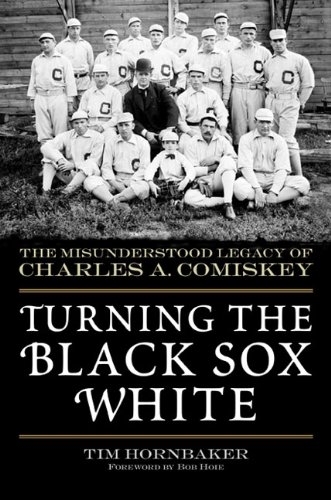
From the first charges of a fix of the 1919 World Series by sportswriter Hugh Fullerton to the publication of Tim Hornbaker's Turning the Black Sox White in 2014, there has been a continuing fascination with The Black Sox Scandal. Gallons of ink were consumed in the initial reporting up through the post-trial banning of the players. Then the Fix entered the literary world courtesy of F. Scott Fitzgerald and from there into multiple iterations of history, literature and film.
The fascination with the scandal has never died and indeed it has spread across the globe. Ten years ago I was contacted by a radio sports journalist in Australia to talk about the Black Sox in the wake of a Rugby scandal that was rocking Aussie sport.
As with so many attempts at understanding historical events or specific human motivation, the arrival at an approximation of truth has proven to be elusive. In an odd sort of way the more that is known and the more that is written, the further we get from historical understanding. In addition much of the writing has been devoid of any attempt at objectivity as storytellers, polemicists, and historians have a point of view that shapes what they see and what they tell.
These genres are now represented in a mountain of literature and we seem no closer to the truth than ever about even the basic facts of the scandal. Dan Nathan has done an excellent job of examining this phenomenon in Saying It's So.
Into this crowded elevator steps Tom Hornbaker to set the record straight, to right some wrongs, or to provide corrections to the historical record. The focus of his attention is Charles Comiskey, Chicago White Sox owner, baseball entrepreneur, and revered citizen of the city of Chicago. He was called "The Old Roman."
Hornbaker goes back through Comiskey's life and baseball career. These early chapters they tell the story of Comiskey as a player, then a manager, a general manager, and an owner. Although there were ups and downs at each level it is clear that "The Old Roman" was a success at every level of the game. His many years in baseball were in part a family affair as his father and sons played various roles in the business.
Comiskey's story is an Alger tale of the son of an immigrant who rose up the social ladder to a high rung in Chicago's establishment. He was a promoter of the National Pastime on a worldwide scale as well as at home. The first two-thirds of the book are full of the details of Comiskey's baseball and private life and offer a feel for the texture of late 19th and early 20th century baseball as well as life in America.
In the end however the main thrust of Turning the Black Sox White is to rehabilitate the reputation of Charles Comiskey, a reputation that suffered from the verdict of the modern chroniclers of the scandal. This group composed of historians, writers of fiction, and filmmakers, says Hornbaker, was influenced by Eliot Asinof who Hornbaker sees as the source of Comiskey's damaged reputation.
In these modern accounts Comiskey is disparaged as a cheap, tight, skin-flint of an owner who treated his players poorly, exploited their labor for little return, and who did his best to suppress any information on the fix to protect his investment in the White Sox. Throughout Hornbaker lays the groundwork to demonstrate that Comiskey was none of these, but rather was a caring, honest, family man of integrity. In nearly every case of controversy or circumstance that might reflect poorly on Comiskey, Hornbaker chooses to read events to Comiskey's advantage.
Despite this tendency Hornbaker convinced me that Comiskey's negative reputation is not deserved. He was no worse than many involved in this sordid affair, and better than some. As to his treatment of his players, Hornbaker offers sufficient evidence to rehabilitate Comiskey on that count.
I am not ready to nominate Charles Comiskey for high honors at the Vatican, but I do appreciate the corrective balance that Hornbaker offers. At the same time I am not certain that he has taken us any closer to an understanding of the scandal in terms of either what or why.
If you are not a fan of game stories and pennant race summaries you will not find this book easy going. At the same time if you do there are interesting tales of the ebb and flow of the fortunes of Comiskey's life, his teams, his league, and his relationship with Ban Johnson.
If you are a connoisseur of The Black Sox Scandal you will no doubt find many points on which to differ with Hornbaker, both in fact and interpretation. What you will also find is that if you are going to treat this subject seriously, you will have to contend with the version of reality presented by Tim Hornbaker in Turning the Black Sox White.
Turning the Black Sox White: The Misunderstood Legacy of Charles A. Comiskey. By Tom Hornbaker. New York: Sports Publishing, 2014. 368 pages. $24.95 (Hardcover).
Copyright © 2014 by Richard C. Crepeau