two good rounds superstars
Reviewed by James R. Holzmeister, Auburn University
28 april 2014 archive
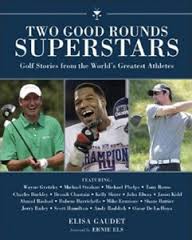
If the first two volumes of the Two Good Rounds series of coffee-table books are any indication, author Elisa Gaudet has apparently stumbled on a successful formula: hold a series of banal interviews with notable personalities on topics loosely related to the sport of golf, tastefully present their answers with numerous color photos in an attractively bound volume, and sell it for $19.95. Volume One in the series, Nineteenth Hole Stories from the World's Greatest Golfers, focused its efforts on a cadre of past and present tour professionals and was successful enough (presumably) to warrant the second volume and its efforts to take on the same process with figures from other realms of sporting endeavor. Destined for living rooms and waiting rooms across America, Superstars: Golf Stories from the World's Greatest Athletes might indeed have little value outside of lightly filling a few awkward minutes before a root canal or dinner at your in-laws. That could be the case. If one considers the work on a slightly deeper level, however, it is perhaps possible to see some redeeming qualities and within those qualities a few intriguing questions certainly emerge from the work. Perhaps these brief lights will suffice to extricate Two Good Rounds Superstars: Golf Stories from the World's Greatest Athletes from the dustbin of post-modern publishing. Only time will tell.
In the longest passages of sustained writing in the work, Elisa Gaudet and tour professional Ernie Els utilize dual introductions to make an impassioned plea for the significance of Two Good Rounds Superstars. From the work's diverse set of athletes, Gaudet claims their shared affinity for golf demonstrates the sport's ability to "excite, inspire, and unite people" from all backgrounds (xiii). The work's international flavor – featuring athletes from popular U.S. and diverse world sports including surfing, cricket, rugby, as well as the usual list of suspects – lends some credence to the author's assertions and some points of interest for the casual reader while at the same time asserting that golf, in and of itself, is truly a world sport. Additionally, Gaudet attempts to argue that Two Good Rounds Superstars' diversity demonstrates golf's claim as a great athletic equalizer, a game that might be played equally well by individuals with drastically different physical profiles and abilities. While this may indeed be true, Gaudet does seem to ignore the obvious contradiction her work represents to this line of argument. It does perhaps help to support the claim that golf can be very effectively played later in life but little beyond that. Every player featured within the book is a world-class athlete after all. Perhaps the most audacious and least supported of Gaudet's claims is that of work's timeless nuggets of wisdom dispensed through one word or one sentence answers to questions such as "[d]ream foursome" and "[f]avorite 19th hole drink." Serious readers are going to have to work hard to find credibility in Ernie Els' assertion that the work presents questions and answers that get "to the heart of [an individual's love for] the game of golf" (ix). The content simply isn't there.
The body of Two Good Rounds Superstars is divided into two or three page chapters devoted to each sporting personality – recording the responses to interview questions and pairing them with full page color photos of the athlete engaged in golf. As one would imagine, the responses to Gaudet's questions range in quality from simple, one-word utterances to slightly longer and more thoughtful exposition. Despite the professional layout and all of the photos, the pages still feel very empty. There are some pithy comments here and there as well as the expected clichés. Viewed individually there is little substance to be found within the vast majority of the answers. When viewed in aggregate however, answers to questions such as "[what is your] one life tip?" and "[how were you introduced] to golf?" do begin to show some intriguing similarities. Due to the consistent length and layout of the chapters and the regular insertion of full color images, it is almost possible to view answers to specific questions flip-book fashion and thereby view the repetition of prose as one moves through various personalities. The visual similarity shared by so many responses is striking, as is their similarity of content. Given the increasing media savvy of the professional athlete, this consistency and the veracity of the narrative provide an intriguing line of inquiry. Regardless of where it comes from or its relationship to reality, the narrative of success – dedication, overcoming failure, persistence – predicated within the volume comes through loud and clear. Let us not forget that this is not simply a success measured on the field of play, but often in the economic game as well. For better or worse, what these people say when it comes to how we achieve success in contemporary culture matters. Knowing the narrative is part of the process when it comes to understanding sport and its social significance.
And perhaps Elisa Gaudet has herself used this narrative to find her own brand of success in the works that bear not only her title, Two Good Rounds, but also the attitude she has sought to instill in her wider enterprises in the golf industry. One needs look no further than the brand's logo – two golf clubs crossed over a martini glass – to ascertain the culture of sport Gaudet's work represents. Focusing much more on the affluent side of golf – $16000 pro-ams, exclusive clubs, travel to exotic destinations, boutique resorts, and mojitos (or Diet Cokes) on the veranda – Gaudet's vision of golf is not meant to inspire grassroots participation but rather culture's fetishistic coveting of the affluence and leisure that have often been associated with the sport. Within golf's current economic climate, a climate that has seen a consistently shrinking base of participation and the annual closure of scores of courses over the past ten years, this focus seems just a bit out of touch. I wouldn't, however, be surprised if she sells two hundred thousand copies.
Gaudet, Elisa. Two Good Rounds Superstars: Golf Stories from the World’s Greatest Athletes. Skyhorse Publishing: New York. 2013. 225 p. $19.95
Copyright © 2014 by James R. Holzmeister