hoop crazy
Reviewed by Myles Schrag, M.S., Human Kinetics Publishers
23 april 2014 archive
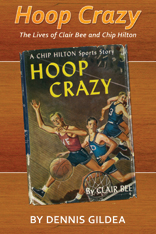
Question: What sports figure that has not been featured in a book-length biography is most in need of that treatment? There are lots of considerations to make when answering that question. Is his or her life story compelling enough? Controversial enough? Were they successful? Innovative? Did they leave a legacy? And is that legacy complete or still evolving?
By virtually any measure, Clair Bee was long overdue to have a comprehensive exploration of his life recorded. Thankfully, Dennis Gildea has righted that wrong in Hoop Crazy: The Lives of Clair Bee and Chip Hilton. Thirty-one years have passed since Bee's death, and 63 have gone by since the defining stain on his exemplary coaching career. Yet, a parade of deserving and not so deserving individuals have been deemed worthy of one (or multiple) biographies while Bee's rags-to-riches and fall from grace story have been relegated to articles, sections, and chapters – mere scraps – of larger works about gambling in sport, juvenile sports fiction, college basketball history, and basketball coaching.
Gildea clearly has read all of those scraps. He lets us know precisely where he stands in a stirring introduction and first chapter. He knows almost every reader will choose to enter Bee's journey because they want the dirt on the earth-shattering 1951 New York City college basketball scandal in which Bee found himself on the firing line. Gildea's tone is clear that the book may be considered a quasi-Saving Mr. Bee piece. But he may sell himself short here. If Gildea provides Bee redemption through a re-reading of the post-scandal Chip Hilton books, he performs a greater service by reminding us that Bee's life was far more than the scandal and his fictional All-American.
This reviewer knew of Bee first as the ambitious coach of the ill-fated Long Island University squad that had eight players indicted for "dumping" games in the scandal that ensnared many teams in Gotham; secondly as the author of the beloved Chip Hilton books that were a generation ahead of my reading years; and thirdly as an "innovative coach," an overused term that in Bee's case is entirely accurate and maybe even an understatement. Other readers may place those accomplishments in a different order, but I suspect almost all readers will be forced to admit they had underestimated Bee's contributions to coaching and sport.
By the end of Hoop Crazy, I was shocked at how much I had missed about this hardscrabble West Virginian before Gildea re-introduced me to him. Bee's street smarts, work ethic, and inquisitive mind had him making an impact quickly everywhere he went, until at a nearly brand-new school, LIU, he was able to build a juggernaut capable of battling the larger, tradition-rich schools both in the city and around the country during the 1930s and 1940s. Along the way, he also took a stand against the 1936 Berlin Olympics by boycotting the Olympic Trials basketball tournament with his LIU Blackbirds. He took stands against racism; most notably on behalf of African-American star Dolly King in 1938, but also mere weeks before the 1951 scandal broke on a road trip to Tucson, Ariz.
His innovations run the gamut, and show his fertile mind. He is generally credited with inventing the 1-3-1 zone defense long before his LIU days. Perhaps not as well known is that he hated zones, but knew he needed to use it when his personnel dictated it. He was among the few coaches who forayed into sport psychology as early as the 1930s, and he was an early advocate for the three-second rule. When the jump ball after each basket was done away with in 1936, Bee strongly opposed it by saying the game would be too fast for the tall players. But when it became the rule of the land, he adapted and actually began recruiting inside players more aggressively.
Gildea does a masterful job at a difficult task – he doesn't let Chip overwhelm what the facts show nor his analysis of the causes, effects, and mitigating factors in Bee's life. While he sets up the book by suggesting he will be making comparisons between Bee the coach and Bee the writer throughout the book, he doesn't sink into psycho-babble explanations of what the books mean. He refers to them sparingly, at least until near the end of the book, Chapter 17: Chip and the Scandal, where the chapter title cues us that he is going to pursue his thesis head-on. Though Gildea is not always convincing as he explains the essential differences between the pre- and post-scandal Chip books, he does poke legitimate holes in the Bee-is-a-hypocrite certainty of Murray Sperber and other adamant critics. By so doing, Gildea admirably performs the vital biographer's role of requiring the reader to reassess what he or she holds to be true about the subject.
In truth, Gildea doesn't have to wow us in chapter 17. He has referenced Chip throughout the book, always in connection to other relevant events that inspired a plotline or a character, and sometimes providing us minutiae and speculation with a wink that is simply fun. Is Chip's uniform #44 a reference to LIU's 44-32 victory over Loyola of Chicago in the 1939 NIT championship? Is the moniker of Chip's teammate and buddy Soapy Smith homage to the soap-and-ladder practice session that prepared his Blackbirds for Loyola's giant Mike Novak?
Given the visual possibilities of the Chip Hilton books, it would have been fun to see more reproductions of the books in the series (though an Appendix with synopses of all 23 Chip Hilton books from 1948-1966, plus the posthumous 2002 title Fiery Fullback, is a nice touch). No one can quibble with Gildea's extensive research, which spans primary documents, and interviews with Bee's former players, colleagues, and friends, as well as thorough readings of the Chip books. Bobby Knight's reminiscences from various sources about his mentor, including Bee's role during Indiana's historic 1976 undefeated season, are a touching closing to the book. Jack McCallum's well-received 1980 Sports Illustrated article about Bee and Chip Hilton is also used effectively as a device to let readers know they are not alone in loving Chip and also in perhaps not knowing the depth of influence that Chip's creator left.
The University of Arkansas Press is to be commended for publishing this important biography of one of the great American sporting lives of the 20th century. Gildea's service here is no small thing. Scandals in college sports have not gone away, though the landscape has changed considerably. Amazingly, Bee wrote a regular newspaper column and even made his picks on other games around the country during the season when the scandal broke. Reading the quotes from sportswriters in the 1950s and Bee's defense of himself, his school, and his profession show just how much attitudes have changed about what college sports is, what it purports to be, and what its role should be. A case in point is Bee's newspaper article titled, "I Know Why They Sold Out to the Gamblers" written months after the arrests. Look at the alleged problems in college sports:
Acknowledging "For the first time in my life, I'm looking at amateur sport from the proper perspective," Bee listed three key points he would stress: an overemphasis on winning; turning amateur sport into a business; and neglecting the educational value of competitive sport. Contemporary intercollegiate sports, Bee asserted, were plagued by four abuses: "recruiting by offering athletes (1) scholarships, (2) cash subsidies, (3) guaranteed passing grades in the classroom, and (4) overemphasizing the importance of sports with extended trips, long schedules, year-round practices, preseason games and regular appearances in off-campus arenas" (page 251).
While no one is condoning players betting on contests in which they participate, it is worth looking at what was considered significant reform in the mid-20th century and how little attention was paid to it. We would do well to compare our era to earlier ones. The NCAA is defending itself on many fronts, whether the recent ruling to allow Northwestern football players to unionize, the upcoming Ed O'Bannon lawsuit that is set to come to trial this summer, or the complaints levied about coaching salaries, BCS football, or one-and-done basketball players on a nearly daily basis. Chip's world was an idealized one; Bee's was one of contradictions. Both are worth evaluating to decide what we want ours to be in 2014.
Hoop Crazy: The Lives of Clair Bee and Chip Hilton, Dennis Gildea. Fayetteville, AR: University of Arkansas Press, 2013. Hardback $34.95. 402 pp. ISBN: 978-155728-641-3.
Copyright © 2014 by Myles Schrag