sport and the shaping of italian-american identity
Reviewed by Frank P. Fury
22 april 2014 archive
My father never got to see Joe DiMaggio play baseball. Maybe that was reason enough to help explain his choice of the sport idol of his youth. Considering he is a lifelong Yankees fan and an Italian-American who grew up in New Jersey in the middle of the twentieth century, you would think his having been 'born at the wrong time' (in Yankees years) would qualify as a minor tragedy. It does not, however, for my father belongs instead to that generation of fans who idolized Mickey Mantle, who, in his appearance, his upbringing and his life narrative was about as American (read: non-ethnic) as it gets. Whereas my first-generation father would always pridefully point out to me the Italian heritage of athletes, actors, politicians and other cultural figures of prominence, the Mantle-DiMaggio dichotomy as framed in my father's childhood—i.e. choosing the non-ethnic hero over the ethnic one—was one that demonstrated for me the formative nature of selecting one's childhood heroes—specifically one's sporting heroes—at an early age. Perhaps in my father's generation (born in 1949, much more "American" and assimilated than his father was) there was less of a need to identify with or put one's sporting faith into a figure of similar nationality or ethnic background. But questions remain: why should ethnicity matter when one chooses one's sports heroes? Or should it matter at all? More to the point of this article, how and why have Italian-Americans acted as sport heroes for our country's youth? And in what ways have Italian-Americans impacted our sporting culture in the United States and in what ways have they symbolized for younger generations the promise of success and achievement in the 20th and 21st centuries?
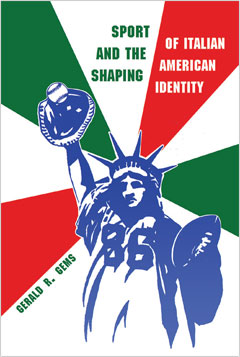
In his book Sport and the Shaping of Italian-American Identity, Gerald R. Gems seeks answers to these questions and more. Gems has produced a comprehensive vision of Italian-Americans' historical place in (but more often out) of the mainstream of American society, and he does it specifically through the lens of their participation in American sport. His early chapters outline how the first-wave Italian immigrants of the very late 19th and early 20th centuries had no time for leisure activities; whereas a number of other immigrant groups came to America with hopes for full integration and assimilation into mainstream American culture, many Italians—for various reasons ranging from language barriers to unique conceptions of family loyalty, personal honor and work ethic—came to this country with the expectation that eventually they would return to their homeland once they made enough money. Even for those who did not hold this more temporary outlook, assimilation was either unwanted or too difficult to attain, as Italian immigrants—because of their darker complexions—often encountered prejudices vis-à-vis the WASP culture in the US. Gems devotes whole chapters to outlining and providing detailed examples of the immigrant experience for Italians, demonstrating that first and second generations increasingly sought assimilation—to be not just "Italian" but preferentially "Italian Americans."
Gems sees a unique and profoundly divisive complex in this "hyphenated" existence that Italians and Italian Americans have suffered through historically in this country. His specific argument in Sport and the Shaping of Italian-American Identity is that sport helped Italian Americans negotiate their "Americanness" and thus assisted in the transition process. Italians—especially Italian males—historically have placed great emphasis on physicality as both a means of demonstrating masculinity, maintaining their honor and fighting for survival. This is one of the reasons, according to Gems, that of all the sports in which Italian-Americans took part in America, boxing became the one that so many of them gravitated toward. Boxing, as Gems has shown himself in earlier of his works and as have many other commentators and scholars of sport history, has in some respects been the sine qua non of American sports in crystallizing the uniquely American belief in rugged individualism and meritocracy. To this end, Gems spends more time in this book discussing famous boxing figures—from Primo Carnera to Jake LaMotta; from Rocky Graziano to Rocky Marciano—than those from any other sport.
Gems' study of the evolution of Italian-American identity vis-à-vis Italian-Americans' participation in sporting pastimes in the US is not only well-written and structured but also excellently researched. The range of his research is indeed truly impressive, balancing contemporary news reports of sporting events from local newspapers such as the Logansport Indiana Pharos-Tribute and the Chicago Tribune to more modern theoretical discussions of ethnicity, race, culture and sport in scholarly journals such as International Migration Review and International Review for the Sociology of Sport. The full-length works Gems cites represent an edifying assortment of texts that feature, for example, biographies of Italian-American figures (e.g. Richard Ben Cramer's Joe DiMaggio: The Hero's Life); the history of sport or a particular history of an individual sport (e.g. Arne K. Lang's Prizefighting: An American History); aspects of 19th and 20th century popular life and popular culture (e.g. Perry Duis's The Saloon: Public Drinking in Chicago and Boston: 1880-1920); and of course the specific experience of the Italian American living in the United States (e.g. Humbert Nelli's From Immigrant to Ethnics: The Italian Americans).
While Gems' research is impeccable and his argument sound and extraordinarily well-detailed via historical examples, the book is not without its potential pitfalls. I use the term "potential" because these are only pitfalls if the reader were to come to this book with certain expectations. For instance, one should be wary of the "and" in Gems' title, "Sport and the Shaping of Italian-American Identity." That is, Gems is so thorough and meticulous in his survey of the evolution of what it has meant to be called "Italian-American" from a broadly cultural standpoint that at times such investigation comes ironically at the expense of his discussion of sport. As an example, Gems devotes two pages in his final chapter to Lady Gaga's impact on 21st century popular culture, pointing out as he does the extent to which she defines herself as an Italian-American. Thus, in this manner, sport becomes bound up in a more generally defined cultural studies approach to understanding Italian-American ethnic identity. Sport is always foregrounded, but Gems is careful to situate it as a pastime alongside a number of other leisure activities and popular entertainment outlets.
Moreover, if one comes to this book with the expectation that the most famous Italian-American sports heroes—namely Vince Lombardi, Rocky Marciano, and the aforementioned DiMaggio—deserve more attention than the rest of the mere mortals in the pantheon of Italian-American sports figures, one would be missing the point that Gems is trying to make. There are any number of biographies or critical studies of Lombardi's, Marciano's and certainly DiMaggio's impact on American sport history—and, in the case of DiMaggio, his impact on American cultural history—and some of them even discuss these men's ethnic heritage. In Sport and the Shaping of Italian-American Identity, these three men collectively are given only twenty or so pages of the 217 chapter pages in the book; such economy is in keeping with Gems' methodology throughout the study, which is to see Italian and Italian-American individuals as constitutive of the fabric of a unique ethnic identity in American culture. In Gems' analysis, each historical individual cited—whether s/he is an athlete or not—makes a contribution, however small, to the mosaic of Italian-American identity in the United States. Theirs is a contested identity, to be sure, and Gems pays tribute to the struggles Italian immigrants and their descendants faced in assimilating to the American mainstream in this meticulously constructed book. The value of Gems' book is that it can teach its reader so much on so many different levels, from learning about the plight of Italian-Americans in the United States to the vicissitudes of popular culture and ultimately sport's participation in both. Ultimately though for members of this listserv, this book is an enriching study of how sport has shaped and continues to shape our understanding of our lives and of both our individual and communal identities.
Gems, Gerald R. Sport and the Shaping of Italian-American Identity. Syracuse, NY: Syracuse UP, 2013. 312 pgs. 8 chapters, 2 appendices, notes, bibliography and index. $45.00.
Copyright © 2014 by Frank P. Fury