¡Arriba Baseball!
Reviewed by Scott D. Peterson, Wright State University
7 march 2014 archive
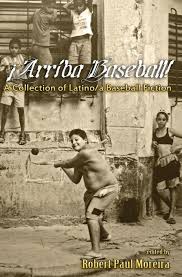
Sports writers and league owners continue to work to keep their industry as non-political as possible, claiming that, among other things, "it should be about the game." Students and scholars of sport culture and writers of sport fiction, including many of the authors included among the selections of ¡Arriba Baseball! know otherwise. The collection fills a gap in baseball literature and gives voice to Latino perspectives long unheard and unheeded. Conveniently—or by design—the pieces fall into three categories: poetry, players & managers, and fans. All three evoke the Latino/a experience of the game while simultaneously highlighting the universals of baseball that cut across histories and cultures.
Although only one contribution has the usual shape of poetry, three other brief selections take the form of prose poetry; together, these four selections provide counterpoint to the fiction. Vidaurre's "Down the Line" invokes the experience of growing up in the shadow of Chavez Ravine in Los Angeles during the era of Fernando Valenzuela—and the politically charged issue of veteranos, local Mexican Americans displaced by the home of the Dodgers. Romo's "Reflections of a High School Benchwarmer" is true on several levels without making reference to real players or teams and is reminiscent of Dybek's "Death of the Right Fielder." The piece by the collection's editor, Moreira, is a prose poem about two Latina ball players that brings gender and ethnicity issues into the mix. Finally, Saldaña's "One Inning at a Time till Nine" is a series of linked poems that demonstrate how baseball becomes engrained in the lives of young players and fans.
Six selections fall into the player/manager category and serve the sport fiction function of providing insight to the inner workings of the game, thus miming the role of sport journalists and biographers. Three of these stories follow the "family drama" model of contemporary MFA writing workshop fiction. Lane's "Baseball over the Moon" and Rice's "Tomboy Forgiveness" provide feminine perspectives on growing up with the game and parental conflicts, while de la Cruz's "The Heat" treats the under-examined world of church softball. The other three stories of this type are more in keeping with baseball fiction's writerly and literary functions. Rapp's "Chasing Chato" is reminiscent of the Sporting Life fiction of the early twentieth century that attested to how a young man could find his way in society by following the Horatio Alger method outlined in the second half of the nineteenth century. Denis's "Juan Bobo" is an absurdist piece that earns some laughs with allusions to Ayn Rand and The Natural. Fans of baseball history might be surprised when Cava's "The Noble Roman" offers a twist to the Roberto Clemente story.
The third set of selections offers insights to the meanings found by fans of the game. Four of the five return to the family drama motif and are balanced with regard to gender. Cantú's "Los Tecolotes" relates the baseball dreams of a female fan, while Hidalgo's "So Much for the Cubs" focuses on the relationship of a Latina fan and her father during a game at Wrigley Field (thus making it a counterpoint to Brewer's father & son story, "Ecstasy in Comiskey Park"). "Uncle Rock" by Gilb dramatizes the choice made by a young boy of a single mother, while Granados's "Good Father" portrays the many levels of a conversation between parents of Little League Players. González's "Ritualidades" involves the mojo machinations of the "It's-only-weird-if-it-doesn't-work" fan found in beer commercials and makes reference to the 1981 playoff showdown between Nolan Ryan and Fernando Valenzuela.
Confirmed by the foregoing paragraphs, the quality of the collection is consistently strong and balanced while addressing significant issues of ethnicity, gender, and politics without losing sight of what the game means to players and fans. As Peter C. Bjarkman notes in his foreward to the collection, baseball reflects on American culture with an indirect and opaque light; readers of ¡Arriba Baseball!—especially students in a sport lit class—will come away with a more complete sense of the game's larger social role and cultural contributions.
¡Arriba Baseball!: A Collection of Latino/a Baseball Fiction. Edited by Robert Paul Moreira. Donna, TX: VAO Publishing, 2013.
Copyright © 2014 by Scott D. Peterson