game changers
Reviewed by Matthew Teutsch, Louisiana State University, Lafayette
10 january 2014 archive
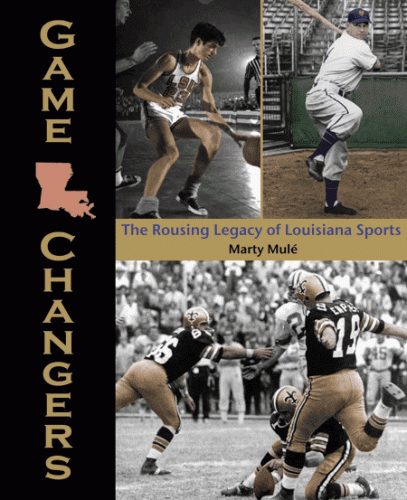
Louisiana is known a "Sportsman's Paradise," and Marty Mulé's Game Changers: The Rousing Legacy of Louisiana Sports looks to add credence to the state's appellation. Just like a tree full of beads after Mardi Gras, Mulé peppers Game Changers with little known facts about sports in Louisiana, covering everything from Louisiana's quasi-religion football to track and field. Mulé's book provides two to four pages on each topic and is filled with photographs capturing the essence of the topics discussed.
Throughout, Mulé displays how much athletes from Louisiana or who spent time in the state have had a hand in some of the most memorable moments in American sports. For instance, did you know that Chris Cagle from Merryville, Louisiana, had the opportunity to alter history by beating Notre Dame in the November 10, 1928 game where Knute Rockne gave his famous "Win one for the Gipper" speech? Cagle, who played four years at Southwestern Louisiana Institute (now UL Lafayette), played four more years at West Point. During the 1928 game against Notre Dame, Cagle threw for one touchdown and while down 12-6 returned a kickoff for fifty-five yards in the final minutes. However, after playing the entire game on both sides of the ball, Cagle collapsed and had to be carried off of the field. The Cadets failed to punch the ball in from the one yard line and ultimately lost the game 12-6. If Cagle could have finished his performance, history might have been different. Even without this game, Cagle became recognized as an outstanding football player and entered the College Football Hall of Fame in 1954.
Along with Cagle's exploits, Mulé notes that Mel Ott, from Gretna, Louisiana, not only surpassed Babe Ruth, Willie Mays, and Mike Schmidt in career hits but that Leo Durocher's famous quote about nice guys finishing last was aimed at him. Later, Durocher commented "[t]hat [Ott] was the nicest guy to ever put on a shoe." Another Louisianaian, Bob Didier, played a major role in Kirk Gibson's dramatic 1988 World Series home run against Dennis Eckersley. A scout for the Los Angeles Dodgers, Didier informed Gibson that if Eckersley got Gibson into a 3-2 count he'd throw a backdoor slider. Gibson remembered the information and used it to his advantage, taking Eckersley over the wall and securing a 5-4 win for the Dodgers in Game 1.
On top of these and other links to memorable moments in America's sports landscape, Mulé presents the improbable statistics concerning the number of well known athletes who have come from Louisiana. Through Super Bowl XLVIII, twelve quarterbacks from Louisiana have started the big game. While that may not seem like a lot, Mulé puts it into perspective. The twelve starts constitute 26 percent of all Super Bowls. Considering that Louisiana only has a population of 4.5 million people compared to the only two states that can claim a higher percentage of starting quarterbacks in the Super Bowl (California and Pennsylvania), Louisiana appears to be an anomaly. However, Mulé also notes that when the NBA celebrated its fiftieth anniversary in 1996 and named its fifty greatest players during that period seven players (14 percent) hailed from Louisiana. Only New York, with a population of 15 million people could claim more—eight.
These anecdotes only scratch the surface of what Mulé includes in Game Changers. Close to half of the book focuses on football, ranging from topics such as the 1908 LSU football team which put up 442 points and only gave up 11 in 10 games to sports journalist Collie J. Nicholson's role in constructing the national image of Eddie Robinson and Grambling State University. Mulé's section covers everything from Lou Brock to Ted Lyons, who pitched 356 complete games out of 484 in his career (73.6 percent); unfortunately, this section leaves out a discussion of the Evangeline League. In basketball, Mulé highlights the exploits of "Pistol" Pete Maravich, Karl Malone, Shaquille O'Neal, and Willis Reed along with the overwhelming dominance of the Baskin High School girls' basketball team which won 218 consecutive games from 1947 through 1953. Not to be overlooked, Mulé concludes the book with small sections of boxing, horse racing, tennis, golf, and track and field in Louisiana before culminating with the Lagniappe (which means "a little extra") section. Here, Mulé covers how the universities in Louisiana received their nicknames, how New Orleans' Jesuit High School picked up four state championships in four different sports in 1946, and Claude Hamilton "Grits" Gresham Jr.'s representation of Louisiana as "The Sportsman's Paradise" to the world.
Overall, Game Changers serves as an eye-opening book that acknowledges the lasting impact of Louisiana on the national sports' landscape. While presented as a book that can be taken in small chunks, Mulé provides readers with a starting point for further research into many fascinating aspects of sports in Louisiana and the world.
Game Changers: The Rousing Legacy of Louisiana Sports. By. Marty Mulé. Lafayette: University of Louisiana at Lafayette Press, 2013. 214 pages. $39.95. (Hardback).
Copyright © 2014 by Matthew Teutsch