mr wrigley's ball club
Reviewed by Mark Noe, Pennsylvania College of Technology
10 january 2014 archive
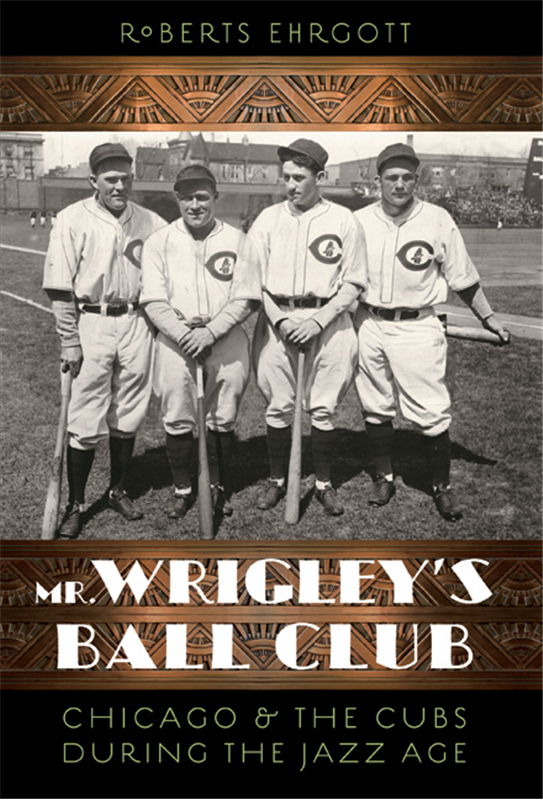
It took the Cubs fifty years in the National League before they finished in last place. That was in 1925. They've spent most of another century perfecting that ability. In this impressive study of the Chicago Cubs from the mid-Twenties to the mid-Thirties, Roberts Ehrgott describes that initial last-place finish, though his focus is on the rapid resurrection of the team. Okay, "resurrection" is the wrong word, I know, as last place is merely the bottom, not death. But after a lifetime of Cub-fan-dom, and after a season that saw at its tail end three champagne celebrations in five days by teams closing out playoff spots in wins against the Cubs, "resurrection" seems to fit far too well to this Cub fan. "Death" and "the bottom" seem awfully close. In contrast, those Jazz Age Cubbies actually did some serious winning in the years immediately after that 1925 finish. The circumstances surrounding those wins were defined by a fascinating milieu—not steroids and inter-league play but other, equally interesting, phenomena.
There were individual stars. Hack Wilson is at the center of Ehrgott's story, with all the pre-Hack and post-Hack coverage anticipatory or reflective. Clearly, there were a few years when Wilson gave The Babe a run for his money, both for individual records and for notoriety. Kiki Cuyler was a superb ballplayer, just in the shadow of Wilson. The greatness of pitcher Charlie Root is palpable through the narrative, Ruth's called home run off him in 1932 notwithstanding. The bad-boy qualities and the impressive abilities of talented Pat Malone both get their space. Charlie Grimm, Riggs Stephenson, Billy Herman, and Gabby Hartnett all get their due. So does one of the first Latin players, the fine Cuban catcher Miguel Angel "Mike" Gonzalez. Among pitchers, the unfortunate Hal Carlson—gassed in combat in the Argonne in 1918, but not so well-known as Christy Mathewson, as Carlson had only a year of major league ball under his belt when he went to war—who was leading the team staff before dying suddenly, just a month into the 1930 season, does as well, along with Guy Bush, Grover Cleveland Alexander, Burleigh Grimes, and, later, Lon Warneke.
There were intense managers. Joe McCarthy led them out of the basement in 1926 and to a championship in 1929. Four games from winning the championship of the 1930 season, he was replaced—in what had to be one of the strangest managerial replacements in major league history—by one of his players, Rogers Hornsby. The next championship season, 1932, saw the Rajah replaced mid-season by one of his players, Charlie Grimm. Don't think today's owners have a monopoly on awkward staff shifts.
There was Al Capone. Gabby Hartnett was roundly criticized in the press when, at a White Sox-Cubs benefit game in 1931, he was photographed chatting with Capone, after having signed a baseball for little Sonny Capone, seated in a front-row box. Two years before, on Valentine's Day 1929, a train bearing many of the Cubs left Dearborn Street Station, heading for Bill Wrigley's hotel on Catalina Island, off the coast of California, to begin spring training. As they boarded the train, word was that there had been a massacre that morning in a garage halfway from the Loop to Wrigley Field, a move already rumored to have involved Capone, against some of his opposition. Jazz Age, indeed.
There are a variety of other notable topics. The stories centering on Bill Wrigley's use of his Catalina Island facilities to let players get back in shape after a long winter are legion. It was Wrigley, aided and abetted by club president Bill Veeck, who did much to popularize the then-novel concept of Ladies' Day at the ballpark. Bill Wrigley's death, and his replacement by son Philip (P. K.), less interested and less hands-on, set a tone for the decades that followed. The mid-season shooting of the fine young infielder Billy Jurges by his girlfriend—prefiguring the similar incident involving Eddie Waitkus nearly twenty years later—came in the midst of the Cubs' 1932 championship run. The story of White Sox player-manager Lew Fonseca—fondly remembered by Cub fans of my age as a wiry septuagenarian batting coach during the 1970s—being part of a mob beating an umpire in a dugout runway in early 1932, thereby taking Chicago headlines away from the Cubs, was totally unexpected. Technology comes into play in 1925, as radio evolves from an occasional mid-game report by whatever reporter happened to be on duty at a station to play-by-play presented by dedicated broadcasters. Stations competed, too: mainstay WGN was only one among many broadcasting the Cubs during those early years. Even the genesis of the Andy Frain ushers (a contingent notably absent when I attended a game this past summer, after not having visited Wrigley Field for a couple of decades) gets its own story line here. Ehrgott relates a multitude of other stories, from the trivial to the arcane, and the occasionally earth-shattering (at least in baseball terms), at points in his narrative, some of them intrigues of which even this well-indoctrinated and long-suffering Cub fan of (what's getting to be) long years proved to be blissfully unaware.
The book may have its minor flaws. I never did see a fully consistent organizational pattern: though it is substantially chronological, the narrative frequently involves instances of two-steps-forward, one-step-back movement. The prose is at times less than scintillating, but it is generally clear. But Ehrgott's research into contemporary sources is extensive and impressive. He studied in minute detail newspaper accounts covering the progress of about ten seasons. And I—a fan who believed he knew baseball, knew the Cubs, knew even the Cubs of the Twenties and the Thirties—gained a far more nuanced picture of the time and of the team from this detailed study. Perhaps, of course, the most important thing the book shows is that a north-side Chicago baseball team could actually make the climb from last place to first in a matter of only a couple of short seasons. For that alone, the book is energizing, intoxicating. It has happened. Thus, at least in the world of possibility, it could again. Hack Wilson, where are you?
Ehrgott, Roberts. Mr. Wrigley's Ball Club: Chicago and the Cubs During the Jazz Age. Lincoln: U Nebraska P, 2013. 485 pp., illus. $34.95.
Copyright © 2014 by Mark Noe