out of the bunker and into the trees
Reviewed by James Holzmeister, Auburn University
21 november 2013 archive
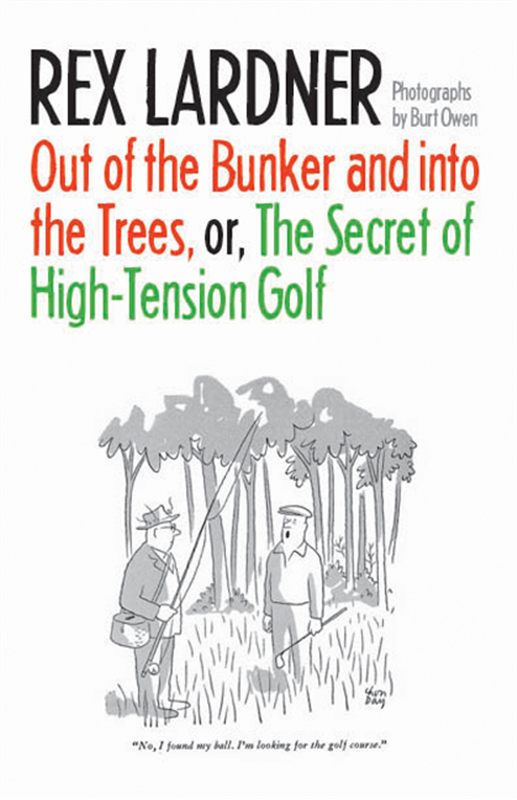
Although Rex Lardner's preference for the tennis court over the practice green might at times become evident in his farcical golf instruction book Out of the Bunker and into the Trees, or The Secret of High Tension Golf (1960), it is clear that the hours he undoubtedly spent hanging about Long Island country clubs served to cultivate a passable knowledge of golf's amateur culture. The true strength of Out of the Bunker lies in Lardner's ability to intimately connect with the collective experience of the millions of individuals who play this most preposterous and engrossing of games. His descriptions of wildly hooking drives, tense conversations with Pepito, his trusty looper, over which club to pull for that tricky sixth stroke, and pithy swing advice – such as: "[t]he object of the golfer is to smash the ball" – are certain to evoke a rueful chuckle from the seasoned recreational player (79). Lardner's effusive discussions of practice and swing theory, when matched with his scores (generally a collection of nines and elevens), will undoubtedly call to mind a string of ineffectual afternoons at the local muni vainly attempting to apply the latest lesson from Golf Digest. Students of the golf swing will witness familiar images as they marvel at Lardner's stark lack of form through a series of "high-quality" quasi-instructional photographs included in the work. The genuine enjoyment the reader derives from these elements of Out of the Bunker evince not merely Lardner's ability to draw upon the experience shared by those who play golf, but also that quality of the game, its timelessness, that critics so often call upon to explain our wider fascination with sport.
Evoking the classic tomes of mid-twentieth century swing theory such as Ben Hogan's Five Lessons (1957) and Sam Snead's Natural Golf (1953), Lardner's raison d'être in Out of the Bunker lies in the presentation of his "revolutionary" High-Tension method, a theory guaranteed to oppose everything that you have previously been told about the golf swing. Lardner describes how a combination of factors, including the influence of a "malicious" squirrel, led to his theory's foundational epiphany: "[y]ou do not get angry because you hit a bad golf shot: you hit a bad golf shot BECAUSE YOU DO NOT GET ANGRY ENOUGH!" (47). While naysayers might believe the lessons of High Tension golf inaccessible, Lardner assures us that despite his "natural" athletic ability and "terrific reflexes," the precepts of the High Tension swing remain accessible to even the most casual player. Through analogies and expert description, Lardner outlines the basic principles of High Tension golf through a series of chapters focusing on different aspects of the game. Along the way he carefully clears up common points of confusion - such as the critical difference between "tension" and mere "anger": "[w]hen you hit something with your closed fist, like a steel locker, that is anger. When you keep hitting it, after learning better, that is tension" (52). Helpfully, each instructional chapter concludes with a series of negative thoughts - things not to do in the golf swing - that he instructs the player to review while standing over a shot. The High Tension method is predicated on a negative mindset that is best cultivated, in Lardner's opinion, through a basic acknowledgement that far from being an escape from the tensions of everyday life, a golfer actually multiplies his or her problems the moment they set foot on the course.
Although the continuity of golf's culture lends itself to the many genuine strengths within Lardner's Out of the Bunker, the work also reminds us that sport, like any cultural production, occurs within the context of a society that is constantly changing. There are certainly elements in the work that seem dated and others where Lardner is clearly drawing on stereotype rather that intimate cultural knowledge. Out of the Bunker features a number of rather tedious departures from the subject of golf that belie the work's temporal and cultural limitations. His discussions of female golfers, as well as drivers (the vehicular kind), are sure to raise the hackles of modern audiences as they evoke the worst tendencies of mid-century misogyny. As it turns out, driving "in traffic behind a car driven by a woman with a woman companion in the front seat" is indeed one of the most effective ways of developing the tension that Lardner prescribes (88). The culture of golf that Out of the Bunker describes, while universal in some sense, is also highly shaped by the upper middle class culture of the Long Island country clubs which form the backdrop for both his knowledge and presentation of the game. Like the vaudevillian routines of Bert Lahr or the fictional shock comedy of Mad Men's Jimmy Barrett, Lardner's humor has a tendency to fall flat in the context of twenty-first century sensibilities. At times boorish and at others overly forced, not every joke in Out of the Bunker is worth the effort.
Despite its weaknesses, or perhaps because of them, Out of the Bunker is certainly worth a read. For the literary, cultural, or sporting critic, Lardner's work provides insight into a sporting culture that perhaps remains in the privileged haunts of golf's upper crust. Beyond simply lampooning the act of playing the game, Lardner's satirical pen is also focused directly on a mentality that places the difference between a double and triple bogey above all other concerns in life. From the golfer's obsessive myopia to the over-indulgent culture of upper-middle class country club life, Lardner's work describes an image of golf that the modern game has agonizingly tried to combat for over half a century. Out of the Bunker reminds us that sport, for all of its continuity, is still a product of the culture that surrounds it, a reflection of both the best and worst of who we are and what we believe.
Lardner, Rex. Out of the Bunker and into the Trees, Or the Secret of High-Tension Golf. Lincoln, NE: U of Nebraska P, 1960 (reprint 2013), 189 p. $18.95
Copyright © 2013 by James Holzmeister