beyond dimaggio
Reviewed by Amy Essington
30 july 2013 archive
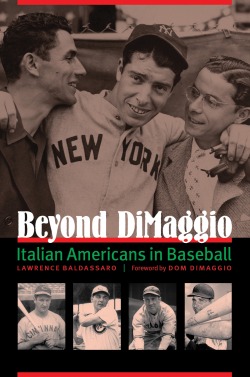
In addition to his work as a professor of Italian, Lawrence Baldassaro previously edited two books about baseball, Ted Williams: Reflections on a Splendid Life and The American Game: Baseball and Ethnicity with Richard A. Johnson. In his first full-length book about baseball, Baldassaro not only catalogs Italian Americans involved in major league baseball, but he connects their story to that of Italian immigrants and Italian Americans in the United States in the late nineteenth and twentieth centuries. This work is a perfect example of how sport in general, and baseball in particular, can be a vehicle for understanding American history and culture.
Baldassaro organizes the book into four sections, Part 1, "The Pioneers," Part 2, "Arrivals, Part 3, "Postwar Boom," Part 4, "Transitional Italians." Each part has four chapters. The material develops chronologically from the first documented Italian American player in major league baseball, Ed Abbaticchio. As more and more Italians immigrated to the United States, their sons looked to baseball as an opportunity to earn a living, something their parents did not understand or support. Italian American baseball players walked a line between their immigrant parents and Americanization. As the first generation of Italian Americans became professional baseball players, they faced the shortening or Anglicizing of their names, newspaper descriptions of "fiery," and the pejorative "wop."
San Francisco played an important role in the history of Italian Americans and baseball. The first professional baseball club in California was organized in San Francisco and the city saw many amateur, semi-professional, and professional teams. The first two generations of Italian Americans became part of the society and culture of the city, more so than in cities in the East, as well as members of the local baseball teams. In addition to Vince, Joe, and Dom DiMaggio, Hall of Famers Tony Lazzeri and Ernie Lombardi hailed from San Francisco. In the 1920s, as Italian Americans joined professional baseball teams, Italian Americans began to find a more visible role in American culture as Nicola Sacco and Bartolomeo Vanzetti, Al Capone, and Rodolfo di Valentina received national and worldwide attention.
In the second part, Baldassaro discusses how the 1930s saw a significant increase in the number of Italian Americans in baseball. In 1934, Baseball Magazine issued its "All-Italian-American Baseball Team." After shifting immigration patterns brought more Southern and Eastern Europeans to the United States, major league baseball saw a change in origins of its players, but Italian Americans still captured people's attention, including the first Italian American Most Valuable Player. Baldassaro illustrates the continued connection of Italian Americans and American society with wartime examples. In 1941, Italian Americans were 6.8% of major league baseball players, many of whom served in the American military during World War II. Some of the players' parents, including Giuseppe DiMaggio, faced travel restrictions during the war, illustrating the country's treatment of resident-aliens. By 1942, with the United States at war in Europe, anti-Italian sentiment found its way on the baseball diamond.
Three teams from New York City, the Dodgers, the Giants, and the Yankees, dominated the post-war period in baseball as described in the third part of the book. Each of the teams had popular players of Italian descent on their rosters, including Cookie Lavagetto, Al Gionfriddo, Joe DiMaggio, Ralph Branca, Billy Martin, and Yogi Berra. By the late 1940s, Joe DiMaggio had reached celebrity status first as a Yankee and then with a marriage to Marilyn Monroe. An Italian American also had an important role in desegregating professional baseball. In 1946, the Brooklyn Dodgers signed Roy Campanella, son of an African American mother and an Italian father. First, desegregating the Class B affiliate in Nashua, New Hampshire, Campanella soon joined Jackie Robinson on the Dodgers.
By the fourth part, in the 1950s, Italian Americans still played on major league teams, but without focus on their ethnic heritage. Italian Americans began to move into coaching and managing positions. The players of the 1960s and 1970s, no longer negotiated the line between traditional ways of immigrant parents and modern American culture. By the 1990s, Italian Americans held executive positions in baseball such as general manager, owner, and even commissioner of baseball.
The book includes an introduction by Dom DiMaggio, an introduction, illustrations, endnotes, a bibliography, and an index. Baldassaro completed more than fifty interviews of people across the spectrum of major league baseball including players, coaches, managers, and executives. While the biographical vignettes are the main focus of Baldassaro, the social and cultural context provide contextualization which rounds out the story of the individuals and a better understanding of the role of Italian Americans in the development of major league baseball as well as American history.
Lawrence Baldassaro. Beyond DiMaggio: Italian Americans in Baseball. Lincoln, NE: University of Nebraska Press, 2011. 520pp. $24.95.
Copyright © 2013 by Amy Essington