children and organised sport
Reviewed by Duncan R. Jamieson, Ashland University
23 April 2012 archive
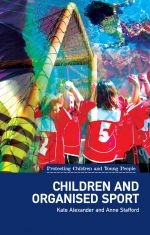
While I never played any organized sports as a child, I do have three children who have played a variety of sports, including soccer, basketball, track, and swimming. While none of them were abused in any of the ways described by Alexander and Stafford—emotional, physical or sexual harm—I have witnessed events related to those in the book, and have been told by others of similar events. When my youngest daughter played on a traveling soccer team (a U-10 and then U-11 team), some of the parents could be verbally abusive. One parent in particular repeatedly yelled "who wants the ball" when she thought the team was not being sufficiently aggressive. After the game this particular parent would publicly belittle and berate her daughter for not playing hard enough, oftentimes saying something to the effect of "why don't you play like so and so, she's so much better than you are." A coach from an opposing team, upset at his team's play, kicked over a bench. While our coach always treated his players with care and respect, we witnessed several instances of verbal abuse by opposing coaches, who often yelled and sometimes screamed at their players when displeased with their play. Though the parents were always on the side of the field opposite from the team and the coaches, it was all too often easy to hear what was being said. Most of us welcomed the "silent Sundays" when fans were instructed to say nothing negative regarding any play.
Through an extensive survey in which they received some 6,000 responses with follow up questionnaires, the authors describe instances of harm or abuse in major youth sports in the United Kingdom. The children engaged in both recreational and competitive sports from the playground level to international competition. The most popular sports studied include football, rugby, swimming, gymnastics, dance, netball, hockey, tennis and badminton. Alexander and Stafford take the United Nations Convention on the Rights of the Child as the minimum standard for the care and protection of children. They cite the Convention's articles that address children's right to health, protection against maltreatment and exploitation and children's right to leisure and play.
Much of what the authors describe is, or at least should be, obvious to most adults. Increasingly children are being subjected to more and more rigorous training regimens that may result in unnecessary fatigue and or injury. The intensity of training increases as children engage in more competitive venues. Children are encouraged to rise above and "play through the pain." All too often, according to their survey, the children's interests and needs were subverted for the well being of the team or more likely the coach's success.
The authors believed that, while most of the public's emphasis has been on instances of sexual abuse, their study reveals that emotional abuse is far more widespread. They also found that both girls and boys suffered, sometimes severely enough that they quit the sport. Emotional abuse could include teasing, often light hearted and innocent but frequently crossing the line to bullying. Here, it was coaches, other players, and spectators who participated. The authors acknowledge it is a fine line between encouragement and bullying, but from the examples provided, it became clear that all too often the statements were not meant to be encouraging. When perpetrated by peers, the victims believed coaches did not take seriously enough the potential harm. The authors also learned that most children did not report incidents, believing it was just a part of the sporting culture. Perhaps more serious is the incidence of sports injuries brought about by the "sport ethic" of playing or training with pain. One adolescent girl, whose life largely centered on competitive swimming, reported having to practice through exhaustion to the point where some swimmers became physically sick. They would then get a break until the vomit was cleaned out of the pool at which point practice continued. Her mother forced her to give up swimming competitively, something she wanted but couldn't bring herself to do for fear of being seen as a failure. She then took up kayaking, where she attracted the attention of national coaches. Unfortunately, she injured her shoulder so seriously she was advised by her doctor not to practice for a few months. The coach insisted she return to practice prematurely, which resulted in a permanent injury and ended her kayaking career while still a teenager. While one would hope this was an extreme case, I know far too many college athletes who have had multiple surgeries resulting from training or competitive injuries. At the age of eleven, my daughter moved up from travel soccer to an elite team, sometimes the result of overly aggressive play. In a game at the end of her second season, a girl on the opposing team specifically targeted one of the fullbacks and sent her to the hospital with a concussion. The injured player recovered with no lasting injury. In the next season, the two teams met again, and one of the parents from the other team was overheard proudly saying, "yeah, that's the girl my daughter took out."
Alexander and Stafford conclude that more attention is focused on preventing abuse of any kind, and that while sport is by nature physical and competitive, it does not have to lead to emotional, sexual, or physical distress. Children should be able to compete at ever higher levels and have fun while they are protected from harm. Certainly, this is what any rational parent should want for his or her child.
Alexander, Kate, and Anne Stafford. Children and Organised Sport. Edinburgh: Dunedin, 2011. xviii+83 pp. References, Index. $29.99.
Copyright © 2012 by Duncan R. Jamieson