lucky me
Reviewed by Kathleen Sullivan
16 September 2011 archive
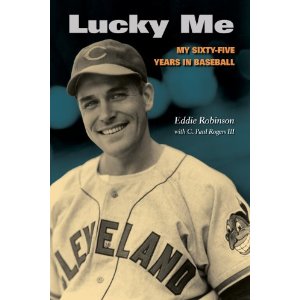
Few people remain in a line of work that gives them great joy and meaning for their entire careers. Eddie Robinson was lucky enough to do just that. He documents his sixty-five years in professional baseball, as a minor league baseball player, major league player, coach, farm director, general manager, scout, and finally consultant, with humor and insight, with co-author and SMU law professor C. Paul Rogers III. Robinson also writes movingly about his personal life, further endearing himself to those of us who have had the good fortune to meet him.
Robinson's early years were filled with the challenges of life in small town Paris, Texas, during the depression. When he was twelve, his parents separated, and he, his mother, and Uncle Herbert moved in with his grandmother, and all worked outside the home to make ends meet. As an only child, Robinson "received lots of attention" (1), but he also learned hard work, especially as a way to support himself and his single mother. Robinson writes, "When I turned sixteen, I started ... loading trucks beginning at 5 a.m. and delivering produce and pharmaceuticals to local grocery and drug stores before 8 a.m. .... Then I went to school all day and after school practiced whatever sport was in season" (4).
Despite his busy schedule, he made time to join the neighborhood baseball team. His talent received notice, and he then joined the local semipro Paris Coca-Cola Bottlers. While playing for the Bottlers, his love for baseball grew to the point that he knew he wanted a career in professional baseball. Robinson's modest beginnings shaped a man who remains infinitely humble and amazingly approachable. At a Dallas/Fort Worth area Society for American Baseball Research meeting a few years ago, he let my son try on his World Series ring.
One of the many strengths of Lucky Me is that I can hear Robinson's voice speaking clearly through the text. Rogers does a masterful job of preserving Robinson's stories of his childhood, as a young ball player, and through decade after decade of baseball history. As I read the book, I can hear the stories and jokes that I've heard a few times in person, and now Robinson and Rogers have preserved those stories for others. One of my favorites involves catcher Yogi Berra and pre-game streakers at Yankee Stadium. Robinson, who was traded to the 1954 Yankees after "that miserable year" in Philadelphia writes, "Yogi came in and headed right for my locker. He said, "Eddie, where were you during batting practice? You really missed it." I said, "What did I miss?" Yogi said, "There were two streakers. They jumped onto the field at the right field foul pole and ran all the way into the stands. And they didn't have any clothes on." I said, "No kidding. I guess I did miss it. Were they boys or girls?" Yogi said, "I dunno. They had bags on their heads" (108-09).
Stories like this and ones such as the time when during a lengthy meeting at the mound Cleveland Indian manager Lou Boudreau asked umpire Red Jones, "an old country boy," "Red, what would you do in this situation?" Red answered, "If I had a field this big, I'd plant it all watermelons" (45) add levity to the deeper insights Robinson provides into his baseball career. He knew everyone in the game, and he lets us know those relationships were important to him.
Later, when he became the general manager of the Atlanta Braves in 1972 and had to fire long-time friend Luman Harris, Robinson regrets the effect his actions had on their friendship. Robinson had first pinch hit against Harris in 1942 when Luman was pitching for the Philadelphia Athletics and Robinson was playing for the Cleveland Indians. Much later, as the general manager of the Atlanta Braves in 1972, Robinson not only had to let manager Luman Harris go, but his friendship with Paul Richards, the previous Braves GM, also became strained. Robinson tried to restore these friendships, but he was not always successful. When Robinson learns that Harris is upset with him, he writes, "I immediately wrote Luman a long letter revisiting our friendship over the years and telling him I didn't understand why he was so upset, but that I would do anything within my power to restore our friendship. Luman never answered my letter. One of the sad things in my life is that I never saw or talked to Luman again before he passed away in 1996" (170).
Despite the fact that he had many, many friends, we understand better the nature of his character when he mourns deeply the loss of one friend and works hard to restore that friendship.
Lucky Me is an essential read for anyone looking for insights into careers in baseball and the men who are lucky enough to have them.
Robinson, Eddie, and C. Paul Rogers III. Lucky Me: My Sixty-Five Years in Baseball. Dallas, SMU Press: 2011.
Copyright © 2011 by Kathleen Sullivan