the pitch
Reviewed by Jeremy Larance, West Liberty University
20 June 2011 archive
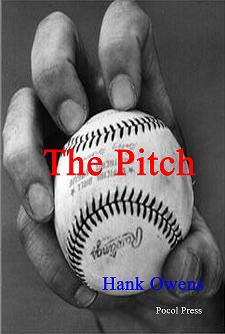
In Hank Owens's The Pitch, Orval Sheckard is a single-A manager of a team so low on the Cubs' radar that he has all but given up hope of ever uncovering any meaning in his life beyond finding an easier way to tell his players that they, like his younger self, just aren't good enough. That changes once Sheckard discovers Rube Tyler, an aptly named knuckleballer who throws the "the most beautiful, wrong-headed, baddest-assed" (27) pitch Sheckard—or anyone else for that matter—has ever seen. Of course, all knuckleballers are "special" in their own way, but it doesn't take Sheckard long to realize that Tyler's gift is exceptional in its own right, "a genuine, true blood baseball miracle" (35), a phenomenon made all the more remarkable by the fact that Tyler is an overweight, over-forty factory worker who claims to have spent the last twenty years of his life throwing balls through a old tire in his backyard. But while a discovery of a pitcher like Tyler might be unexpected in the real world, in the genre of baseball fiction such "miracles" tend to be slightly more common and, therefore, a little less miraculous. However, like the knuckleball itself, The Pitch adds just enough twists to turn the timeworn "out-of-no-where" story original and entertaining.
The title of the novel is a bit misleading, since the story is really more about Sheckard than it is about Tyler or his unbelievable pitch, but because he finds his own life so meaningless, Sheckard is only able to tell his own story as it relates to Tyler. Take, for example, Sheckard's description of the first time he witnesses Tyler's knuckleball. For some people, watching a skilled knuckleballer is like watching a master illusionist defy the laws of nature, but for Sheckard it is more akin to a religious experience: [L]adies and gentlemen, what I saw that night might have beat the second coming, because it changed my life and how I think about ball, forever. I saw Rube Tyler throw a ball for the first time that night, and brother, I don't ever want to see something like that again, because what happened after that would shake up everything I know about physics and God and baseball and no one ought to get all that messed up around in their heads more than once. (25) In other words, even if there were such a thing as an ordinary knuckleball, Tyler's ability to seemingly break the laws of both God and nature changes everything Sheckard ever thought he knew about baseball, life, and everything in between. Sheckard does not know how Tyler throws "the pitch," and he never makes much of a concerted effort to figure it out, at least not in the beginning, as if he wants to prolong the magic and mystery of Tyler's pitch as long as possible.
"Rube's pitch needed nothing," Sheckard tells himself early on, "it was perfect. Everything else about Rube . . . was gonna need work" (43). Part of him knows that he is probably incapable of perfecting a "miracle" anyway, and an even greater part of him simply does not want to know, since figuring it out might somehow ruin his own story. However, Sheckard does identify several key moments when he wishes he had pushed the issue further, for although he won't go as far as to ruin the ending for his readers, he frequently lets them know that Tyler's story will quickly become a tragedy.
In an interview posted on his publisher's website, Owens suggests that his novel be read as a retelling of "the classic middle-age Faustian bargain," in this case, the selling of one's "soul for the unhittable pitch." Needless to say, on some level, practically every novel about professional baseball players is a Faustian tale of some kind or another since, metaphorically speaking, every major leaguer must sacrifice something (be it his body, love, or simply time) to make his boyhood dreams of someday playing in the Show come true. One could easily argue that the entire steroid era in baseball was one collective "Faustian bargain," when countless numbers of ballplayers at every level of professional baseball made secret pacts to gain (and/or maintain) the strength they felt they needed to succeed. But if Owens' intended for his novel to be read as an allegory for the steroid era, it is only a subtle one, for the word steroid never appears in The Pitch. In fact, the closest anyone ever comes to accusing anyone of cheating at all is when befuddled managers accuse Tyler of illegally tampering with the ball, which is practically an "acceptable" form of cheating in baseball anywayÑas long as you don't get caught. Sadly, in that sense, The Pitch just might be a work of magical-fantasy fiction after all, a story about the enchanted kingdom of the Keokuk Westerns, where every struggling Single-A ballplayer is willing to make it to the next level on his own God-given ability, everyone, that is, except for Rube Tyler.
Without giving away his secret entirely, it should be noted that Tyler's "Faustian bargain" isn't necessarily a figurative one; there is an actual moment when he must make a conscious decision to sacrifice himself for the game that he loves. Once Tyler makes the team, The Pitch reads like most other baseball novels that focus on the story of a single player who is trying desperately to live out his dream of playing professional baseball before time, fate, or both catch up to him. The only major difference in Tyler's case is that his "Faustian" window of opportunity is tragically shorter than most. However, make no mistake, Rube Tyler is no second coming of Roy Hobbs: he can't hit, he can't field, and he can't throw anything other than a single pitch that is anything but natural. To make matters worse, what physical ability Tyler does possess quickly worsens as the season progresses, as his body seems to deteriorate rather than grow stronger with use. Tyler's ailing body becomes such an issue that, if not for Sheckard's constant foreshadowing, one might believe that he might literally die on the field before he ever makes it to the big leagues at all.
Nevertheless, as previously stated, The Pitch is Sheckard's story, not Tyler's. After all, there are only so many ways of describing a one-pitch wonder, regardless of how insanely unpredictable "the pitch" may be. Even though he may thoroughly believe that he is telling Tyler's story, the more interesting narrative in The Pitch is Sheckard's account of how he, himself, comes to grips with the twilight of his own career in professional baseball. Unlike the players and other coaches on his team, Sheckard has no dream of moving on to bigger and better leagues. Early on in the novel, he looks back at his career and tells his younger self, "[I]n a few years you're gonna have a heart condition, your stomach's gonna hurt every day and you're gonna have trouble peein'. And all you're going to have to show for it is a career in crappy little small town ballparks. On your tombstone it's going to say 'A-ball.' Get used to it" (5). Sheckard's foil in the story is his best friend and opposing manager, Tug Johnson who, unlike Sheckard, has a life beyond the game: a wife, grandchildren, and cancer, a disease he ironically regards as his last "chance to build something real" (105). By the end of the novel, it becomes clear that Sheckard has told this story as part of a response to Tyler's, forcing himself in the process to reevaluate his own life and, of course, baseball in general.
The only regrettable aspect of The Pitch is that it is, unfortunately, a little uneven. Specifically, Sheckard's voice changes dramatically throughout the course of the novel. The early chapters, for example, are full of wonderfully elaborate descriptions of the minor-league milieu, including some Apocalyptic passages that would make even the most articulate Southern preacher proud, and there are, of course, all of the "choice words" that one would expect from the mouth of an uneducated (but seasoned) single-A manager. As the novel progresses, however, Sheckard's voice becomes less and less interesting with fewer elaborate passages and more straight-forward descriptions of events, almost as if he (or Owens) simply wants the get the story over with so that he can go ahead and explain the mystery behind Tyler's pitch. Again, this is not to say that The Pitch is not an enjoyable novel; it truly is a very entertaining story, but it is not quite as good as it possibly could have been had the second half of the novel maintained the same level of narrative voice throughout.
All that being said, categorizing The Pitch as poorly written or overly somber is in no way an accurate description of what is an otherwise very funny and, overall, a very refreshing treatment of one of the baseball genre's more cliché ridden plotlines. Think The Natural meets You Know Me Al meets Doctor Faustus (mostly the funny bits).
Owens, Hank. The Pitch. Clifton, VA: Pocol Press, 2011, paper, 191 pages, $17.95.
Copyright © 2011 by Jeremy Larance