baseball in the garden of eden
Reviewed by Duncan R. Jamieson, Ashland University
7 June 2011 archive
I recall distinctly as a child going to our church's father and son banquet in the late fall. Two events during the evening stand out: first, the pastor, affectionately known to my generation as "Leech," would invite the women who prepared the meal to emerge from the kitchen with the words, "Gentlemen, the Ladies," which always resulted in a hearty round of applause; and second, the evening's program, which consisted of filmed highlights from the World Series. Unless my beloved Yankees played, I wasn't particularly interested. Of course, as soon as the Series appeared on television, the program changed. By that time, however, the boys of summer and their game had probably slipped from its position as the nation's number one sport, replaced by either football or NASCAR, depending on who's reporting.
We are an interesting people, reveling in our "Americaness" at the same time we acknowledge hyphenated identities. While most identify themselves as "Americans," which is completely appropriate, most also revel in the reality that, in the not that distant past, their ancestors came from some place other than what is today the United States. This is not meant to diminish in any way those who trace all or part of their ancestry to the Native Americans who had been here for several thousands of years when the first Europeans showed up to "discover" this new world. Perhaps, this is as true of baseball's origins as it is of people. The myth, discredited by scholars, fans, and likely the public as well, that baseball represents a completely American sport, symbolizes half of our identity, while books like Baseball in the Garden of Eden that examine the English heritage and convoluted American origins of the game represent the other half.
It is interesting that the commission, which determined Abner Doubleday to be baseball's midwife helping in the delivery in rural Cooperstown, New York, first saw the light of day during the Progressive Era, the same era which established the Quota Acts to restrict immigration and "fix" the ethnic identity of the United States. Both the Doubleday myth and the Quota Acts are representative of the 100% Americanism movement that found favor in the late nineteenth and early twentieth centuries, and is the cultural descendent of the 1850s Nativist movement, which was in its heyday when the different forms of baseball gained popularity.
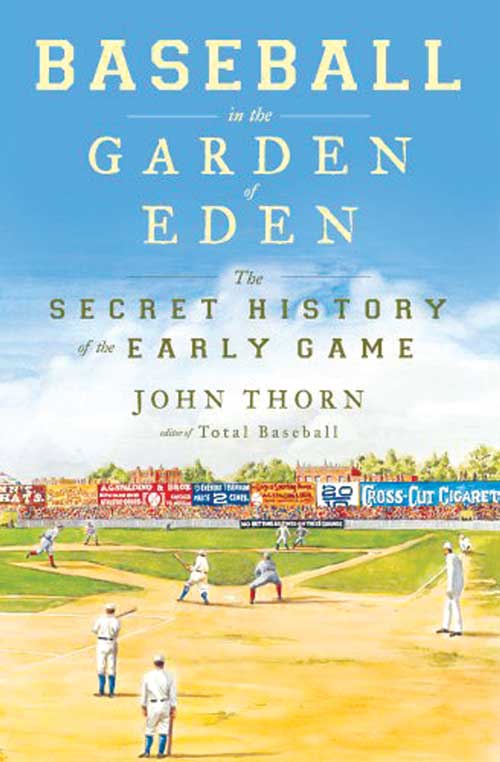
John Thorn's Baseball in the Garden of Eden examines the early days of the game in the United States when baseball was played at places like Hoboken's Elysian Fields. In this bucolic setting, the innocence of amateurs playing a ball game for exercise and camaraderie give the game its Edenic image. Soon, however, the competing ideas of play and organization, and its pre-American origins in English games of old cat or town ball creep in as the serpent to tempt participants and observers away from perfection. In reality, as Thorn so aptly puts it, baseball has its origins in bat and ball games played well before the Danes, Romans, or Normans saw fit to invade the British Isles.
Several variations of baseball existed in antebellum America, most prominently the New York, Philadelphia and Massachusetts games. Though perhaps not the best, the New York game became dominant in the years after the Civil War because it was the one most frequently played in the army camps, and then taken around the country as the soldiers returned home, thus driving the others to oblivion. Still, even the New York game became an amalgam as aspects of other variants of baseball became entrenched in the national pastime. These different variations date to the eighteenth century when it was a game, not a business, when men played it because of its athleticism and brutality. To put the runner out required hitting him with the ball. Men played with neither glove nor protective gear. In these early days, the pitcher served the ball to the batter, allowing the latter to put the ball in play, thus placing the emphasis on the fielders. Slowly, the game changed as pitchers surreptitiously developed ways to deliver the ball that made it hard to hit but not so obvious as to attract the attention of the umpire. Around the same time, to put the runner out, the fielder had to catch the ball on the fly, rather than on one bounce. As the game became codified, called balls and strikes crept in as did nine players on a side playing for nine innings.
With these changes came a couple of other significant developments. First, players began being paid to play, ending the amateur status of the game. Before too long some began being paid rather handsome salaries. Second, as professionalism crept into the game, it became more attractive to gamblers, which then raised the specter of fixing a game. Long before the Black Sox scandal of 1919, the Louisville Grays led the 1877 pennant race and then allegations surfaced that four players, including star pitcher Jim Devlin succumbed to bribes, something that also happened the year before. One of the endearing features of Thorn's history of the early game is his ability to connect extraneous facts. For example, in 1900, John McGraw and Wilbert Robinson, who played for the Baltimore Orioles, refused to report to Brooklyn, even though it had picked up their contracts. The pair cited business interests in Baltimore, including their interest in the Diamond Café, "a billiards parlor where, incidentally, duck pin bowling was first seen" (p. 250). Ultimately, they were sold to St. Louis, but they managed to have the reserve clause removed from their contracts, allowing them to play where they wanted. Thirty years before McGraw refused to go to Brooklyn, Democrat Frank Kelly murdered Octavius Catto, founder, captain, and infielder of the Pythian Base Ball Club of Philadelphia. Kelly assumed Catto was a Republican and shot him in the back and then the heart, without provocation. When he was tried for murder, the jury found him not guilty. At different points in the book, Thorn also discusses the origins of softball, or why a pitcher who is taken out of the game is said to be "driven from the box." Thorn includes information on early African Americans who played in the major leagues before the color line developed. Further, long before "A League of Their Own," Thorn describes how, in addition to the nineteenth century "bloomer leagues," Lizzie (Stroud) Arlington pitched an inning in 1898, giving "up two hits but no runs in this the first appearance of a woman in Organized Baseball" (p. 248).
Baseball in the Garden of Eden explores in detail the earliest days of America's national pastime. Thorn traces its rise in the years after the Civil War, as the New York game overtakes its competitors. Though we continue to refer to it as a "game," it is during the late nineteenth century that it clearly becomes a business with power shifting from the players to the owners, especially with the establishment of the reserve clause, which despite a later Supreme Court ruling, seemed to Thorn both un-American and unethical. Even then, however, the elite players earned salaries far in excess of those who came to watch the action. By the close of the nineteenth century, with baseball novels and songs all the rage, and a very early version of fantasy baseball being played, baseball had truly come into its own. "The national game was beginning to supply emblems for democracy, commerce and community that would subtly change America forevermore. In our determinedly secular nation, a fan's affiliation with his team could exceed in vigor his attachment to his creed, his trade, his political party, all but family and country, and increasingly even these were wrapped up in baseball" (195). Though not as adamant as this, when my father's beloved Dodgers left Brooklyn for the West Coast, he never listened to nor watched another Dodgers game. Since the Giants also left and being devoted to the National League, in time, he transferred his allegiance to the Mets. By this time, the program for the annual Father and Son Banquet had long since given up the sixteen millimeter filmed highlights of the World Series. As the nation and the game changed, we came to realize, if we didn't always know, that Abner Doubleday and Cooperstown, New York had nothing to do with baseball's origins. John Thorn provides us with a detailed and thoroughly documented history of its real origins, and is an interesting companion piece to David Block's Baseball Before We Knew It: A Search For The Roots Of The Game (Lincoln: University of Nebraska Press, 2005).
Thorn, John. Baseball in the Garden of Eden: The Secret History of the Early Game. New York: Simon and Schuster, 2011. (xvi + 365 pp., Ill, notes, index, $26.00)
Copyright © 2011 by Duncan R. Jamieson