alexander cartwright
Reviewed by Derek Catsam, University of Texas of the Permian Basin
18 May 2011 archive
Ransom Stoddard: "You're not going to use the story, Mr. Scott?"
Maxwell Scott: "No sir. This is the West, sir. When the legend becomes fact, print the legend."– The Man Who Shot Liberty Valence (1962)
Writers have been printing the legends about baseball's origins for more than a century. Thus, we all know the legend. Abner Doubleday invented baseball out of whole cloth in bucolic Cooperstown, New York. A few years later, Alexander Cartwright formalized the rules and created the first formal baseball club, the New York Knickerbockers. By the turn into the twentieth century, these legends formalized as facts, and the facts became so pernicious that, even today, many people are invested in their veracity. Growing piles of scholarly literature and journalistic investigation revealing that Doubleday had virtually no role in the game at all or that baseball owes its origins to bat and ball games played for centuries and that games of "Ball" were familiar to Americans at least as far back as the 18th century have had relatively little effect on the pervasiveness of the myths and legends of an origin story that emerged, as much as anything, to legitimize baseball as a solely American game during an increasingly nationalistic era.
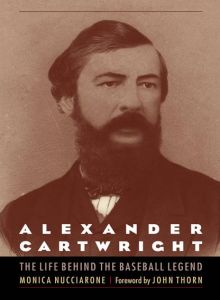
Monica Nucciarone has entered the affray to try to determine where the lines between myth and fact lie in her persistent and engaging investigation of the life of Alexander Joy Cartwright, the man who shares the stage with Abner Doubleday in baseball's creation mythology. Her book consists of two parts. Part one, "A Legendary Life," serves as a biography of Cartwright that brings the real man to life. Part two, "The Mythography of a Man," attempts to determine what is fact and what is fiction in regard to Cartwright's hand in creating baseball. She largely succeeds on both fronts.
"A Legendary Life" traces Cartwright's life from New York, where he was indeed part of the original Knickerbocker group that established formalized rules for baseball, through his travels west to San Francisco, and continuing to Hawaii, where he spent the bulk of his life. This biographical sketch occupies the bulk of the book. It also provides what might be a "marketing problem." For while the typical buyer of Alexander Cartwright will be looking for insight about Cartwright, the baseball man, they will be surprised – and many will be disappointed – by the fact that baseball occupies a shockingly modest role in Cartwright's life by the time he leaves the mainland United States. This reality is telling and fuels Nucciarone's arguments in the second part of the book. But one can imagine disappointed casual readers who did not expect to read more about the history of Hawaii than the history of baseball.
The irony is that Nucciarone does use Cartwright's biography to tell a compelling history of Hawaii from independence to not-exactly-consenting statehood. Cartwright was an important figure in Hawaiian society, and if he did not spread the gospel of baseball to the islands, he did play a significant role in the history of a place in part because he managed to avoid the worst excesses of what was, at times, an ugly American nationalism even while he was undoubtedly a supporter of the American flag. If baseball fans might end up surprised by the relative lack of baseball in the bulk of the book, western and Hawaii historians might not be aware that Nucciarone has made a nice contribution to their fields. Indeed, one can easily imagine this book in Hawaii history classes at schools and universities in the 50th state.
In "The Mythography of a Man" Nucciarone makes her contribution to baseball historiography. To be sure, myriad historians (including John Thorn, who contributes this book's foreword) have enriched and complicated our understanding of the variegated roots of baseball, exploding mythologies in the process. But Nucciarone provides a thorough examination of the question of Cartwright's role in establishing the rules of baseball and finds it wanting. Nucciarone is judicious and cautious in her assessments, making clear that she is only willing to go as far as the evidence allows and keeping her speculation to a minimum. Thus, there are no "j'accuse!" moments. Nonetheless, the mass of evidence makes clear that the Cartwright story is largely the product of legend and that, while Cartwright was undoubtedly present at the creation (of the Knickerbocker club and the writing of the game's rules), he was not there alone and may not even have been the central figure. And while Cartwright has long been credited with spreading the game as he traveled westward across the United States, there is little or no hard and fast evidence for this and what evidence there is most often comes from Cartwright's boosters, including family members who understandably wanted to preserve the family legend.
Nucciarone's work shows above all the importance of the historian's fealty to evidence. Maxwell Scott may have preserved to print the legend, but the historian has to counter the legend and do their best to print the facts, to leaven those facts with interpretation, and to do their best to arrive at their version of that most contested of things, truth. Alexander Cartwright provides a welcome addition to our understanding of baseball's still legend-enshrouded early decades.
Nucciarone, Monica. Alexander Cartwright: The Life behind the Baseball Legend. Foreword by John Thorn. Lincoln: University of Nebraska Press, 2009.
Copyright © 2011 by Derek Catsam.