56
Reviewed by Duncan R. Jamieson, Ashland University
4 April 2011 archive
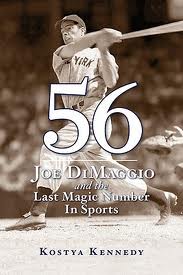
Googling the number "56" will bring up Joe DiMaggio's 1941 consecutive games hitting streak, as will googling "the streak." Earlier, as a member of the minor league San Francisco Seals, DiMaggio established a streak of hitting in 61 consecutive games, May through July, 1933. DiMaggio's hitting streak remains not only unbroken, but also not all that seriously challenged over the last seventy years. Prior to DiMaggio, baseball recognized St. Louis Browns first baseman George Sisler as establishing the longest streak in 1922 at 41 games, somehow overlooking the 1896 45 consecutive games streak of Wee Willie Keeler, left handed right fielder for the Baltimore Orioles. Since DiMaggio, the closest anyone has come is Cincinnati Reds second baseman Pete Rose who in 1978 hit in 44 consecutive games. The only other players to reach the 40s were Bill Dahlen, short stop for the Chicago Colts who hit in 42 consecutive games and Ty Cobb, Detroit Tigers outfielder who hit in 40 consecutive games. Whether or not the record will remain unbroken is a fascinating question of statistical analysis. Kostya Kennedy, senior editor for Sports Illustrated, devotes the last chapter of 56 to the subject, focusing on the work of statisticians and baseball aficionados. The result? "Through the end of the 2010 season, [there were] 17,290 players known to have appeared in the major leagues. Only one of them has ever hit in 56 straight games" (p. 243).
This is the story of perhaps the most impressive record in sports and the man who made it. Kennedy brings to life the late spring and early summer of 1941 when DiMaggio broke free from an early season slump to lead the Yankees to first place over the Cleveland Indians and then to defeat the Brooklyn Dodgers in the World Series. He covers these soaring heights as well as depthsthe death of Lou Gehrig, the Yankees' outstanding first baseman who mentored the young DiMaggio. In addition to players and sports writers, he includes the thoughts of young fans who played sandlot ball during the spring and summer. Their recollections add depth to the narrative, making it seem more immediate. If the reader did not know the outcome of the story in advance, this would be a great thriller.
Beginning on May 15, with the Yankees in 4th place, 5 games behind the Indians, the twenty-six year old centerfielder "lined a hard, low single into left center field for his only base hit of the game" (p. 21). The Yankees lost that game to the Chicago White Sox 13-1, putting them below .500 early in the season. DiMaggio kept hitting in each game until sportswriters, players, and the public recognized a streak in the making. It continued until July when the Yankees met the Indians in Cleveland's Municipal Stadium. In the first game of the series, the Yankees beat the Indians 10-3 in a game where DiMaggio got three hits. The next day's night game set an attendance record of 67,463, the largest crowd in 1941 and the largest crowd for "a night game in any stadium anywhere, ever" (p. 302). Cleveland's Bob Feller, scheduled to pitch the third game in the series, sat in the dugout conflicted. While he did not want to see DiMaggio get a hit against his team, he did want the opportunity to stop the streak. Like the Cleveland fans, he wanted DiMaggio to hit a single and then stranded on first. But this was not to be. Cleveland's third baseman, Ken Keltner, snagged DiMaggio's first shot down the base line and threw him out at first. DiMaggio walked in his second at bat. His third at bat came in the seventh inning with the score tied. Again, DiMaggio put the ball down the third base line and again Keltner threw him out at first. DiMaggio had one more at bat in the eighth inning; he hit into a double play, ending both the inning and the streak. He simply picked up his glove and trotted out to center field. The Yankees won the game, 4-3. Walking back to the hotel with Phil Rizutto, DiMaggio realized he left his wallet in the locker room's lock box. As they passed a bar, he borrowed $20.00 from Rizzuto and went in, alone.
As Kennedy makes clear, it requires a rather large cast of characters to maintain a streak. First, obviously, is the batter who must get a hit in consecutive games. Next is the pitcher, who must pitch to the batter, rather than pitch away and award the batter a base on balls for whatever reason. Next is the batter's manager who could signal the batter to take a pitch resulting in a walk. If it were late in the game and if the batter had not gotten a hit earlier, the strategy might win the game but end the streak. Next come the batter's teammates, especially those who bat just before him. They need to insure that the team remains at bat so the batter with the streak gets another chance for a hit. Finally, the official scorer determines whether the batter earned a hit or the fielder made an error. In DiMaggio's case, the only serious challenge to his streak came in the 30th game of the streak when official scorer Dan Daniel, who also was covering the game for New York's World-Telegram, hesitated. Not wanting to make a mistake, he took so long to decide that John Drebinger, sports reporter for the New York Times who was sitting next to Daniel, said it sure looked like a hit to him. DiMaggio had hit a ball which some contended the Tigers shortstop Luke Appling should have handled easily, throwing him out at first. But the ball took an awkward hop and hit Appling in the shoulder before bouncing away. Hit or error? Kennedy rightly devotes an entire chapter to analyzing this one play, considering the thoughts and opinions of those who witnessed the play as well as the historical analysis of a variety of observers, and concludes the decision was correct, a conclusion reached by both friends and foes of DiMaggio at the time.
This is a solid baseball book with a glance at American society and culture. DiMaggio's streak comes between the third inauguration of Franklin D. Roosevelt as president and America's entry into World War II. Though officially neutral, Roosevelt's policy of lend lease clearly supported the Allies. News of DiMaggio's streak vied with war reports for first place in newspapers. Though the streak took place when Germany invaded Russia, thus violating its non-aggression pact with the Soviets, Kennedy fails to mention the invasion. He does discuss DiMaggio's parents who, as Italian immigrants, had their movements restricted (they did not become American citizens until after the war). Some players eligible for the draft had already been called up, while others waited for the inevitable. DiMaggio's turn would come in 1943 when he entered the Army Air Corps.
Kennedy explores that the era was a low point in America's acceptance of others. When DiMaggio joined the Yankees in 1936, he became part of manager Joe McCarthy's "Italian Battalion," made up of Tony Lazzeri, Big Dago; Frankie Crosetti, Little Dago; and DiMaggio, Dago. Reporters called him Giuseppe or the Walloping Wop. Opposing players and fans applied other ethnic slurs like guinea or spaghetti bender. Later, when Phil Rizzuto joined the Yankees he too became Little Dago. Italians were not the only ones singled out for ethnic abuse; Jewish players had to contend with Jewboy or Heeb.
DiMaggio did not enjoy interacting with the fans or even with other players. Almost reclusive in his manner, he even kept his wife Dorothy at arm's length. Kennedy explores his marriage, which resulted in a son before ending in divorce in 1944, by which time DiMaggio was in the military. Though DiMaggio claimed to be devoted to Dorothy, his attitude toward her was very controlling. An actress when they met, she gave up whatever chance she had at a career to become his wife because he wanted her at home in their New York City apartment. He also had one night stands with other women while on the road, somehow believing he was remaining faithful to her.
A Newark New Jersey undertaker, Jerry Spatola read of the Yankees reclusive loner, far from his California home. As an Italian like DiMaggio, Spatola waited after a game and invited him to his home for dinner with his wife and two daughters. Though still quiet, DiMaggio enjoyed the Italian meals, which reminded him of his adolescent days in San Francisco. Through Spatola, known as Jerry Spats, DiMaggio secured a chauffeur cum bodyguard, and an introduction to Newark's crime boss, Richie the Boot (né Richard Boiardo). In 1939, before the World Series between the Yankees and the Cincinnati Reds, Spatola organized a testimonial dinner in DiMaggio's honor. Newark became a second home for DiMaggio, who spent a great deal of time and energy there, visiting children in the Hospital and Home for Crippled Children. There, he'd sign autographs and distribute pennants and baseballs.
Kennedy's 56 is a book with broad appeal. Baseball fans and followers of the Bronx Bombers will certainly enjoy this fast read. More importantly, even those with little or no interest in baseball, or those who despise the Yankees, will find this a fascinating study of a record, and everything that goes into its creation.
Kennedy, Kostya. 56: Joe DiMaggio and the Last Magic Number in Sports. New York: Sports Illustrated Books, 2011. 368pp. Ill., photographs, bibliography and index. $26.95
Copyright © 2011 by Duncan R. Jamieson.