the amazing tale of mr. herbert and his fabulous alpine cowboys baseball club
Reviewed by Kathleen Sullivan, Southern Methodist University
21 February 2011 archive
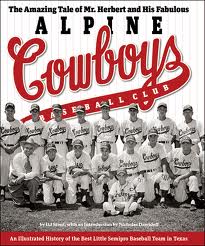
Stout's Amazing Tale is a lovely pictorial history that transports the reader to a time when baseball was the heart of an isolated west Texas ranching community, Alpine, nearly one hundred and fifty miles southwest of Odessa. The books begins with a short memoir by Stout about his father, Doyle E. Stout, Sr., who pitched for the Alpine Cowboys, a team that flourished for fifteen years under a variety ofnames, all ending in "Cowboys," through the generosity of local rancher "Mr. Herbert" L. Kokernot, Jr. (1900-1987). The second part of the book is a reprint of a 1989 Sports Illustrated article by Nicholas Dawidoff, which gives the reader a short history of the team and its sponsor. The vast majority of the book is a compilation of year-by-yearteam and individual player photographs from its inception in 1946, through its 1959 purchase by the Boston Red Sox, and finally ending in 1961, when the Red Sox abandoned Kokernot Field to the local Sul Ross University baseball team. As I was enjoying the beautiful pictures and reading the interesting sidebar "Cowboy Tales" (first-hand accounts of players), I anticipated the "tale" part of Mr. Herbert's life to unfold. While the book gives us intriguing glimpses into the man, especially as he smiles endlessly with his teams (he's the one in a cowboy hat and boots) and poses happily with his family in 1961, a detailed explanation of his life as a baseball fan, civic booster, and educational philanthropist is missing. Perhaps we will get a better understanding of his motivations when Stout and co-author David Wilkinson complete their forthcoming novel about Mr. Herbert. Regardless, Stout's current work offers several enticing clues about why Mr. Herbert devoted much of his life and income (Kokernot Field alone cost him $1.25 million in 1947) to baseball. Mr. Herbert, like his father Herbert L. Kokernot, Sr., valued serving others through supporting education. The elder Kokernot served as a trustee for Baylor University and was president of the San Marcos Baptist Academy. He was also Chairman of the Board of the Baptist Foundation of Texas and Vice President of the Baptist General Convention of Texas. To this day Kokernot Residence Hall at Baylor University provides us with a Baylor-Kokernot connection.
Continuing his father's tradition of service to others, Mr. Herbert provided young men, including Stout's father, college scholarships to Sul Ross University while they played baseball for the Alpine Cowboys. Baseball players received tuition, room, board, and income until many of them eithergraduated or signed major-league contracts. Mr. Herbert never took a portion of their signing bonuses, telling them, "I sell my cattle, but not my ball players" (47). After the Boston Red Sox bought the Cowboys at the end of the 1958 season and turned them into a Class D Sophomore League farm team, Mr. Herbert insisted on no alcohol sales at the games. Although Mr. Herbert's connections to the Baptist church or Baylor University are never mentioned, he had seven players from Baylor on his 1950 team and longtime Cowboy manager and friend, Tom Chandler, was a Baylor graduate. In addition, photographs reveal ballplayers routinely serving food at the local Paisano Baptist Encampment.
After careful consideration, I don't think that Mr. Herbert "indulged in the ball club mainly just for the fun of it" (104). Mr. Herbert found a way for the passion of his life, baseball, to be combined with service to others by providing college scholarships to young men. While the photographs are marvelous, I hope that the forthcoming novel reveals to us a stronger tale of Mr. Herbert than the cowboy smiling among the baseball players does.
Stout, DJ. The Amazing Tale of Mr. Herbert and His Fabulous Alpine Cowboys Baseball Club. Austin: University of Texas Press, 2010.
Copyright © 2011 by Kathleen Sullivan.