sport, rhetoric, and gender
Reviewed by Alex Truncale, Oklahoma State University
16 February 2011 archive
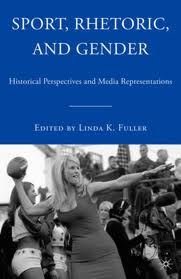
The question of whether or not we have moved past issues of gender equality is addressed this collection of essays on gender and sport. Edited by Linda K. Fuller, these essays prove that, at least in the realm of sport, we are still all too quick to revert to the ways of the past. Because sport is (and, as some essays in this volume will argue, always has been) an enormous part of our culture, it is appropriate to look at how gender norms in sport have constituted a constant presence that relegate women to a subservient role, despite the seemingly progressive advances. Sport, Rhetoric and Gender takes a pragmatic look at women in sport. While the essays cover a variety of topics, the overwhelming theme points to the idea that little has changed for women in the sport world. Although women's involvement in sport at all levels is considered commonplace, they are still regarded as the "other" in the realm of athletics. There is continued marginalization of women in sport, and the language of sport, which privileges the male, exacerbates the issue.
Sport, Rhetoric and Gender has six different "parts," each with a specific topic relating to sport and gender and containing between two and five essays. The first collection of essays examines the language of sport related to gender. It contains an essay by L. Marlene Mawson, who coins a new phrase, "Sportpersonship," to replace the gender-biased term "sportsmanship." The three essays in the section are excellent resources for anyone studying rhetoric and sport, and the way in which the gendered language of sport, has evolved in recent years. Although this collection is aimed at gender studies, those involved in the study of language, or anyone interested in the semantics and etymology of these gender-specific sport terms will find the essays enlightening. This may lead the reader to question why sport jargon favors the male, and why it has been an important factor in belittling women's involvement in athletics.
Part II examines the overlooked history of women in sport. Mike Sowell's essay chronicles the career of Annie Laurie, said to be one of America's first sportwriters. Nancy G. Rosoff's essay discusses the concept of the "athletic woman" as the ideal woman at the turn of the last century. Parts III, IV, and V explore women's marginalization in print, broadcast and visual media, respectively, including an essay by Susan Burris about the deterioration of the Women's National Basketball Association (WNBA) and an essay by Marie Hardin and Julie E. Dodd, which examines a "women's-only" column from a popular running magazine. Part IV contains an analytical essay about the broadcast of a women's collegiate basketball game. The last part contains five miscellaneous essays, or "Classic Case Studies," including a look at the overall sexualization and double-standards in sport. Clearly, the essays attempt to redefine sport language. While the groundwork for the issue of gender-biased sport language was established early, the latter part seeks to rectify the wrongs of history. It appears to answer the question of how can we, as fans and participators in sport, create a new language or, at the very least, new terminology that will allow a more inclusionary tone.
Mawson's essay, "Sportwomanship: The Cultural Acceptance of Sport for Women versus the Accommodation Cultured Women in Sport," contends that, historically, the term "good sport" is given to a person (man or woman) who "is said to display good sportmanship (author's emphasis)" (19). The term "sportmanship" describes an athlete who plays by the rules of the game based on the ethical and moral values society places on sport. According to Mawson, "sportwomanship," a term, invented by the author, "refers to ethical behaviors ascribed for women engaged in sport and behaviors representative of femininity in society" (20). Essentially, Mawson argues that women engaged in sport are subjected to society's standards for women, even while they are involved in, at times, fierce athletic competition, while the actions of men are more readily excused. It is only when women display ethical values, such as fairness and courtesy, during sporting events, in other words, when they demonstrate typical feminine ideals, they are, ironically, said to display "sportmanship". Mawson argues that a new term, "sportpersonship," should be used when discussing either a man or woman displaying ethics and moral values within the boundaries of sport to rid society of terms such as "sportmanship" and "sportwomanship," which "connotes a different standard of behavior" between men and women (28).
This discussion of language and sport continues in the next essay, "Language, Gender and Sport: A Review of Literature" by Jeffrey O. Segrave, Katherine L. McDowell and James G. King III who reinforce the idea of women becoming the "other" in sport. Male involvement in sport has always been accepted as commonplace; whereas, women in sport is still something mystifying. Additionally, women tend to lose their femininity when they step onto an athletic playing field, and instead are subjected to "continual references to lesbianism" (33), which, the authors argue, is a transparent attempt to discredit women's athletics. The authors reach the conclusion that, because the language of sport has been so male-centric, "Women athletes are thus denied both status and legitimacy, and sport is privileged as a male preserve" (35). We see this today, with television networks' limited coverage of women's athletics. This marginalization continues in Faye Linda Wachs' essay, "'Throw Like a Girl' Doesn't Mean What It Used To: Research on Gender Language and Power," wherein she argues those who have power define language and, thus, define what is acceptable and what is not. This is the reason why fans of collegiate sport simply accept the premise of differentiating women's athletic teams from their male counterparts, particularly in terms of team names. Wachs uses the examples of "Lady Gamecocks," "Wildkittens," and Lady Lions (and, at my own university, Oklahoma State, the "Cowgirls"), which thus furthers the idea of "otherness" in women's athletics. Additionally, the "masculinization" (48) of women's athletics has greatly affected women as they attempt to gain legitimacy in an arena where the very language is defined by male-dominated forces.
Part II, "Historical Perspectives," examines the history of women in sport in the United States. While these essays focus on a more historical perspective, they also deride the notion that women in sport is something relatively new and, therefore, has a difficult time being accepted. Nancy G. Rosoff's "A Glow of Pleasurable Excitement: Images of the New Athletic Woman in American Popular Cultural Culture, 1880-1920" examines the idea that the athletic woman is not a recent phenomenon, but rather something that has existed for many years. Rosoff states that women were involved in basketball as early as the 1890s, shortly after James Naismith invented the game. Additionally, advertisements in media outlets during that time featured pictures of women with an athletic build and typecast them as the type of ideal and attractive women. Women's historical involvement in sport also extends beyond the playing field. Mike Sowell's essay "A Woman in a Man's World: Annie Laurie, One of America's First Sportwriters" discusses Winifred Black (pen name "Annie Laurie"), who is largely credited with being the first sportwriter in American history, and with creating a whole subgenre of journalism that did not previously exist. Therefore, the idea that women's involvement in sport emerged as a result of the feminist movement of the 1960s and 70s is highly faulty. Although this movement was crucial in spearheading the passage of Title IX, which gave women access to the same amount of funding at the colligate level, women have been a part of the sport landscape in this country for well over 100 years, thus making women's athletics not something new, but a continuation of a tradition.
Parts III, IV, and V discuss the marginalization of women in sport in a variety of media representations, including print, broadcast, and visual media. Susan Burris's article "She Got Game, but She Don't Got Fame" details the struggles in women's professional basketball, and chronicles the evolution of the WNBA. In the next essay, Cheryl Cooky takes on this concept in Sports Illustrated for Women. Contemporary representations of women in sport media, Cooky writes, "often trivialize, objectify and/or marginalize women in sport and physical activity" (98); that is, when women in sport actually are represented. The problem with this, Cooky adds, is that women are so used to reading the "real" Sports Illustrated, that SI for Women may be perceived as inferior.
Language and how it is used to describe women in sport makes it appear that women's sport are a novelty and not bona fide athletics. Team names that designate a women's team from a men's team and the continued treatment of women's athletics as something inferior to men's athletics perpetuate the stereotype. These essays demonstrate the kind of power words can have, particularly when describing a topic such as gender and sport. The reader will inevitably draw the conclusion that the marginalization of women and sport will not end until there is a systematic change in the language with which people refer to this traditionally male-dominated segment of society.
Fuller, Linda K. (Ed.). Sport, Rhetoric, and Gender: Historical Perspectives and Media Representations. New York: Palgrave MacMillan, 2006. $25.48 in paperback; $64.13 in hardcover. 288 pages, references.
Copyright © 2011 by Alex Truncale