the great match and our base ball club
Reviewed by Scott Peterson, University of Maine
21 November 2010 archive
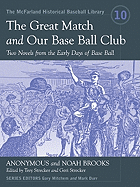
These two early baseball texts are well met (and well married) in the recently published book that was edited by Trey and Geri Strecker. While Our Base Ball Club focuses more on illustrating how "baseball fever" could overtake a nineteenth century American town, both texts demonstrate the contemporary significance of the game. Both authors—Noah Brooks, who had ties to Bret Harte and the local color movement and Mary Prudence Wells, whom Geri Strecker identified in a recent Nine article as the most likely candidate for the anonymous writer of The Great Match—treat the game as a recent and popular phenomenon. Thus, as cultural artifacts, these texts provide insight to the early days of baseball and the game's evolution into America's pastime. What's more, both authors develop the formula that would later be used by twentieth century journalists to write the game into American culture through Bildung narrative, transitional values, and the "big game."
Both narratives involve young men using the game of baseball as an important part of their maturation or Bildung process. Dick Softy, of The Great Match (1877), and Larry Boyne, of Our Base Ball Club (1884), prepare to take their place in the world through the discipline and self-confidence they develop while training to be baseball players. Both characters also experience resistance from the upper class cultural gatekeepers of their respective communities who frown upon young men who waste their time with "base ball." Even though it was published just seven years earlier, The Great Match is set in western Massachusetts and harkens back to the cultural supremacy of England, while Our Base Ball Club is set closer to the American frontier of northern Illinois and seats cultural authority in the local judge, entrepreneurs, and industrialists. In both cases, however, the authors leverage the status of baseball by showing how the game can aid in the proper development and maturity of a young man. Ring Lardner, Bozeman Bulger, Charles Van Loan and other early twentieth century baseball journalists adopted the same strategy to redact the rowdy image of professional players and make them fitting role models for the middle-class readers of The Saturday Evening Post.
Brooks and Wells anticipate the transitional values used by later baseball authors when the virtues of Puritan and Victorian identity come in conflict with the more commercially driven definitions of manhood and masculinity that were developing in the late nineteenth century. What's more, both authors anticipate elements used by later baseball writers when they make gambling the central conflict faced by their protagonists. In The Great Match, admiring fans are torn between their favorite player and his lack of integrity. In Our Base Ball Club, Larry Boyne must practice situational ethics to keep a gambling scandal out of the press and thus preserve the image of the burgeoning game of baseball. The players in both texts also enjoy a certain amount of celebrity status that challenges the nineteenth century virtue of humility, as when the small town players walk the streets of Chicago and overhear discussion of their on-field exploits in Our Base Ball Club and when an Irish immigrant uses his position as the pitcher of the local nine to exert his will on the local entrepreneur in The Great Match. Later baseball writers addressed some of the same issues when their protagonists struggled between acting within the strictures of Victorian character and developing the modern tastes encouraged by the ads at the back of The Saturday Evening Post and other middle-class magazines.
Wells and Brooks also laid the groundwork for the formula used by later writers when they employed the "big game" as the endpoint of baseball narratives featuring best-of-three-game series. The Great Match pits the old money of rural Dornfield against the nouveau riche of industrial Milltown. While Our Base Ball Club follows a similar pattern, there is less nationalistic freight attached to the match-up between the rural community of Catalpa and the city of Chicago. These similarities and the ones discussed above open the door for a view of Our Base Ball Club being written in opposition to The Great Match, as if Brooks was determined to produce a truer representation of how a town can be overrun by baseball fever—while also including the elements of romance that might interest the feminine half of his audience. Furthermore, Brooks takes his tale to another level by setting a portion of it in a real city (Chicago) and, according to Albert Goodwill Spalding, peopling it with "personages which are not wholly of his imagination." Whether or not Brooks actually had Spalding and his hometown in mind is less important than the fact that Spalding saw himself as a model for Larry Boyne and Catalpa as a version of Rockport, Illinois due to the local color Brooks used to create a sense of verisimilitude for his "slender plot" that was "threaded on a base ball match" (to quote Spalding's introduction again). Where the author of The Great Match bolstered the narrative with country manners and Martha Washington teas, Brooks incorporated early box scores and the telegraph to put the reader in the story and further pave the way for later journalists who used real elements in their fiction.
Thus, not only is it more than fitting that The Great Match and Our Base Ball Club have been published together in a single volume, but both narratives are also worthy of scholarly attention even if their protagonists are young men and women on the cusp of maturity. The issues of gambling and honesty and situational responses to them make the texts and their characters into snapshots of American culture. What's more, the use of the Big Game formula by both authors shows how early authors created the formula for writing the game into American culture due to its social, individual, and economic utility. Therefore, readers of this recent book might be drawn in by the baseball—but they should stay for the glimpses of how our modern sport culture developed in the late nineteenth century. The fact that The Great Match is not mentioned in Andy McCue's bibliography, Baseball By the Book, further illustrates the service done by the Streckers and the McFarland Historical Baseball Library in bringing it to our attention in the present volume. So, three cheers and a tiger for all involved in the book's production.
The Great Match and Our Base Ball Club: Two Novels from the Early Days of Base Ball, edited by Trey Strecker and Geri Strecker. Jefferson, NC: McFarland & Company, Inc., 2010, paper, $33.00.
Copyright © 2010 by Scott D. Peterson.