cycling: philosophy for everyone
Reviewed by Duncan R. Jamieson, Ashland University
20 November 2010 archive
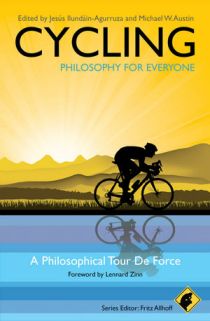
I am not now, nor have I ever been, a bicycle racer. I have never entered a citizen's race, the lowest category, nor have I ever participated in a time trial. While it might be a fear of losing, I prefer to see it as knowing my limits. I do ride a lot, I can ride hard, and I have striven to improve my personal bests, but the only person I compete against is myself. While the cover illustration of Cycling shows a bicycle racer on an early morning training ride, both the cycling and the philosophy contained within these pages apply equally well to the greatest bicycle racers of all time—Lance Armstrong or Eddie "The Cannibal" Merckx, to mention but two—as to bicyclists who commute, tour or travel by wheel. All who ride know the intimate connection that makes wheel and rider one. Whatever the goal, the bicycle becomes new each time it is ridden, and no matter how often the same road is ridden, it too becomes new.
Whether you use the bicycle to make your living, to take you to your living, or to take you on an escape from your living, there is a great deal in Cycling: Philosophy for Everyone. You do not need extensive knowledge of either bicycling or philosophy to enjoy, learn from, and be entertained by these incredibly diverse essays. As might be expected most of the authors are academics at various stages in their careers as philosophers. A diverse number of disciplines are represented, from ethics to phenomenology to Ancient Greek to classical South Asian philosophy A few are in other academic pursuits, and a few of the essayists have little or no connection to academe, working in some aspect of the bicycling industry. Only one of the authors is not an avid bicyclist; the others are racers, tourists, travelers or commuters. The editors have done an admirable job of tying the essays into six stages to explore all aspects of life on the wheel. While a couple of authors have taken bicycle metaphors and technical language to an extreme, diluting the power and readability of their essays, the vast majority of the essays are written clearly and succinctly for bicyclists and non bicyclists alike. The same is true for philosophy; there's something if it's your field and there's something here if you're a novice as well.
This eclectic group of essays share the idea that bicycling is an ideal means of transportation, whether the goal is earning the yellow jersey, commuting to work, or escaping everyday life for a while. The essays all explore the idea that bicycling is an excellent means of achieving the basic goal of philosophyÑto know oneself. Further, these essays all share the reality that the bicycle offers the only realistic opportunity to combine both travel and environmental connection. Unlike our four wheeled friends (or for that matter our two wheeled friends who use power assists), bicyclists see, feel, and smell that through which they ride. The clearest example of this is that there are very few flat roads; what appears flat to drivers in reality is usually a gentle slope either rising or falling. This demonstrates an environmental connection lost to those who cruise by in air conditioned, surround sound ignorance. Several of the essays are related more directly to racing, and in particular to the Tour de France, as well as other prestigious, but less well known to Americans, European stage races. In these essays is the clearest, simplest connection between bicycling and philosophy. In both, the pursuit is truth or phrased another way, honesty. The individual who cheats demeans the sport and the discipline as well as all those who participate, including him or herself. The reward for those who seek honesty and truth legitimately (without the use of performance enhancing drugs or plagiarism) is courage, discipline, respect and justice. Racers like Greg LeMond and Lance Armstrong are clearly heroes here in the United States. However, while we recognize July 21, 1969 as the day when the first men landed on the moon, Belgians remember it as the day when Eddie Merckx won his first Tour de France, one of five wins.
Beyond racing, many essays explore the ways in which bicycling reflects life. One essay explores the connections between learning the art of balancing a wheel and the art of balancing life. Devotees of the wheel understand their connection to the environment. They also understand the importance of cooperation and team building, attributes as important in touring and commuting as in racing. These essays explore the philosophical implications of such actions.
Plato believed that wonder was the only beginning of philosophy. Wonder is also fundamental to bicyclists, whether they race, commute or travel. Even tearing along at speeds much higher than the average commuter or traveler would achieve, the racer still has time to strategize and wonder about the surroundings. Bicycling never engages the rider's entire consciousness, so there is plenty of time to ride and philosophize.
Ilundain-Agurruza, Jesus and Michael W. Austin, eds. Cycling: Philosophy for Everyone. West Sussex, England: Wiley Blackwell, 2010. Xiii + 273 pp.
Copyright © 2010 by Duncan R. Jamieson.