the hard way home
Reviewed by Duncan R. Jamieson, Ashland University
7 October 2010 archive
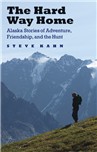
These are wide-ranging stories, from the difficulty of enforcing laws to watching porcupines to fighting forest fires. What holds them together is the author's passion for the Alaskan outdoors. He writes with such intensity that you can share in the solitude of fishing alone as well as rage at the overcrowded conditions of too many fishers on too small a section of stream. Even if you've never hunted (I haven't even fired a gun), you can understand all the intricate aspects of hunting and become as annoyed as the author becomes when someone with too much time and money comes to the wilderness only to kill big game. Before reading Kahn's The Hard Way Home, I had only a passing understanding that hunting involved far more than shooting one's prey. As Kahn explains, when done correctly, hunting may well not result in a trophy. It is the total experience—hiking, camping, stalking (phrased another way, communing with the natural environment)—that is the beauty and passion of hunting. This does not even begin to consider the other possibility of hunting with a camera rather than a rifle.
Working from notes kept over decades of living and exploring in Alaska, Kuhn has divided the book into three sections. The first, "Ranging Out," explores his interest in the outdoors, including adventures he's had in both airplanes and boats. Despite being a passenger in a small plane when the engine quit—the carburetor had iced up—his faith in the pilot put him back on the plane for the return trip. Because carburetor icing leaves no evidence, Kahn had to trust the pilot's knowledge and experience that this was a valid explanation of the problem. Later, on a guiding trip in an exceptionally remote location, he discovered a crash site, which contained airplane wreckage and one set of human remains; he created a fascinating word picture of the final moments of both the pilot and the plane. Though others might have shied away from flying in small planes after these experiences, Kahn went on to earn his pilot's license, then to buy and fly his own small plane.
The second section is "Guiding Days," in which he recounts the couple of decades when he earned his living as a big game guide. He apprenticed with others to learn the craft, which he describes as both hard work and vacation. As a guide, Kahn had much more empathy for the individual who scrimped and saved to afford one hunting trip compared to the hunters of more independent means who returned year and year to add another trophy to their collection. He has the greatest respect for his fellow guides, with whom he maintained a friendly, albeit intense, competition. Kahn recounts sharing a camp with another guide to whom he lost the preferred route one morning. Going in the opposite direction afforded Kahn spectacular sights that otherwise he would have missed. The third portion of the book reviews his life after he retired as a guide. Though he remains living in the wild as much off the grid as possible, the rigors of guiding had taken too much toll on his body to continue. He hunts and fish to be as self-sufficient as possible. Like James Fenimore Cooper's Natty Bumppo, who spent time in jail for shooting a deer for food out of season (The Pioneers), Kahn has few regrets for fishing for sustenance even though his fishing license had expired and he hadn't been to town to renew it. Unlike Bumppo, he suffered no ill effects, though they both questioned the ethics ofan encroaching and increasingly repressive social ethic.
There is an interesting juxtaposition here between author and reader. Having always lived in Alaska, and most of that in rural, wild Alaska, Steve Kahn views himself, and rightfully so, as an "Alaskan man." Alternatively,though I have lived away from New York City longer than I lived there, I continue to think of myself as a New Yorker and likely always will. However enamored I am of Kahn's rugged outdoors life, while I thoroughly enjoyed his account and urge others to read it, I have no interest in living it. The New York I grew up in was a far different place from the New York that exists today. While much of it remains the same, it is no longer as safe to walk some streets or ride some subway lines late at night as it once was. Wild Alaska, however, remains much the same today as it was when Kahn first wandered there several decades ago. If you've read and enjoyed John Krakauer's Into The Wild, his recounting of the wilderness adventure, which cost Chris McCandless his life, you will find much to enjoy here. Certainly, if McCandless had the benefit of Kahn's knowledge and experience, Krakauer would not have had a book.
Kahn, Steve. The Hard Way Home: Alaska Stories of Adventure, Friendship, and the Hunt. Omaha: University of Nebraska Press, 2010. Xii + 209 pp. $22.95.
Copyright © 2010 by Duncan R. Jamieson.