drowned boy
Reviewed by Scott D. Peterson, University of Maine
17 September 2010 archive
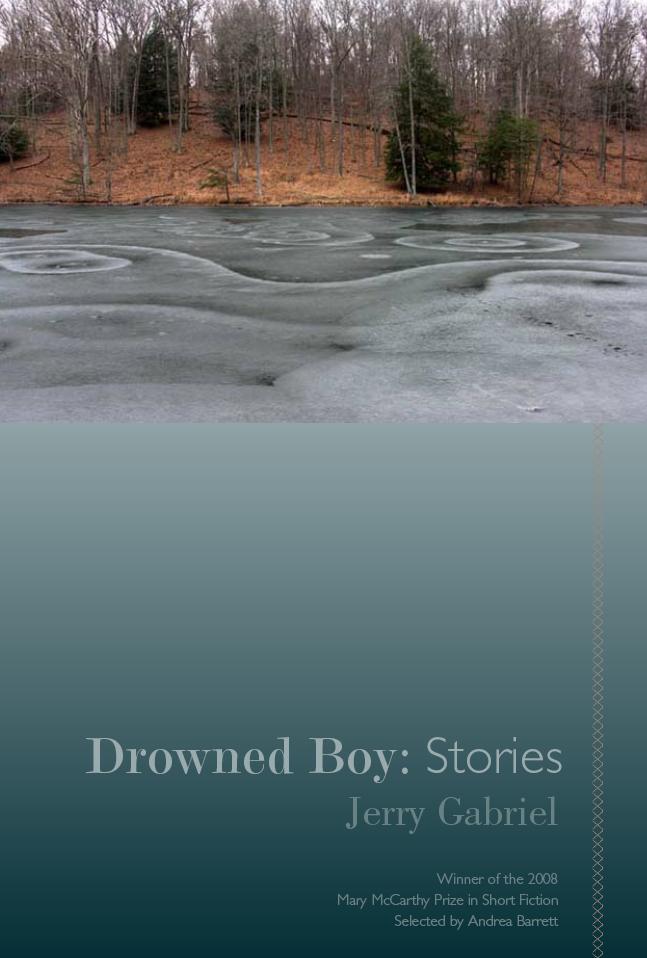
The seven stories and the novella that make up Jerry Gabriel's recently published collection are linked by a single character, much in the manner of another Ohioian, Sherwood Anderson. The pieces follow Nate Holland from age eight to young adulthood and portray his upbringing in a small town in Southeastern Ohio. Gabriel's prose is spare and nuanced, giving the pieces a tone that is thoughtful and often stunningly beautiful—without giving into excess emotion. As a first book, the range of narrative strategies shows this to be the work of a writer who has learned his craft and honed it carefully. Although only two pieces are directly sport-themed, the rest of the book will appeal to fans of sport literature due to the regular references to sport. With these repeated allusions to baseball, basketball, and football as the background of this carefully constructed tapestry, Gabriel's work demonstrates the importance of sport in American culture.
Gabriel uses the identity-forming role of sport to begin to weave his tapestry in the first piece, "Boys Industrial School," when eight-year-old Nate embarks on an adventure with Donnie, his older brother, to earn a reward for finding an escaped juvenile delinquent. The role of sport as social glue at family gatherings is employed in "Falling Water," a first person narrative that contains a tightly drawn portrait of Nate's parents and a particularly beautiful closing image that speaks volumes of their relationship. That same bonding function is employed in "Atlas," another first-person Nate narrative, along with the expectation of athletes to behave in a manner that is distinctly different from counter-cultures like the hippy movement of the 60s.
In the same vein as these stories, the collection's title novella, "Drowned Boy," uses the connection of childhood sports as a motivation for Nate to attend the funeral of a dead classmate. This longer piece is an elaborate pas de deux between Nate and Samantha, who is equally drawn to the death of her classmate, as the two of them circle toward a collision course that is both expected and surprising.
The two sport stories in the collection are fine examples of how narratives can be built around sports. "Marauders" is a first-person plural confession of local basketball fans who realize they are looking to sixth grade boys to provide meaning to their lives. "Slump" on the other hand, relates the first-person observations of a local youth baseball umpire and shop teacher who witnessesÑand eventually puzzles outÑthe inexplicable decline of a little league baseball star. As with the other stories in the collection, "Marauders" puts the reader on the backroads, inside the walls of the decrepit gymnasiums, and at the scarred tables of small town bars with the disappointed adult women who use basketball to get through the dark nights of their post-industrial winters. Part Breakfast Club (but from the faculty point-of-view) and part Election, "Slump" explores the politics of small town sports and high school. Once again, the story hits the proper notes in its treatment of how peopleÑreal peopleÑmanage to adapt and evolve. It is also refreshing in its treatment of young adults and their ability to know what they want in life.
Taken together, the pieces in this collection were a pleasure to read. The stories and novella, although disparate in their structure and spread out across time and space in their settings, always ended on a note that made me both happy and sadÑhappy because they ended so well, but sad they had to end.
Gabriel, Jerry. Drowned Boy. Louisville, Kentucky: Sarabande Books, 2010. 154 pp. $15.95 paper.
Copyright © 2010 by Scott D. Peterson.