three finger
Reviewed by Mark D. Noe, Pennsylvania College of Technology
6 September 2010 archive
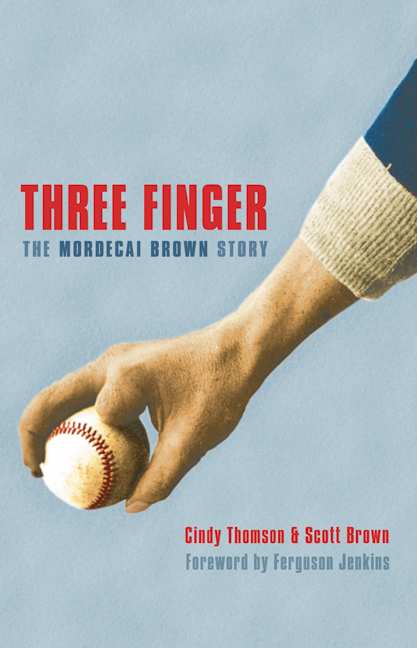
A good baseball biography needs to blend, in sufficient detail, the personal and professional lives of its subject, at the same time it sets the professional portion in the context of the greater baseball world . . . and, often, the broader cultural milieu. Finding the right balance of these elements is the tough part. When an author is kin to the athlete, achieving that balance is harder yet. Cindy Thomson joined Scott Brown, both distant relatives of Mordecai Brown, to manage that balance well through much of their jointly written biography, Three Finger: The Mordecai Brown Story.
Both authors learned only after reaching adulthood that they had family connections with Mordecai Brown. Over several years, their newfound relative became a focus of interest for them, and they eventually put together his life story. Home setting, upbringing, familyÑthey're all covered well, both for Brown's early life and later years. Coverage of his active ball-playing years is less complete, though the high points are handled in good detail. By the end of the book, his career and life are both rendered sufficiently for a basic understanding of the man, not just of the ballplayer, and his world.
Brown was what we'd today call "disabled." Yet his 239 wins, his 2.06 career earned run average, and his membership on a team with a slew of league pennants and World Series wins belie that expression. That the team was the Cubs might make a 21st-century reader think "fiction," but they were indeed the Cubs, and Mordecai Brown did all these things despite—or more precisely because of—his mutilated right hand. Early chapters trace Brown's route to the big leagues, beginning in Nyesville, Indiana. They offer details about the childhood injury that, astonishingly, made his career possible. The injury, which took place when he was just five years old, actually happened in two stages. First, the hand was horribly mangled in a feed chopper, then rather hastily repaired by a former Civil War surgeon, trained to make quick fixes of battle injuries. After sewing up what remained of the hand, he splinted the fingers and sent the boy home.
Weeks later, while playing with his sister, the boy fell on the hand, breaking six bones (though neither child realized the extent of the second injury). The two kids conspired to keep it secret from their father, knowing he would have been angry with their action. When, eventually, the doctor removed the splints, he had trouble believing what he saw. He likely "considered re-breaking the misaligned fingers to set them straight again, but he dismissed the notion, probably figuring the boy had already undergone enough trauma." As a young man, those fingers kept Brown from being hired to do the mine labor that was common labor for a young man in his home region, though a mine operator did hire him for a clerical job.
The mangled hand might have kept him above ground instead of down in the mines, but he was still eligible to play on the company baseball team. On a series of miners' nines, young Brown played third base and pitched, doing well at both positions, though the pitching was confined to relief work. The problem was that his throws from third often proved troublesome to the first baseman, as they made some strange twists and turns en route to the man's glove. Finally, thanks to a scheduled starting pitcher's drunken state one Sunday in July, 1898, Mordecai Brown was handed a baseball and named starting pitcher in a game, which he won easily. Though he had much to learn as a pitcher, the combination of his natural talents and his unnatural grip set him on the trail to stardom. Still, it was a long, circuitous trail: his route to the Cubs traversed a series of Indiana back roads as he moved up through the levels locally and then regionally.
At the professional level, Brown was originally signed, ironically, not by the Cubs but by the St. Louis Cardinals. More, the Cards traded him to get a veteran pitcher they thought would be a key to their near-term success. (Forgive a Cub fan who has survived the second half of the 20th century for thinking immediately of a doubtful-youth-for-proven-age trade made in 1964, between these same two teams. Perhaps, in the great scheme of things, Brock-for-Broglio was simply Redbird revenge.) Brown's arrival in Chicago coincided with the Cubs' halcyon days, the days that included three consecutive pennants, the legendary leap past John McGraw's Giants in 1908, and, most recently, that oft-recalled World Series win preceding the century (and more, but let's not talk about it) drought.
The central segment of the book covers the high points of Brown's days as a Cub, focusing on several incidents now enshrined in baseball mythology. The 1908 season gets two chapters, with the second devoted to just the playoff game and the World Series that followed. Other chapters encompass a season, sometimes two, till near the end of Brown's career. The final quarter of the book treats of Brown's brief stops with other clubs, then his return to the minor leaguesÑwhere he pitched for the love of it and coached youngsters at the opposite end of their career arcÑand finally his post-baseball life.
Those bookend portions of this biographyÑthe early and the late chaptersÑprovide intimate details about Brown's family and the man himself. While other biographies have offered many of the same details, there is a personal side to some of what Thomson and Brown manage to give here. They interviewed family members, providing a modestly different vantage point for their perspective. A substantial selection of accompanying photos, again including some recently pulled out of family scrapbooks, enhances that personal side. Several capture that gnarled right hand (one printed, colorized, on the cover). Another is the last known picture of the uninjured hand, on little Mordecai at age four or five.
While the book is marred by a handful of editing errors—not typos but bona fide mistakes in language or detail—they are easy to read past or mentally correct. Far more important is the book's exposure of the personal side of the life of an early baseball deity, a man who showed it was grit more than girth that make a star baseball player, which the book presents well. A Foreword by Ferguson Jenkins, a Cub pitching star from a later period, grounds the story in the greater breadth of Cub lore. An Appendix provides statistics, and (unusual for many family-based studies) there is a complete Index. As usual, the physical volume is up to the expected quality of a Bison Books product. Three Finger: The Mordecai Brown Story is a fine addition to the baseball fan's library.
Cindy Thomson and Scott Brown. Three Finger: The Mordecai Brown Story. Lincoln: U of Nebraska P/Bison Books, 2006. 250pp, illus. $17.95 paper.
Copyright © 2010 by Mark D. Noe.