soccer stories
Reviewed by Michael Buma, University of Western Ontario
4 September 2010 archive
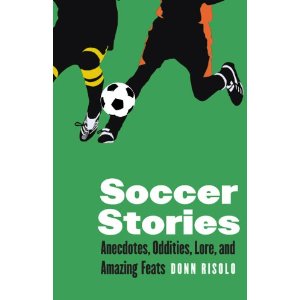
As its subtitle announces, Donn Risolo's Soccer Stories is a collection of "anecdotes, oddities, lore, and amazing feats." That's a pretty accurate description. Rather than advancing a unified or progressive argument, Risolo offers a magpie nest of snippets, stories, and soccer minutiae. Each of these is delivered as a distinct section, which, in turn, is organized into chapters along loose thematic lines. Most of the entries are quite short, and few run longer than a page or two. The result is a book that can be consumed equally well in large portions as it can in random five-minute sittings. In addition to my usual routine of reading on the living room couch, I brought Soccer Stories with me to the beach, the dentist's waiting room, and to several other places where distraction abounds. Normally, I have a hard time reading in busy public spaces, but given the episodic structure of Soccer Stories, this actually worked quite well.
Soccer Stories is in various turns enthralling, amusing, and tedious, but predominantly tends toward the more favorable of these descriptions. Risolo seems to have left no stone unturned in his search for unlikely details and curios, and in many cases the results are both interesting and strange: an Istanbul McDonalds that permanently changed the color of its iconic golden arches to black and white in order to promote a local team, a Malagasy team who scored 149 goals on their own net in protest of the referee's performance, a Romanian player whose contract was purchased by another club for 15 kilograms of sausage, a Brazilian team who ran out of cash and had to offer their players payment in cattle, an amateur tournament held by eight Russian teams at the North Pole (which, quite fittingly, was won by the employees of a refrigeration plant), and, among many other possible examples, a pair of fans who legally named their son Graham Alex Jimmy Stewart Gerry Brian Martin Steve Sammy Stuart Lou Gordon David Tommy Matt Cross to commemorate Manchester United's roster in the year of his nativity. This is crazy stuff, much of which can be filed under truth being stranger than fiction. But Soccer Stories is also at times tedious and overly trivial. Risolo's discussion of field dimensions, rule permutations, and World Cup attendance statistics, for instance, seem out of place, and a few of the anecdotes ultimately fall flat, which, to be fair, is bound to be the case in such a collection.
Despite explicitly targeting an American readership (the longest chapter focuses on American involvement in the game), Risolo's introduction acknowledges that soccer doesn't have the following in North America that it enjoys almost everywhere else on earth. This, of course, necessitates a quick and dutiful case for soccer's appeal, in which Risolo rehearses several familiar arguments that North American proponents tend to make in support of their game: primal simplicity and portability, a pace and value system that metes out offence sparingly but in dramatic "nuclear bomb blast[s]," the fact that soccer is played without hands and therefore requires greater creativity and skill, the relatively average stature and dimensions of the players (as opposed to, say, basketball's preference for height or gridiron football's for bulk), and, finally, the fact that soccer is pretty much universal in the rest of the world. There are, of course, counter-arguments for many of these claims that have often been made and repeated by what Franklin Foer calls the North American "anti-soccer lobby." But as Risolo concludes, despite the outright hostility of some and the passive indifference of others, soccer is quickly moving beyond its status as a niche sport and entering the North American cultural mainstream.
So how does Soccer Stories fit into this changing cultural landscape? Risolo bills the book as a "pause during [soccer's] inexorable march" toward success in North America. Clearly this is the perspective of a true believer, and in a sense it is Risolo's faith in soccer's appeal that makes the entire collection possible. Rather than offering another protracted and repetitive apologia, Risolo's belief that soccer will eventually win over North American hearts allows him to turn away from the game's culture wars and explore "some of the interesting, amusing, odd, and amazing tales that help flesh out soccer and give the game its color." The result is an interesting and original book that rather necessarily ends up reaching to the converted. While Soccer Stories is full of the delightful details and arcane quirkiness on which super-fandom feeds, it probably won't appeal to the casual observer whose primary experience with the game is tuning in to the World Cup every four years or bringing the kids to little-league. Soccer hasn't yet achieved the critical mass of passion and prominence in North America that would ensure wide readership for a book such as this, an unfortunate reality given that many of Risolo's stories are very much worth telling.
Risolo, Donn. Soccer Stories: Anecdotes, Oddities, Lore, and Amazing Feats. Lincoln, Nebraska: University of Nebraska Press, 2010. 376 pages. Paper. $24.95.
Copyright © 2010 by Michael Buma.