in search of powder
Reviewed by Angie Abdou, College of the Rockies
1 September 2010 archive
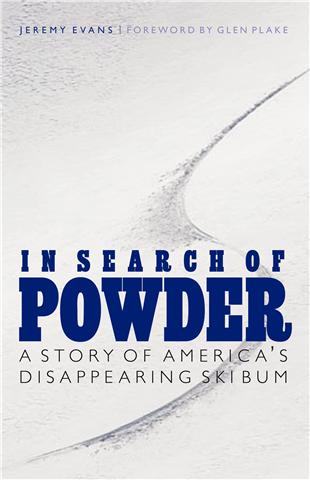
In Search of Powder is Jeremy Evans' tribute to the dying ski-bum culture. Like others before him, Evans laments the rising cost-of-living as mountain towns turn into mountain resorts. He complains that this inflation has forced out ski bums who must reshape their lives to adapt to urban sprawl. The goal of his book is to "describe why ski bums are becoming ghosts in their own backyards and what kind of spirits will be lost when they do vanish" (xxv).
The central argument is not a new one. Evans asserts that "rising real estate costs, misguided values, an immigrant work force, and ski resorts operated by publicly traded corporations or other profit-above-all-else people have changed the dynamic of ski towns and the ski bum lifestyle. It's more difficult now. It's different. Ski towns have become extensions of America, where money and real estate and commutes dominate the way of life" (xxiv).
Hal Clifford has already made that very argument in Downhill Slide: Why the Corporate Ski Industry is Bad for Skiing, Ski Towns, and the Environment (Sierra Club Books 2003). Clifford devoted 300 pages to his scathing condemnation of the relatively recent emergence of publicly traded ski corporations, claiming that the threat of commercialization means that modern ski towns are no longer idyllic escapes from the mainstream, consumerist culture. Instead, skiing itself has become a consumable experience. Since In Search of Powder is so much like Downhill Slide, readers might expect Evans to enter into a more direct conversation with Clifford's book and build upon Clifford's argument, rather than merely repeating it.
Like Clifford, Evans includes some rapturous descriptions of the flow state achieved while skiing: "Everything else is stripped away-bills, career, societal expectations-like peeling away bark and aiming for its core. The popping continues, the bouncing from edge to edge, the smacking of your bases as they sink into another layer. All you are left with is yourself, the mountain, and God's greatest creation-snow. With each turn, with each pop, you eliminate excess from your life" (63). Also like Clifford, Evans reveres those whose lives are dictated by snow conditions rather than work opportunities because "career advancement is meaningless if your passions are sacrificed along the way" (xviii). And, like Clifford, Evans makes an argument for the way in which "when skiing was at its peak in popularity, the image of colorful characters living a simpler life was hijacked by marketing gurus and prostituted to sell the mountain lifestyle" (143). During these parts of the book, I could not help but wonder what Evans was adding to the discussion of the future of skiing and ski towns.
In Search of Powder is most thought-provoking in its consideration of extreme sport. Evans exposes and questions the risks taken by the branded athlete turned "billboard" (208) and "test dummy" (218) by his corporate sponsors. He tracks the growth of the ski video-or "ski porn" (193)-industry and the emergence of the Winter X Games. He subtly calls into question a sport where death is always "conceivable, if not certain" (181). It is on these topics that I wish Evans would have spent more time.
Even in these more profound sections, though, the writing is distracting. Evans makes sweeping generalizations: "Big breasts, however, have always been admired by men" (148). He writes awful similes: "Red brake lights exploded everywhere like sad eyes in the back of robots' heads" (xviii). He has editing errors: "the guy who ekes out a living each year working a menial job and can buy little more than basic luxuries" (xxv - surely he means basic necessities, right?). He misuses words: "the drugs were very, very prolific" (16). He oversimplifies other sports: "And when he contracted the ski bug, skiing was no longer a recreational sport like football or how tourists view skiing, but a feeling. It shaped his personality and helped him answer two important life questions: Where should I live and how will I make money?" (5). Of course, many football players use their sport to shape their personalities and to answer these same questions. The strength of In Search of Powder, then, is not in its analysis or in its contribution to sport studies. Evans' work is heavy on description and quotation, light on interpretation and commentary.
However, the originality of In Search of Powder is in its comprehensive descriptions and its archiving of ski-bum stories. Evans captures the gritty details of this esoteric lifestyle to a degree not accomplished elsewhere. He brings to life a world where a young man's existence can be fully dedicated to "shredding the shit out of the mountain" (184). He immerses readers in a culture where asking "what do you do?" means "what kind of drugs do you take" (18). He vividly portrays unique ski-town personalities such as: Tom Rudder who belches beer to punctuate every sentence (13); Jack Carey who just wants to have the simple life of living in the valley, hiking and "doing" his girlfriend in the hills (111); and Howie Henderson who insists "What do you mean I can't ski past that closed sign? Why are the Hobacks closed? Don't tell me I can't do something. I can do anything I want to do and ski patrol can't stop me. I will drink them under the table" (172). The extent to which the ski-bum life is like no other is best captured in Johnny Davis' nostalgia about his friend Paul: "I remember one gal, Judy, she had a body on her that wouldn't quit. Paul opened up the ketchup bottles and started pouring it all over her and licking at off. My buddy and I look at each other, saying 'Is this the life or what?'" (9).
Clearly, I am not the target audience for this book. I love ski towns: I live in one. I love men who insist on skiing as often as possible: I married one. However, if Evans' beer-belching, ketchup-lickers are meant to be representative of ski bums, I cannot bring myself to mourn their disappearance.
Evans, Jeremy. In Search of Powder: A Story of North America's Disappearing Ski Bum. Lincoln, Nebraska: University of Nebraska Press, 2010. 225 pages. Paper. $16.95.
Copyright © 2010 by Angie Abdou.