the art and aesthetics of boxing
Reviewed by Dick Stull
6 July 2010 archive
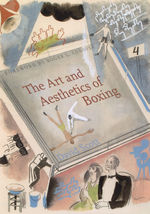
If you thought that boxing was just a couple of guys slugging it out in the ring, think again. Dublin's Trinity College Professor of French (textual and visual studies), expert on semiotics (the study of signs and symbols) and amateur boxer David Scott has written a book that pushes the boundaries of pugilistic possibilities. If you never considered the meaning of modernism, if you haven't recently reviewed your notes from your college art appreciation class or recall Sister Wendy's PBS series on the history of western art, put on the head-gear and get ready to trade post-modern punches with Scott – or prepare to at least rope-a-dope.
Scott's primary artistic metaphor for boxing is the "framing of violence." Drawing on boxing historians, such as Elliot Gorn and others, Scott summarizes the evolution of boxing in the ancient Greek world through the late 18th century where the gathering of spectators around two combatants formed the outline of a ring. The famous Queensbury Rules written in 1865 provided for the standardization of many practices still used today, such as the number and length of rounds, length of rest periods, etc. The ultimate squaring of the circle in the form of the ring with ropes and the introduction of boxing gloves were later developments (ironically, boxing gloves made fighters more vulnerable to harder blows to the head now that the brittle bones in the hands were protected). These advanced evolutionary changes provided fighters with infinitely more possibilities for footwork, moving, punching angles, clinches and strategies and, in the process, allowed for more artistic combinations and permutations, more metaphors, more visual representation, more prose, more poetic possibilities for the observer – aesthetics.
Scott also references many of boxing's cultural contexts and psychological complexities – he draws on the works of Gerald Early, Joyce Carol Oates, and many others. He attests to boxing as a source of fascination for American writers like Norman Mailer, Ernest Hemingway, Jack London and artists like George Bellows and Thomas Eakins. The powerful undercurrent of masculinity suffuses the book. For example, Scott discusses the idea that a boxer is not fighting one's opponent but rather one's own shadow. A knockout blow "temporarily restoring the split consciousness to one as opposed to two centers, as one figure's phallic verticality triumphs over the other."
Later, Scott takes us into fourth dimensional rounds where the April, 1968 Esquire cover of Muhammad Ali is an updated St. Sebastian martyr – and homoerotic allure. Scott's chapter entitled "Boxing apparel and the legible body" writes about the boxer's trunks in ways that the bar-room Pabst crowd might have missed: "The satin material added a touch of feminine glamour both to the state of purposeful undress of the boxer and to the otherwise relentlessly masculine ethos of the sport." The psycho-sexual implications/insights get downright scary. A senior seminar with these readings and a heavy dose of hallucinogens might literally shatter one's world. This is a long way from Fight Club!
But it's the hidden lines, angles, and shadings that appeal to Scott's aesthetic nature, as well as language and metaphor. This is where the going gets tough in the latter reading rounds – a boxing poster for a welterweight title fight imputes the Big Bang theory as presentiment for the impending knockout, or the Italian futurist art movement in the 1920s presages our evolving mechanized world through movement in stillness, dynamism in static objects like a painting or sculpture. I was tempted to analogize Scott's analyses to Tom Wolfe's classic piece of modern art criticism The Painted Word, or the clever imputations in creative wine tasting summaries. Scott's analysis of a modernist boxing poster, for example, forced me to look "again." I saw design where I used to see randomness. Just as I detected the "hint of a chocolate nose" in the red wine after it having been deftly suggested by a clever wine steward, so I did with many of Scott's analyses. It took a lot of cerebral sparring, feints and roadwork to gain new insights into "seeing," though after every round I came back with a headache. Scott is a professioral Aaron Pryor, coming at you from all angles, relentless.
Scott has a particular interest in the advent of and significance of the ropes. The ropes provide a "sense of containment, a loose elasticity and a marginally expanded contract space of movement – a three-dimensional Cubist space providing the spectator a pan-optical view in contrast to the confinement and focus of the boxer's " blank page for the poet or the empty canvas for the artist's already charred and laden dynamism. It is an infinitely variable parabola of geometrical motion awaiting activation by the imprint of the boxers." Pugilistic paraphrase? Fight trainer Angelo Dundee's loosening of the ropes the evening before Muhammad Ali's epic 1974 Rumble in the Jungle heavyweight championship defeat of George Foreman to "set the stage" for Ali's infamous "rope-a-dope" strategy. Ali used the ropes to absorb Foreman's blows before turning into a matador in the eighth round and knocking Foreman out – it was the shape-shifter Ali as wily improv-artist with a little help from his trainer.
Scott also has some arresting analyses of boxing photographs, discusses surrealist poets and modernist writers, and at the end of his book includes pictures of eighty year old Spaulding advertisements for boxing gear. This reminded me of comedienne Lily Tomlin's one-person show, The Search for Intelligent Life in the Universe, where, in contemplating a Campbell's tomato soup can, she asks herself and the audience, "Soup? Art? Soup? Art?" Is this a Scott semiotic left hook? Ads? Art? Ads? Art?
Many years ago I remember reading about two artists in San Francisco who not only didn't like each other's work, but didn't like each other either. They decided to hold a three-round boxing match in order to settle their animosity and at the same time raise funds as a benefit for the "arts." Many of San Francisco's cultural elite turned out for this infamous fight. Neither of the two artists had any training in the skills of the "manly art," but apparently it was a sensation in San Francisco. They beat each other up for three rounds while the crowd cheered them on. As I recall, the next day the headline in the paper read, "It wasn't art!" Both boxing and art critics agreed on that one. Scott's book can be appreciated by both art and boxing aficionados. It offers new ways to make "sense" of our world through the creative representation of relationships hidden within the most primal of human activities – boxing. I went all 15 rounds with Scott's The Art and Aesthetics of Boxing – he won the unanimous decision. He's tricky, clever, and hard to hit. I learned about the boxing ring as a three-dimensional picture frame, as ritualistic theater and poetry for physical, psychological and cultural combat – or, just another way of saying, "Let's get ready to rumble!"
Scott, David. The Art and Aesthetics of Boxing. Hardcover: 204 pages. University of Nebraska Press, (2009) ISBN 978-0-8032-13867 Includes
figures, photos, bibliographic references, notes and index.
Copyright © 2010 by Dick Stull.