1921: the yankees, the giants & the battle for baseball supremacy in new york
Reviewed by Duncan R. Jamieson, Ashland University
4 July 2010 archive
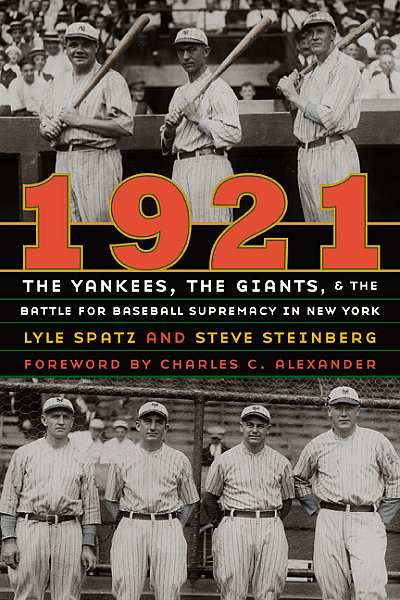
Probably few Americans took much notice of the July 1921 Joint Resolution of Congress, which officially ended American hostilities with the Central Powers in The Great War. After all, the troops had come home a few years earlier. The Red Scare, while a recent memory, was a fading one. Sacco and Vanzetti languished in a Massachusetts prison, but only leftists and intellectuals seemed interested in their plight. Inaugurated earlier in the year, the scandals-both economic and sexual-of "normalcy's" Warren G. Harding, the last in a line of undistinguished Ohio presidents, had not yet forced him to walk the halls of the White House at night. Wall Street stood at the beginning of a phenomenal bull market.
However interesting the above material might have been to an informed minority at the time and to historians today, the sports pages gained far more attention; tight pennant races in both the National and American Leagues took center stage. This helped redeem baseball after the 1919 Black Sox baseball scandal and the 1920 death of Cleveland's shortstop Ray Chapman, felled by a bean ball in an August game against the Yankees. The New York Giants clinched their pennant first, followed by the New York Yankees, resulting in only the second one city World Series (the first was in Chicago in 1906).
Not until the end of the season was it assured that the two New York teams (playing in Brooklyn, the Dodgers were not considered a part of New York) would meet each other. Not only would it be an all New York series, all the games would be played in Manhattan's Polo Grounds. Owned by the Giants, they rented it to the Yankees until they built their stadium across the river in the Bronx. The National League's New York Giants, representing the Gay Nineties, and the American League's New York Yankees, the upstart team of the Jazz Age, alternated being the home team in this, the first of only two World Series played in only one ball park. While the Giants won the World Series, along with the 1922 rematch, they lost the 1923 series in the newly completed Yankee Stadium, "the house that Ruth built," commencing the Yankee's dynasty. New York City had become the king of baseball, led by "the best team money can buy," a term as popular then as it was following the conclusion of the 2009 World Series.
While our generation clearly has technological advantages unknown in 1921, these advances have not come without a cost. Watching a game on television is certainly interesting and exciting, and with cable and satellite, the avid fan can watch virtually any game. To gain this, however, we gave up the beauty of the newspaper account. Sportswriters provided a color and depth to the game that today's broadcasters cannot match. Not only do the authors offer a stellar account of the 1921 season, they repeatedly use the words of the sportswriters of the day, some of which present the social issues that help define the era. Sports fans followed the 1921 season from the pens of some of the best writers of the twentieth century-Grantland Rice, Heywood Broun, Damon Runyan, Westbrook Pegler and Ring Lardner to name just a few. Writing about Game Three, when the Giants were down two games and behind by four runs in the third, Chicago's Hugh Fullerton (1873-1945) predicted that their situation was "about as bad as Abie Cohen's chances of being elected chief of the Ku Klux Klan" (p 344). The sportswriters had no entitlement to the well turned phrase; during the 1921 season when the Yankees met the Browns in the Polo Grounds, Urban Shocker intentionally walked the Babe twice, much to the disappointment of the fans. After the game. Browns' manager Lee Fohl explained that since he couldn't play his "outfielders in the middle of the next block," he had to order Shocker to walk the slugger (p. 301). The result is a feeling akin to being an actual observer of the season.
At the beginning of the live ball era, the hero of the book, and of baseball, was Babe Ruth, who as the face of the nation's pastime, restored the glamour and excitement. At the other extreme was New York Giants Manager John McGraw, who had little use for the American League in general and the New York Yankees in particular. Spatz and Steinberg are more judicious in their treatment; while the Babe is clearly the hero of 1921, they devote equal time to both McGraw and Miller Huggins, the Yankee's skipper.
When the World Series began, New York Governor Nathan L. Miller backed the Giants, despite the fact they had won only one World Series previously and despite the fact that McGraw had lost the next four that the Giants entered. Realizing his untenable position, Miller backed the Giants because both he and McGraw were born in New York's Cortland County. Though Miller's prediction proved correct, his political career followed the fortunes of the Giants. A more astute politician, Al Smith, who defeated Miller in the 1923 election and held the post for three terms to Miller's one, did not take a public stand on the Series, but he was one of the notables in attendance at the first game.
Unfortunately, the generation that followed the 1921 season witnessed the United States again at war, with many more young men dying on the fields of France. After the successful conclusion of hostilities this time, the American would remain in Europe to occupy and to rebuild shattered countries. Shortly after the end of World War II, Americans would survive yet another Red Scare. Despite continued protestations of innocence and pleas for clemency from around the world, including one from Pope Pius XI, Sacco and Vanzetti died in the Massachusetts electric chair in 1927. Breaking news of scandals drove President Harding to make a tour through the West to speak and fish; in San Francisco, he died before the worst of his failings came to light and the worst of his cabinet appointments went to prison. And the stock market, after reaching dizzying heights late in the 1920s, crashed, awakening Americans to the worst depression in the nation's history. And through this era, the New York Yankees and the New York Giants, the heroes of 1921, would appear in thirty-one World Series, with the Yankees winning 18 and the Giants two.
Spatz, Lyle and Steve Steinberg, 1921: The Yankees, The Giants & The Battle for Baseball Supremacy in New York. Lincoln: University of Nebraska Press, 2010. ISBN#: 978-0-8032-2060-7.
Copyright © 2010 by Duncan R. Jamieson.