shelby's folly
Reviewed by by Richard Arlin Stull
3 July 2010 archive
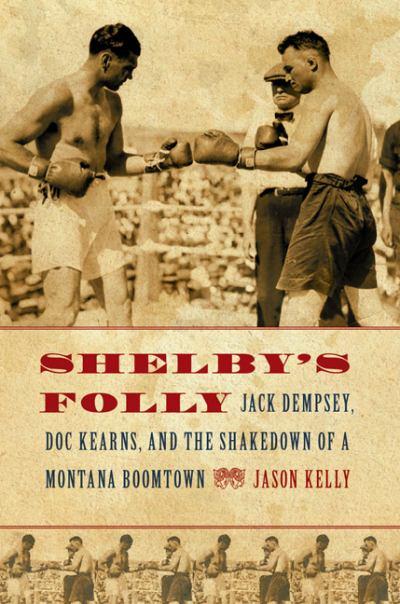
Jason Kelly's Shelby's Folly is a highly entertaining slice of American history using Jack Dempsey's July 4, 1922, heavyweight title fight versus Tommy Gibbons as a backdrop for brazen American optimism, small town politics, and snake oil salesmanship. The real protagonists in this story are the small boom-and-bust town of Shelby, Montana , and Dempsey's manager, charismatic con man Doc Kearns. Shelby's mayor, "Body" Johnson, lets the news media know that Shelby, the pretender to the title of " Tulsa of the West," is out to become the center of the American sports world. Though initially it was a publicity stunt, private citizens and business interests become enamored of the opportunity to host the fight, despite, as Kelly writes, "having no arena, no transportation, infrastructure, no restaurants, and no hotel rooms to accommodate even a fraction of the crowd."
Enter Dempsey's manager , Doc Kearns. Kearns was a former Alaskan adventurer, boxer, baseball player, taxi driver, bartender, Barbary Coast carouser, fancy dressing, champagne-drinking, fast-talking, and womanizing manager of the heavyweight champion. "Every day was New Year's eve," as one notable sportswriter referred to Kearns. He put the "ooze in schmooze," according to Kelly. His rise to the top of the fight game is a classic "only in America" story, not unlike another boxing promoter half a century later by the name of Don King. Kearns gets varied interests in the town to pony up $100,000 as the first installment on a guaranteed total of $300,000 for the privilege of hosting the fight. Somehow, the town manages to build a new 40,000 seat outdoor octagonal stadium, "transportation, infrastructure, restaurants, hotel rooms, etc."
Kelly does an admirable job in the opening chapter of setting up the fight, segues into describing the characters in the town, its history and the heroic efforts not only to get the fight, but to accommodate the fans. Dempsey, age 34, was enjoying the trappings of fame and wealth that came with the championship. Though past his prime, he was still a fearsome puncher who bored in on his opponent and rarely took a step back. "Cerebral slugger" Tommy Gibbons, age 32 and a 5-1 underdog, was a master boxer in the mold of former heavyweight champion Gentleman Jim Corbett. Confident that he had the stamina and style to beat Dempsey, Gibbons was even willing to fight without a guaranteed cut of the gate. The townsfolk of Shelby identified with and embraced the straight-arrow family man Gibbons. Even Chief Curly Bear of the local Blackfoot contingent made Gibbons an honorary member of the tribe before the fight. Kelly also describes the fight itself in the penultimate chapter where Gibbons surprised many in giving Dempsey all he could handle. Kearns broke countless investors and four local banks before he absconded after the fight, leaving everyone but himself and Dempsey the poorer for it. As with modern day examples of cities hosting the Olympic games, Shelby 's balance sheet in the end was bright red. The town of Shelby and Tommy Gibbons, however, "went the distance."
Kelly's final chapter is a great "where-are-they-now" (or "where did they go?") wrap-up, letting the reader discover what happens to the town characters you get to know in the story. Kelly has a wonderful ironic writing style Ð he is a storyteller, the kind of person you would have liked to have had teaching your college history class. Describing the Shelby townspeople with fond appreciation and tossing out enough alliterations to rival Robert Louis Stevenson, Shelby's Folly is a quick read night table soap opera that you enjoy coming back to after a hard day's work. It recreates a time and place in America with just the right combination of romanticism, humor, and reality. It could easily be made into a three-act play or movie. Too bad we can't resurrect James Cagney to play Doc Kearns. Kelly's book also has twenty-three photos including Dempsey, Gibbons, the town of Shelby and its characters, and a bibliography.
And what about Kearns' bilking of the good people and four banks in Shelby ? Wasn't this just "business?" as usual? Kelly slyly slips the reasons for Kearns' real motivation into one of the chapters, giving even more flavor to this Wild West comedy/tragedy of errors. Turns out it was personal after all.
Kelly, Jason. Shelby's Folly: Jack Dempsey, Doc Kearns, and the Shakedown of a Montana Boomtown, by. Hardback: 214 pages. University of Nebraska Press (2010) ISBN-978-08032-2655
Copyright © 2010 by Richard Arlin Stull.