the imperfect diamond
Reviewed by James A. Vlasich, Southern Utah University
10 June 2010 archive
The strife between management and labor in baseball in some ways parallels that of other industries. Contention in the late nineteenth century would finally give way to more equitable treatment in the next century. Baseball players, however, faced an even steeper hill to climb because they were thwarted by the Supreme Court and the reluctance of Congress and management to see them as a legitimate group of workers who should have the right of collective bargaining. Players were discouraged from unionizing because their careers were brief and any form of strike could lead either to blackballing or simply a loss of skills through non-working periods typically associated with strikes.
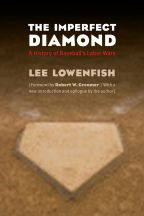
The contentious nature of player/management disagreement and the long, drawn out attempts to form a union are the subject of Lee Lowenfish's book, The Imperfect Diamond: A History of Baseball's Labor Wars. Using standard works on the history of the game by Harold Seymour, Robert Smith, and David Voight, the author puts his story into proper context. He adds significant biographies and autobiographies of the major figures in the story, works on the legal aspects of the business, archival collections, and excellent academic studies on the business side of the game. Grounded in thorough research that provides the plethora of material for this detailed study, Lowenfish accurately covers a history that reveals a one-sided account of management's control over players based on the reserve clause.
Lowenfish cites some of the standard players in this drama, along with some rather unknown figures. Beginning with the formation of the Brotherhood of Professional Base Ball Players under John Montgomery Ward in 1885, the group took on a mentality similar to the Knights of Labor. They eventually formed the Players League to compete with the dominant National League. Lacking sufficient financing and business skills, the league folded in 1890 and the senior circuit reigned supreme for the next decade. At the turn of the century, another players association, dubbed the Players Protective Associate and supported by Samuel Gompers, made a brief attempt to counter the owner's dominance but fear of collective action against monopolistic rulers stymied any effort by labor. Even the work of David Fultz, as head of the Fraternity of Professional Baseball Players of America, resulted in few gains. The formation of the Federal League in 1913 did little more than raise the salaries of a few stars. However, it did lead to a landmark Supreme Court ruling under Justice Oliver Wendell Holmes in 1922 that nonsensically determined that baseball was not a business because it did not involve interstate commerce.
Stifled by economic hardship during the Depression years and the autocratic lordship of Commissioner Kenesaw Mountain Landis, players' unionization was delayed until the end of World War II. By then, wartime associations of players made them aware of common concerns. Court cases following the war incited a spirit of rebellion and brought the possibility that baseball was operating outside the law by not applying the Veterans Act to the players. More serious trouble followed with the formation of Jorge Pasquel's Mexican League and the famous suit by Danny Gardella in which lawyer Fredrick Johnson argued that the radio and television broadcast had diluted the basis of the court's decision on non-interstate commerce. Lowenfish argues that new commissioner "Happy" Chandler mishandled the Gardella situation and that Landis, who had kept baseball out of the courts between the World Wars, was better suited for the business side of the job. This case led to the Celler Committee investigation of baseball's anti-trust exemption in 1951.
Emboldened by congressional investigations and supportive court comments, the players, led by Ralph Kiner and Allie Reynolds, hired lawyers and formed the Major League Baseball Players Association in 1953. When Robin Roberts and Jim Bunning pushed for a representative not connected to the owners, Marvin Miller, an official with the United Steelworkers Union, entered the scene. More dedicated to the players' well being than other union leaders, Miller forcefully educated them in "their hidden strengths." Gradually, the story of Curt Flood's battle against the reserve clause emerged and, while he lost his case in the Supreme Court, fans saw the inequity of the ancient system of owner control and rejuvenated players realized that unity of purpose would produce results. Ironically, the author rushes through the significant story of Dave McNally and Andy Messersmith, which could use more development because it actually limited the reserve clause and initiated a new era. The book ends with the players triumphant and free agency established.
This is no new history of the contentious labor battle in baseball's history. First published in 1980 and updated in 1991 with emphasis on players' strikes, lockouts and collusion, The Imperfect Diamond has emerged as a classic in baseball history. However, the very revisions that bring it up-to-date also point to its problems. Instead of revising the original core of the book to fit its modern additions, the author lets them stand. For example, when addressing the Supreme Court's decision of 1922, he writes that anti-trust exemption continues until the 1990s. Actually, it's still alive today. This and other similar problems should be ironed out to make for a much smoother transition through the editions. There are also some typos in the early section that should be corrected. Finally, and most importantly, is the problem of author bias. Lowenfish is too obvious in his cheerleading for the players. An objective approach would make for a much more powerful statement on player/owner relationships over the long history of the sport. Many modern day fans feel that the pendulum has swung the other way and it is the owners who need unionization in order to halt frivolous spending, soaring salaries, and the high cost of attending a game. The very fact that more than half of the teams are eliminated from post-season play on opening day because they cannot afford to buy a winning team points to a need for a salary cap. Of course, this would mean a strike and the possible cancellation of yet another World Series. This situation suggests that another edition of this otherwise excellent work is in the offing.
Lowenfish, Lee. The Imperfect Diamond: A History of Baseball's Labor Wars.
Copyright © 2010 by James A. Vlasich.