coast to coast
Reviewed by Jason Blake, University of Ljubljana, Slovenia
MARCH 25, 2010 archive
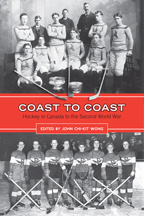
If new secondary literature on hockey keeps appearing, we hockey scholars will have to stop whining about the lack. 2009 was a fine vintage, with Canada's Game? Critical Essays on Ice Hockey and Identity (edited by Andy Holman), Now is the Winter: Thinking about Hockey (edited by Jamie Dopp and poet Richard Harrison), and John Chi-Kit Wong's Coast to Coast: Hockey in Canada to the Second World War – the subject of this review. This collection of essays by various scholars is a follow-up to Wong's 2005 Lords of the Rinks: The Emergence of the National Hockey League, 1875-1936. That book was significant because Wong was the first historian to gain access to the NHL archives.
Coast to Coast is first and foremost a book for historians, and I am doing it a minor injustice by approaching it as a literature guy. Nevertheless, such historical studies can inform one's interpretation of recent hockey literature, and this is why Wong's collection will appeal not only to historians.
The greatest virtue of Coast to Coast is that it goes beyond the NHL, which has usurped the North American hockey story. Team Canada and Team USA may have delighted fans in the deciding games in Vancouver, but most of the male players would surely prefer a Stanley Cup ring to Olympic gold. In the opening essay, Daniel MacDonald writes with fire and ire about the NHL: "As a hyper-capitalist, mega-metropolitan sports cartel, which is not without its labour difficulties, it has been naturalized as the premiere hockey league in North America and probably the entire world" (3). And yet the NHL story has been mythologized to the point of nausea.
The NHL's dominance comes, of course, at the expense of other regions. Coast to Coast turns the spotlight away from the big cities. These other regions include the part of Nova Scotia discussed by MacDonald in "Class, Community, and Commercialism': Hockey in Industrial Cape Breton, 1917-1937," Robert S. Kossuth's "Chinook Country Hockey: The Emergence of Hockey in Pre-Second World War Southern Alberta," and Wong's own "Boomtown Hockey: The Vancouver Millionaires," which, though focusing on a big city, looks at a professional league that existed before 1917 (i.e. before the NHL was founded).
Wong's article rounds off the Canadian hockey story, taking it to the shores of the Pacific decades before Vancouver got an NHL team. He provides an extremely thorough overview of the years leading up to "the time Vancouver hosted the 1915 Stanley Cup competition" (224), and almost half of the article is about Vancouver's rise as a city rather than the rise of the Millionaires. Considering mainly the economics and business aspects of professional hockey at the time, Wong convincingly argues that the dominance of one hockey brand was not inevitable. Things could have been different; the NHL could have been nipped in the bud.
The illustrious Patrick family promoted hockey to promote their Vancouver hockey enterprise. They "created a hockey culture by encouraging and cultivating interest in the sport" (239), in the meantime making it a game enjoyed coast to coast. Previously, warmish Vancouver had played other sports. However, Wong is careful to argue that this was primarily a business arrangement, and the Patricks had "no grandiose plan to move Vancouver and the West Coast closer to the Canadian culture" (246). Before an arena with artificial ice was built, Vancouver seemed more favorable to cricket, soccer and lacrosse.
The problem with so many collections is unevenness and lack of focus. Happily, this is not the case in Coast to Coast. Even if the Table of Contents looks scattered, the contributors collectively fulfill a purpose. By relating some of the previously silenced hockey stories, they show how the mythology of hockey came into being. Another continuity plus: most of the chapters refer to other chapters, and the authors do not appear to be writing in a vacuum.
As Robert S. Kossuth points out, to understand hockey's cultural dominance, one has to "search the periphery of sport in smaller communities throughout Canada" (203), not least because "hockey did not thrive equally throughout the country or even within regions, particularly rural regions" (217). Also, hockey had different meanings for different groups. For the very Irish-Canadian Montreal Shamrocks, a victory over the well-heeled and very English-Canadian Montreals was "akin to victories of colonized peoples over their colonizers in sport" (Barlow, 41).
For my money and interest, J. Andrew Ross's "Arenas of Debate: The Continuance of Professional Hockey in the Second World War" is the strongest chapter. With clarity and narrative verve, Ross outlines the complications of maintaining a professional league during a war. This required cross-border political machinations to keep Canadian players staffing American NHL teams instead of Canadian platoons and divisions. Businessmen somehow had to convince politicians that hockey was essential for wartime morale. I left this chapter to the end, wrongly convinced that I already knew the story (as a boy I believed the popular histories that told about Maple Leafs owner Conn Smythe putting his business interests on hold to support the war effort; his autobiography If You Can't Beat 'Em in the Alley, written with Scott Young, was remarkably coy on this point). Smythe was undoubtedly a good patriot, or at least a flag-waving monarchist, but he also knew how to feather his own nest. He kept gate receipts flowing and made sure players completed their mandatory military training in the off season. Having dug through archives and government correspondence, Ross is able to show the dirty stuff going on behind the scenes in a very North American propaganda game.
As so often occurs, the newspapermen of the time got it best. Ross quotes a sardonic editor who failed to see how "in order to smash Hitlerism . . . the front line of the Boston Bruins must be kept intact," and another who remarked, "'something is phony' when Hank Greenberg of the Detroit Tigers and others had to settle for $21 a month [i.e. what he was paid as a draftee], while 'our Canadian cousins continue to ring the cash register'" (94). Roch Carrier, author of the ubiquitous "The Sweater" quoted on the Canadian five-dollar bill ("Our real life was on the ice"), has argued that in Canada you can explain anything through hockey. Not quite. Equating everything to hockey can lead to dangerous oversimplication. However, as Ross shows, one can use hockey it as an inroad to understanding parts of culture and society beyond the ice surface, beyond the so-called magic circle of play. Ross's consideration of hockey south of the border is also welcome, as this part of the North American hockey story is too often ignored by Canadian scholars.
A few chapters show a keen interest in narrative, examining individual newspaper reports and trends in sports reporting. In "'Scientific Aggression': Irishness, Manliness, Class, and Commercialization in the Shamrock Hockey Club of Montreal, 1894-1901," John Matthew Barlow argues that reporters in Montreal "became less concerned with the idea of fair play" and "more interested with winning and losing" (37) long before the amateur debate died. In a special subsection, Barlow provides cogent Ð almost literary Ð readings of individual press accounts. Important, too, is his highlighting of how self-consciously the journalists created stories of games. Consider this 1900 pronouncement: "Narrative in the superlative can only convey an imperfect sense of the paragon of perfection and sensation detail of this, the last and premier exhibition of a week's great hockey" (64). It's a shame Aethlon was not around then.
Stacy L. Lorenz and Geraint B. Osborne's "Brutal Butchery, Strenuous Spectacle" begins with a synthesis of views on violence in hockey, and then focuses on reports of a particularly lusty 1907 game between the Ottawa Silver Seven and the Montreal Wanderers. In this case, the Ottawa side was clearly abusive, perhaps criminally so. The Montreal papers condemned them, while the Ottawa papers employed euphemisms and excuses to sail them through their version of the game. Then, as now, newspapers were often (though not always) shameless boosters for the home team. Collectively, the journalists' tales show that sports violence is not just violence, but "our" violence versus "their" violence – in this case, Montreal papers' "brutal butchery" was Ottawa papers' "strenuous spectacle." The juxtaposition brings to mind the creative writing exercise in which a budding author describes a crime from the victim's and then from the perpetrator's viewpoint.
Carly Adams's "Organizing Hockey for Women: The Ladies Ontario Hockey Association and the Fight for Legitimacy, 1922-1940" is streamlined, readable (with convenient headings) and convincing. By examining the place of women's hockey in Canada back in the early days, as well as the mythology of hockey as a cornerstone of Canadian identity, Adams fills a real gap in hockey research. The Canadian $5 bill may depict people playing happily on the frozen lake, but in fact you had to be in a league to matter. Playing hockey, even for the amateurish love of it, was a struggle, especially for women. As one early promoter of women's sport wrote in a 1935 Toronto Daily Star article, "the hockey rinks aren't in love with letting the girls have their choice of hours or nights either on their ice surfaces, taking what is left has become a custom" (143). Last year the Toronto Star ran a similar series on prejudice against female players – plus ça change . . .
Even when they could find ice time, women were supposed to play differently (and sometimes under wildly different conditions – Robert S. Kossuth remarks that an 1897 women's game in Alberta "raised considerable interest even though no spectators were allowed" [207]). This sporting otherness hinged on more than a vague feminine code. "There was one, and only one, proscribed way that women's hockey should be played," namely, without "'anything which savors of rough or unladylike play" (147). Hockey violence and aggression is nothing new, and even then fans bent over backwards to justify (or simply ignore) abhorrent on-ice behavior. Not so for the women's game. "An outbreak between two players on the ice," noted the same moralistic reporter cited above, "would almost spell 'finis' to the game in any town on the circuit" (148). This is surely exaggerated, but it points out the hypocrisy at the heart of Canada's favorite game.
My only real criticism piggybacks on what Wong notes in the introduction: "Readers will find that certain regions of Canada and certain people's experiences are missing, most regrettably those of the French-speaking and indigenous populations" (ix). Similarly, Lorenz and Osborne urge caution in applying conclusions derived from English Canadian newspapers to French-English dialogue, and write, "examinations of such narratives would be welcome avenues for future research" (195). The indigenous angle is reasonably well-covered (Michael Robidoux has carried out much academic work; those in search of good hockey stories can track down W.P. Kinsella's "Truth," Richard Wagamese's 1994 Keeper 'n Me and Rob Ritchie's Orphans of Winter). What remains in hockey scholarship is a strange provincialism: Canadian scholars continue to emphasize the Canadianness of the game, sometimes ignoring rich hockey tradition in the Northern United States, yet they also shy away from Quebec. Would someone please bell this cat?
Wong, John Chi-Kit, ed. Coast to Coast: Hockey in Canada to the Second World War. Toronto: University of Toronto Press, 2009.
Copyright © 2010 by Jason Blake.