burying don imus
Reviewed by Sylvester Frazier, University of Texas at Arlington
MARCH 23, 2010 archive
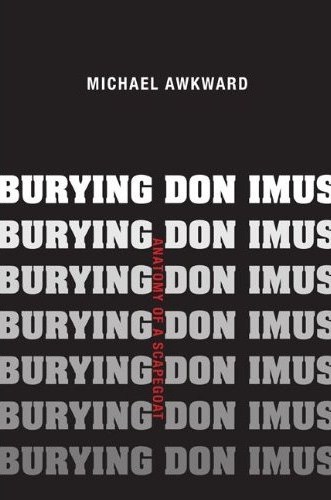
(Un)burying Don Imus: African- American Public Critique and Reaction to Racism
So, who can call who "nappy-headed hoes?" Michael Awkward examines this and the role of African Americans in the public discourse regarding race from a unique perspective in Burying Don Imus: as a member of the "affronted" group and as a fan of Imus's popular radio talk show. His position allows him to view the 2007 incident in an overall objective manner. As an African American scholar, he has a better understanding of the nuances of the landscape, such as the politics of black hair. Awkward begins with Imus's controversial comment, "That's some nappy-headed hoes" made while referring to black females on the Rutgers basketball team during 2007, but really uses this as a jumping off point to focus on African-American reaction and tendency to generally shine a spotlight on racist speech whenever it occurs. He believes that the collective trauma of the group's experience in America has contributed to the need for a subset of blacks to mobilize when there is apparent, if not obvious, racist comment or incident. Their reactions often occur before the actual facts have become public knowledge. Because this group, including individuals respected in the black community, becomes more obsessed with proving that racism still exists (an awareness most thinking individuals already have), Awkward believes that this practice may not be healthy for African-Americans as a whole. He recognizes that there is a show of force when blacks are able to join together against a common enemy, but is not sure that the enemy African-Americans are focusing on is the proper one. Awkward provides a difficult and poignant example of jumping to negative conclusions involving his mentor, Houston Baker. Baker assumed the guilt of the Duke Lacrosse team based solely on his presumptions and real life experience with sexual assault of women close to him. Throughout the book, Awkward outlines his hope that despite grappling with changing racial attitudes, the goal of blacks would become placing value on reviewing the facts to accurately identify the good and bad guys as oppose to labeling individuals as racist before reviewing all available facts.
As a longtime fan of Imus in the Morning, Awkward is able to describe the normal edgy style of humor that Imus and his crew uses as well as understand the intent of the host. His discussion of the show leads into a general critique of race comedy with an emphasis on who is allowed to make jokes about those outside their race. He addresses the notion of the so-called double standard in speech where black comedians may be able to use a term like "nappy headed hoes" but whites are branded as ignorant for making sport of what they perceived as the same societal observations. But, he also acknowledges that there is a line (albeit not clearly established) and questions what the punishment should be when the line is crossed. He recognizes, however, that there is inherent problem when dealing with speech, especially if words or phrases are used in the wrong context or without true understanding of the connotation of the words.
Although Awkward makes interesting points regarding race, the most difficult aspect of the book had more to do with an issue of writing style than content. He writes in a stream of consciousness manner which allows him to include many complex ideas in a single sentence, but does not allow the reader to absorb the thoughts completely before reading a counterpoint. He also has a habit of starting sentences too often with connectors. On one page, he follows an eleven line monstrosity with another lengthy sentence beginning with "and" leading into to a paragraph that begins with "however." Even for a stream of conscious reader and writer, the continued elongated sentences make the book into a continuous single thought, but unfortunately one that becomes too difficult to digest thoroughly without rereading particular sections. Despite this, Burying Don Imus is still an enjoyable, worthwhile read that raises the proper questions regarding the need for African Americans to focus more on the multi-faceted truth as oppose to simple accusations.
Burying Don Imus: Anatomy of a Scapegoat. Michael Awkward: University of Minnesota Press, 2009. 207 pp. Hardcover. 24.95
Copyright © 2010 by Sylvester Frazier.