cricket, literature, and culture
Reviewed by Jeremy Larance, West Liberty University
MARCH 8, 2010 archive
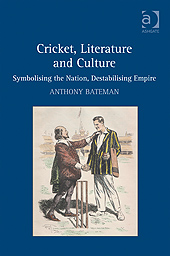
Few sports, if any, can boast of having a literary canon as extensive or as highly regarded within its own culture as cricket, and, with the possible exception of baseball, no other sport has played a larger role in the development of a national identity than England's "noble game." That being said, book-length studies of cricket literature have been few and in between, a surprising void in the study of sport literature given the sheer amount of material available and the comparable work done with the literature of baseball in the United States. Consequently, Anthony Bateman's Cricket, Literature and Culture: Symbolising the Nation, Destabilising Empire is unquestionably a much-needed and welcome addition to the study of sport in literature. Those unfamiliar with cricket-lit (and cricket in general) will find Bateman's study to be a very accessible introduction. Devotees will find Bateman's critical examination of the history and aesthetics of cricket-lit to be one of the more thorough treatments of the genre to date.
Speaking as an American who wrote his dissertation on the literature of cricket before such a book existed, I can personally attest to how useful Bateman's industrious work will be to anyone who desires to know more about a topic which, to be perfectly honest, is a complete mystery to the grand majority of Americans. As the English novelist John Fowles once wrote, "Britain and America were created, as every serious historian knows, just to see how profoundly two cultures sharing a common language can fail to understand each other. Nowhere is this more clearly demonstrated than in the malignant mutual travesty that concerns our respective summer games." Fortunately, one does not need to understand fully the mysteries of cricket in order to appreciate Bateman's exhaustive analysis of the game's literary history, nor does one need to speak the mysterious language of cricket in order to understand what Bateman identifies as the two essential questions driving his study: "First, what role did literature play in the dissemination and acculturisation of cricket within the nation and empire? Second, what role did literature play in the counter-hegemonic re-articulation of cricket within the colonial dispensation?" (2). In other words, Bateman, like so many critics of sport literature, is primarily interested in how sport literature affects perceptions of character and national identity. Consequently, though his focus may be narrowly defined, Bateman's general concerns should be familiar to anyone with a basic understanding of the sport literature genre. Fear not your inability to understand the meaning of googlies and sticky wickets; cricket may not be a game you know, but essential meaning of sport endures.
In his first chapter, Bateman gives a thorough analysis and overview of cricket's literary origins and early growth up through the nineteenth century, during which time cricket literature developed into nothing less than what he refers to as a "textual phenomenon" (16). Although cricket emerged some time during the sixteenth century as a game of ruffians and Sabbath-breakers, by the mid-1800s cricket authors actively sought to raise cricket "above the level of mere sport into the supposedly higher domain of the literary and the aesthetic" (4). It was during this time, Bateman argues, that the cricket field became one of England's most recognizable national milieus, a standard (if not mandatory) setting in literature dealing with the education of the English gentleman and, symbolically, one of the country's most decipherable metonyms of imperial hegemony. The second chapter jumps ahead to the inter-war years when, according to Bateman, a boom in cricket-related publications struggled to heal the nation while deliberately propagating a return to the aristocratic ideals of the nineteenth century. Inter-war cricket-lit, Bateman writes, "produced an image of temporal and spatial conformity in which the various manifestations of the sport were essentially the same, and, as such, enforced an idea of Englishness that was both hegemonic and based on a principle of de-individuation" (77). Chapter Three focuses on the writings of Neville Cardus, who "more than any other cricket writer, . . has become a construct who transcends the fields of 'cricket Literature' and 'literature' to become a component of the national culture" (95). In Chapter Four, Bateman returns to the nineteenth century and examines more closely "cricket's imperial dissemination and acculturisation" (12). Here, Bateman demonstrates how the propagation of cricket literature played a major role in the construction of an "imagined community of empire" which could ostensibly "transform" any colonial male into a proper "English" subject, endowed with "the strength of the empire" and legitimized as a equal (12). Remarkably, this held true for even the most "foreign" of English subjects, including Kumar Shri Ranjitsinhji, an Indian prince, who legitimized his "Englishness" by becoming one of the most admired cricketers of the early twentieth century, a legitimacy all the more solidified by the publication of his highly successful collection of cricket essays, The Jubilee Book of Cricket. Chapter Five, like Chapter Three, focuses on the works of a single author, this time the cricket writings of C.L.R. James, the West Indian author whose Beyond a Boundary is generally hailed as one of the genre's seminal texts. Finally, in what is essentially an epilogue, Chapter Six offers two brief case studies, one that contextualizes the Caribbean cricket verse of Faustin Charles and another that examines the impact of the "Packer Affair" of 1978, and how that Australian scandal jeopardized the "core values" of traditional "English" cricket (201). At barely eight pages, this last chapter is admittedly short, but it does demonstrate the potential usefulness of Bateman's work, and, perhaps more importantly, this chapter demonstrates how the study of cricket-lit can and should progress if given the attention it deserves.
As aforementioned, this is a book that was sorely needed, and Bateman has filled that void well. The twenty-three-page bibliography alone will prove to be an invaluable resource to future students of the genre or for anyone with a general interest in learning more about the history and literature of cricket. Unfortunately, works such as this, those which fill a comprehensive need, often have breadth but lack depth, and that-at times-is unavoidably the case with Bateman's study of cricket culture and the rich history of its literature. Necessarily, only a limited number of texts could be discussed at length, and, as such, some of the genre's most important works are sometimes restricted to just a few pages' worth of discussion, and some major cricket authors, such as John Arlott and Edmund Blunden, are arguably just as worthy of their own "chapters" as Cardus and James, but-again-such exclusions are not so much deficiencies Bateman's work as it is a sign of work left to be done.
Writing in 1970, cricket historian Rowland Bowen speculated that by the end of the century cricket would go the way of the British Empire, greatly minimized and only remotely remembered as relic of a once "Golden Age." Furthermore, cricket's literature, he argued, would one day be "regarded a wondrous thing," through which future scholars of English culture might discover invaluable insights into the minds and traditions of a bygone era (252-53). And while contemporary cricket fans might find fault in Bowen's pessimistic predictions, his general assessment of cricket's literary "future" might finally be coming into fruition. Although Cricket, Literature and Culture: Symbolising the Nation, Destabilising Empire only touches the surface of one of sport literature's richest canons, Bateman has hopefully opened the door for others who can follow his lead and give the genre of cricket literature the attention it so justly deserves.
Bateman, Anthony. Cricket, Literature and Culture: Symbolising the Nation, Destabilising Empire. Burlington, VT: Ashgate, 2009.
Copyright © 2010 by Jeremy Larance.