miracle collapse
Reviewed by Richard Crepeau, University of Central Florida
FEBRUARY 24, 2010 archive
At the beginning of the 2008 season, a large coterie of sportswriters boldly picked the Cubs to finish on top of the National League and go on to send the Cub curses to the dustbin of history with a World Series triumph. Thus, foolishness and folly added another chapter to the historical record of futility that is the Chicago Cubs.
On this recent occasion of failure, there was no Bartman, no Jim Frey, Don Zimmer, committee of managers, or the infamous Black Cat of 1969 to blame. It was just one more year in the 100-year history of futility. In honor of the anniversary, a Cub fan in Rockford, not the same one described by Harry Carey as the man who caught the foul ball down the left field line, created a Cubs T-shirt in Cubs Blue with the Cubs red numerals on the front, a simple "1908." I expect that my descendants and I will be able to wear that shirt through the current millennium.
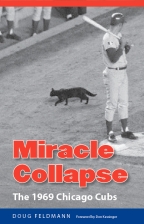
So it was with great anticipation that I began Doug Feldman's tribute to the disaster of 1969, the year of the Curse of the Black Cat. As any Cubitte can tell you, the 1969 pennant was lost that early September night in Shea Stadium when a black cat got onto the field before the second game of the two game set. It came across the field, approached the Cub dugout, and stared into the eyes of Cub manager, Leo Durocher. "It is hard to say who was more spooked; Leo twitched nervously as he got up and moved, and the cat darted across the home plate area toward safety on the Mets side of the field and disappeared through the wall as quickly as it had arrived" (214).
The incident immediately became part of the Cub's lore of curses and failure. Added to the Black Cat were the disturbing numerical omens that this game was Fergie Jenkins 13th loss of the season, and Met homers by Don Clendenon and Art Shamsky were their 13th of the season. The alignment was cosmic.
More to the point, this was the sixth loss in a row for the Cubs and their longest losing streak of the season. At the same time, the Mets were on a roll even winning a game in which they struck out 19 times facing Steve Carlton. From September 3 to September 15, the Cubs went from a five game lead to a four-and-a-half game deficit in the NL East (215-221). Needless to say, more than a black cat was at work in the midst of this free fall. It was quite simply classic Cubs.
Doug Feldman does an excellent job capturing the collapse of September and offering some explanations, not based on cats, for the startling turn of events. In an epilogue, Feldman does a follow-up looking at the principal players in the 1969 drama. The best of these tales from late in the 1971 season is the description of Ron Santo grabbing Leo Durocher by the throat and choking him, following a clubhouse rant by the manager in which he personally insulted the Cub icon and third-baseman.
The problem with this book is that it takes nearly 200 pages to get to this high drama as there is simply too much day-to-day, game-to-game reporting. There is also too much filler that has little to do with the Cubs or with baseball, and these attempts at historical context simply do not work. Do we need to know that as the Cubs had an off day and played an exhibition game in Tacoma that Woodstock was beginning in upstate New York (193). A one-page digression on Ted Kennedy and Mary Jo Kopeckne in the middle of a discussion of the All-Star break hardly seems to offer enlightenment on either of the events (173-174).
There are memorable moments and interesting material on various Cub players and on Leo the Lip. There just isn't enough of this to sustain the narrative. The last forty pages are dynamite, but the first two hundred are a chore. This would have made a very good lengthy magazine piece or a much shorter book. As a Cub fan, I remember too much of this season of high hopes shattered, and Feldman failed to reconnect me with that time and place.
For others, it might be different.
Doug Feldmann, Miracle Collapse: The 1969 Chicago Cubs. Lincoln and London: The University of Nebraska Press, 2009. 304 pp. 10 images. Paper. $17.95.
Copyright © 2010 by Richard Crepeau.