canada's game: hockey and identity
Reviewed by Jason Beck, Curator, British Columbia Sports Hall of Fame and Museum
FEBRUARY 15, 2010 archive
A funny thing happened this past December. The thermometer dipped low enough long enough in our little corner of West Coast paradise for ponds to freeze over solid and ice hockey to be played on the surface.
Pond hockey. Shinny. That most purely Canadian of games.
Maybe not so surprising, considering I am a proud Canadian and love our frozen national sport, but first consider two unusual circumstances: I live in a rare tropical corner of the Great White North where snow – and more importantly ice – is nearly as rare as a Vancouver Canucks trip to the Stanley Cup Finals. And secondly, I am a lifelong soccer player, who never played any form of organized hockey beyond rollerblading on concrete with friends in a dusty machine shop. So why is it that three hours striding and sweating over a frozen sheet chasing a little black piece of rubber by the glare of headlights made me puff out my Canadian chest a little further for a week? Maybe the same reason why the average group of Canadian soccer players gathering for Tuesday night training often find themselves talking not of Manchester United's recent victory, but of the Canucks' shootout win over the hated Flames or why Roberto Luongo's selection to Canada's 2010 Olympic ice hockey team will undoubtedly help Team Canada – there is only one up here – bring back gold after our collective national embarrassment in Torino four years ago.
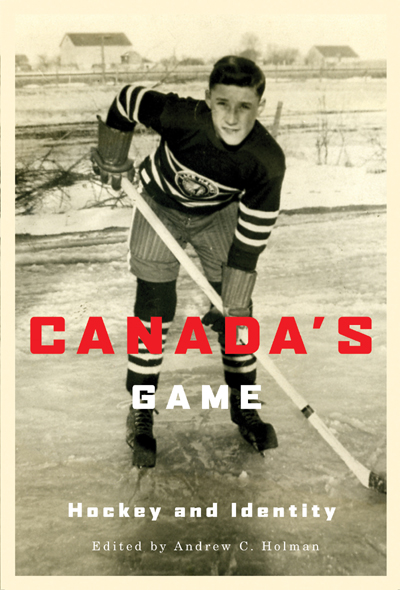
Around the same time as my brief brush with Rockwellian Canadiana occurred – before the temperature inevitably rose and Vancouver's annual drippy monsoon returned – a new book that attempts to get closer to answers to such questions, fittingly titled Canada's Game, fell into my lap. Through a series of ten scholarly articles compiled by editor Andrew Holman, Canada's Game probes those two 'odd couple' Canadian subjects that sofa and serious scholars alike tend to pair up and square off in discussion, one Canadians are sure of (we think), one less so: hockey and identity.
The result is an eclectic mix of articles that uses hockey to dance with and around the elusive issue of Canadian identity, some getting closer to the heart than others. Canada's Game will not bring academic discourse on Canadian identity to an end, nor will it provide the reader with all the answers sought. Yet on both counts it does bring us a step closer and is therefore a welcome addition to the growing body of literature on the subject Holman cautiously terms "hockey studies" (7).
Depending on your specific area of interest, there is something here for most hockey enthusiasts of the scholarly slant including a few faithful standbys of any good ol' Canadian hockey discussion: the '72 Summit Series, hockey in fiction, violence and fighting in the game, legendary arena shrines like the Forum or the Gardens, the 2004-05 NHL lockout and the commodification and commercialization of the game. Particularly rewarding is well-known puck poet Richard Harrison's thought-provoking article "Between a Puck and a Showpiece" that eloquently discusses why the poetry of the average NHL game fails to translate itself into the American consciousness like that of baseball, football or basketball:
there are elements in hockey that cannot be translated into another language (even when the other language is called by the same name) without considerable cultural adjustment on a wider level than simply being able to follow what's going on or to understand the words. (157)
Holman successfully incorporates a few surprises as well, even for those well-read puck fanatics. A historical piece by Greg Gillespie, "Big Liners and Beer Gardens," on the 1936 Port Arthur Bearcats, who represented Canada at the 1936 Winter Olympics and lost the gold to the British (gasp!) of all nations, for instance. An article by Karen Skinazi, "The Mystery of a Canadian Father of Hockey Stories," delves into the influence of Leslie McFarlane – long-time ghostwriter of the Hardy Boys series under the famous pen name Franklin W. Dixon and also father of well-known hockey broadcaster and historian Brian McFarlane – on shaping the future narration of Canada and of hockey. Her two-page chronological list (121-122) of selected works of hockey fiction in Canada from 1950-2007 on its own is worth the book's list price, particularly for those inspired to delve further into other pieces of "pucklit."
There's even an article that attempts to turn on its head the standard Canadian fallback position of the villainous "American corporatist" as solely responsible for the destruction of our game. As Craig Hyatt and Julie Stevens illustrate in their piece "Are Americans Really Hockey's Villains?" some Canadians may think hockey – namely the NHL form – is no longer ours, but for some Americans, it is no longer theirs either. At certain key points in the NHL's development, Canadian businessmen have tainted the so-called purity of Canadian hockey – "the Americanization of professional hockey" (pg 28) – as much or more than their American counterparts. Interviews with displaced Hartford Whalers fans (whose voices could easily be swapped with those of the Winnipeg Jets or Quebec Nordiques) hammers this point home.
In his introduction, Holman makes clear the high esteem he holds Gruneau and Whitson's groundbreaking 1993 book Hockey Night in Canada and how much of the hockey scholarship since has built upon the foundation that seminal book laid. While newcomers to hockey's expanding library would be better off starting with Gruneau and Whitson before tackling Canada's Game, I can give no better compliment to Holman's collection of articles than to describe it as a worthy companion to Gruneau and Whitson's earlier work.
Canada's Game: Hockey and Identity. Edited by Andrew C. Holman. Montreal, QC: McGill-Queen's University Press, 2009. viii, 240 pages. $24.95 (paper).
Copyright © 2010 by Jason Beck.